
When the mercury plummets below zero, choosing the right outerwear isn't just about style—it's a matter of safety, comfort, and endurance. Two of the most common contenders in cold-weather wardrobes are puffer jackets and wool coats. Both have loyal followings, but when faced with truly frigid conditions—think -20°F (-29°C) or colder—which one actually keeps you warmer?
The answer isn’t as straightforward as it seems. While puffer jackets are often marketed as ultra-warm due to their lofty insulation, wool coats carry a legacy of natural warmth and durability. To make an informed decision, you need to understand how each fabric works, how they perform under extreme conditions, and what factors beyond material affect heat retention.
Understanding Insulation: How Warmth Works
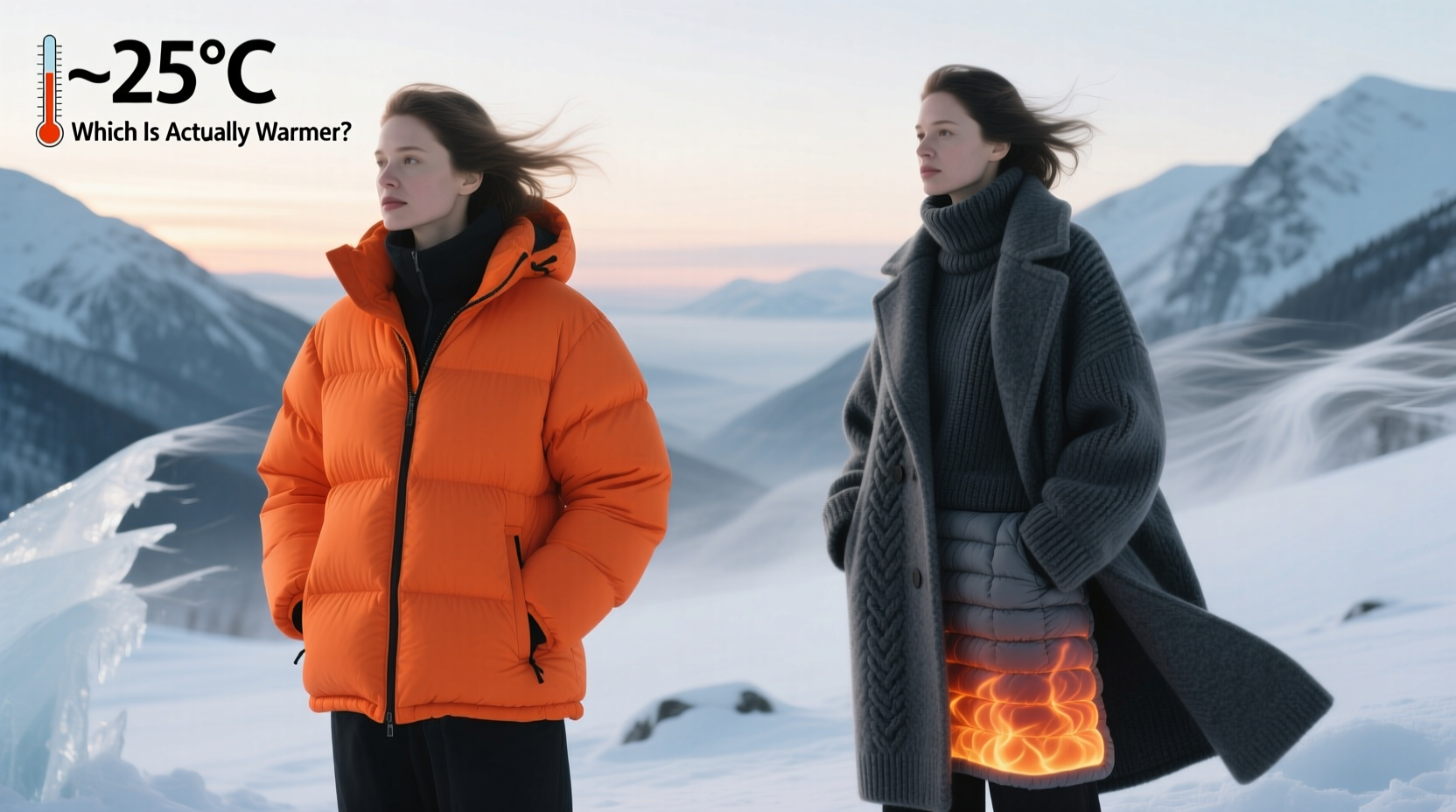
Warmth in clothing comes from trapped air. The human body generates heat, and effective insulation prevents that heat from escaping into the environment. Materials create tiny pockets of air that act as barriers to thermal transfer. The more efficiently a garment traps and retains this warm air, the better it insulates.
Puffer jackets rely on synthetic or down fill (usually goose or duck down) to create these air pockets. Their quilted design segments the insulation, minimizing convective heat loss within the garment. Wool, on the other hand, is a natural fiber with crimped strands that naturally trap air between fibers. Even when compressed, wool maintains some loft, allowing it to retain warmth under pressure.
However, structure matters. A puffer jacket’s high-loft construction gives it superior passive insulation in dry, static conditions. Wool coats, typically denser and less voluminous, may feel less “puffy” but offer consistent warmth across varying activity levels and moisture exposure.
“Down excels in dry cold, but once wet, its insulating power collapses. Wool sacrifices some peak warmth for resilience.” — Dr. Lena Torres, Textile Scientist at Arctic Gear Labs
Performance in Sub-Zero Conditions: A Direct Comparison
To compare puffer jackets and wool coats effectively, consider four key variables: insulation type, breathability, moisture resistance, and wind protection.
| Feature | Puffer Jacket (Down-filled) | Wool Coat (Heavyweight) |
|---|---|---|
| Insulation Efficiency (Dry Conditions) | ★★★★★ | ★★★★☆ |
| Maintains Warmth When Wet | ★☆☆☆☆ (unless treated) | ★★★★☆ (wool absorbs moisture without losing all insulation) |
| Breathability | ★★★☆☆ | ★★★★★ |
| Wind Resistance | ★★★★☆ (with shell fabric) | ★★★☆☆ (depends on weave density) |
| Durability Over Time | ★★★☆☆ (down can clump; shells abrade) | ★★★★★ (wool resists compression and wear) |
| Weight per Unit Warmth | ★★★★★ (very lightweight for warmth) | ★★★☆☆ (heavier for equivalent warmth) |
In ideal, dry, wind-free environments, a high-fill-power down puffer jacket (e.g., 800+ fill) will outperform even the heaviest wool overcoat. Its ability to trap large volumes of air with minimal weight makes it exceptionally efficient. However, real-world winter conditions are rarely ideal. Snowfall, sleet, wind, and physical activity introduce variables that shift the advantage.
Tip: In humid or snowy climates, consider a water-resistant shell over your wool coat or opt for hydrophobic down in puffers to maintain thermal efficiency.Real-World Scenario: A Winter Hike in Northern Minnesota
Jamie, an experienced outdoors enthusiast, planned a two-day snowshoe trek in northern Minnesota where temperatures regularly dropped to -15°F (-26°C). She packed both a premium 850-fill down puffer and a vintage camel-hair wool topcoat inherited from her grandfather.
On the first day—dry, calm, and sunny—the down jacket kept her comfortably warm even during low-activity periods. She wore it over a merino base layer and fleece mid-layer. The lightweight warmth was unmatched.
But by day two, a light snow began falling, followed by freezing fog. Her down jacket started absorbing ambient moisture, especially around the shoulders where sweat accumulated. Despite being labeled \"water-resistant,\" the down began to clump slightly, reducing loft and warmth. She switched to the wool coat, which had been stored in a dry sack. Though heavier, it felt consistently warm, didn’t dampen easily, and dried faster when dampened by snowflakes.
Her takeaway? “The puffer won on comfort and weight, but the wool coat saved me when conditions turned. It didn’t feel ‘wetter’ after hours outside, and I never worried about compressing it in my pack.”
This scenario illustrates a critical point: performance depends not only on temperature but also on environmental dynamics and personal exertion.
Key Factors That Influence Warmth Beyond Material
Choosing between a puffer jacket and a wool coat shouldn’t be based solely on insulation type. Several interrelated factors determine actual warmth:
- Fit and Layering Compatibility: Puffer jackets often fit bulkier, making it harder to wear multiple layers underneath. Wool coats, especially tailored ones, allow for better layering due to structured cuts.
- Activity Level: High-output activities generate sweat. Down loses effectiveness when damp from perspiration. Wool wicks moisture and continues insulating, making it better for active use in extreme cold.
- Wind Exposure: Most puffers come with tightly woven outer shells that block wind effectively. Traditional wool coats may require a storm-facing liner or separate windbreaker for maximum protection.
- Compression: If you're packing gear, down loses loft when compressed. Wool recovers better after being folded or sat on.
- Care and Longevity: Down requires careful washing and drying to maintain loft. Wool repels odors, resists stains, and can go longer between cleanings—ideal for extended trips.
“In polar expeditions, we see teams using hybrid systems: down for camp warmth, wool or synthetic mid-layers for movement. No single garment does it all.” — Captain Elias Reed, Antarctic Logistics Specialist
Step-by-Step Guide: Choosing the Right Outerwear for Sub-Zero Use
Follow this practical sequence to select the best option for your needs:
- Assess Your Environment: Is it dry and still (favoring down), or wet, windy, and variable (favoring wool)?
- Determine Activity Type: Are you commuting, hiking, standing still, or working outdoors? Active use favors breathable materials like wool.
- Evaluate Layering Needs: Can the coat accommodate thermal base layers and a mid-layer fleece or sweater?
- Check Moisture Management: Does the puffer have hydrophobic treatment? Is the wool coat lined or blended with weather-resistant fibers?
- Test Real-World Fit: Try on both garments with your typical winter layers. Ensure sleeves are long enough, hoods (if needed) fit over hats, and there’s no gaping at the waist.
- Consider Backup Options: Carry a packable puffer as an emergency layer if relying primarily on wool, or bring a wool mid-layer if depending on down.
Hybrid Solutions and Modern Innovations
The debate doesn’t have to end at “puffer vs wool.” Many modern brands blend the strengths of both. Examples include:
- Wool-blend puffers: Outer shells made from boiled wool for wind resistance, filled with recycled down.
- 3-in-1 systems: A removable wool liner inside a waterproof puffer shell.
- Tech-treated wool: Fabrics like Stormsystem®-treated wool offer water repellency without sacrificing breathability.
- Synthetic alternatives: PrimaLoft® and Coreloft™ mimic down’s loft while performing in wet conditions, offering a middle ground.
For urban dwellers who face fluctuating indoor-outdoor temps, a wool coat provides elegant versatility. For backcountry travelers prioritizing weight and warmth-to-bulk ratio, a high-quality puffer remains unbeatable—provided conditions stay dry.
Frequently Asked Questions
Can a wool coat be as warm as a down jacket?
In raw insulation terms, a standard wool coat typically cannot match the warmth of a high-fill-power down puffer in dry conditions. However, when moisture, wind, or activity levels are factored in, the difference narrows significantly. With proper layering, a heavy wool coat can provide comparable comfort in everyday sub-zero scenarios.
What happens to down when it gets wet in freezing temperatures?
Wet down loses its loft and clumps together, drastically reducing its ability to trap air. In freezing conditions, moisture can ice up inside the jacket, creating cold spots and increasing heat loss. Some modern down is treated with DWR (durable water repellent) coatings to resist moisture absorption, but it’s not foolproof.
Are there warm wool coats designed for extreme cold?
Yes. Military-grade greatcoats, Icelandic lopapeysa-style woolens, and Canadian heritage Mackinaw wool coats are engineered for severe winters. These use dense, fulled wool (up to 30 oz/yd²) and often include storm flaps, deep collars, and double-breasted closures to enhance thermal performance.
Final Recommendation: Match the Garment to the Mission
If your priority is maximum warmth in dry, static conditions—such as waiting at a ski lift, attending an outdoor event, or walking short distances in controlled environments—a high-quality puffer jacket is likely the warmer choice. Its superior warmth-to-weight ratio and excellent passive insulation give it the edge.
However, if you’re facing prolonged exposure, variable weather, physical activity, or high humidity, a well-constructed wool coat offers more reliable, consistent warmth. Wool’s ability to manage moisture, resist compression, and maintain insulation under stress makes it a resilient performer in unpredictable sub-zero settings.
Ultimately, the smartest approach isn’t choosing one over the other, but understanding their roles. Think of a puffer jacket as your high-efficiency heater for optimal conditions, and a wool coat as your dependable all-weather shield. Together, they form a robust defense against extreme cold.
💬 Have experience with puffers or wool coats in extreme cold? Share your story or tips in the comments—your insights could help others stay warm and safe this winter.








