Choosing the right sunglasses isn’t just about style or brand prestige—it’s about harmony. The shape of your frames should complement your facial structure, balance proportions, and highlight your best features. Among the most debated styles are oval and round sunglasses, each offering a distinct aesthetic and functional profile. While both have gained popularity through fashion icons and modern reinterpretations, one may suit your face far better than the other. Understanding the subtle differences between these shapes—and how they interact with various face types—can transform your look from trendy to timeless.
The Anatomy of Face Shapes and Frame Harmony
Your face shape is the foundation for selecting flattering eyewear. Sunglasses act as a frame within a frame, drawing attention and altering visual perception. The goal is not to mask your face but to enhance its natural symmetry. There are six primary face shapes: oval, round, square, heart, diamond, and oblong. Each has unique proportions that respond differently to frame geometry.
Oval faces are often considered the most versatile, with balanced cheekbones, a gently tapered jaw, and a forehead slightly wider than the chin. This shape typically suits most sunglass styles, including both oval and round. Round faces, characterized by soft angles and nearly equal width and length, benefit from angular or elongating frames to add definition. Square faces feature strong jawlines and broad foreheads, so softer, curved frames can offset sharpness. Heart-shaped faces are wider at the forehead and narrow at the chin—ideal for bottom-heavy or rounded frames that balance the upper face. Diamond faces have prominent cheekbones and narrower foreheads and jaws, calling for frames that widen the appearance of the forehead and chin.
Tip: Hold a mirror up and trace the outline of your face with a washable marker. Compare the silhouette to standard face shape charts for accurate identification.Oval Sunglasses: Subtle Elegance with Functional Flair
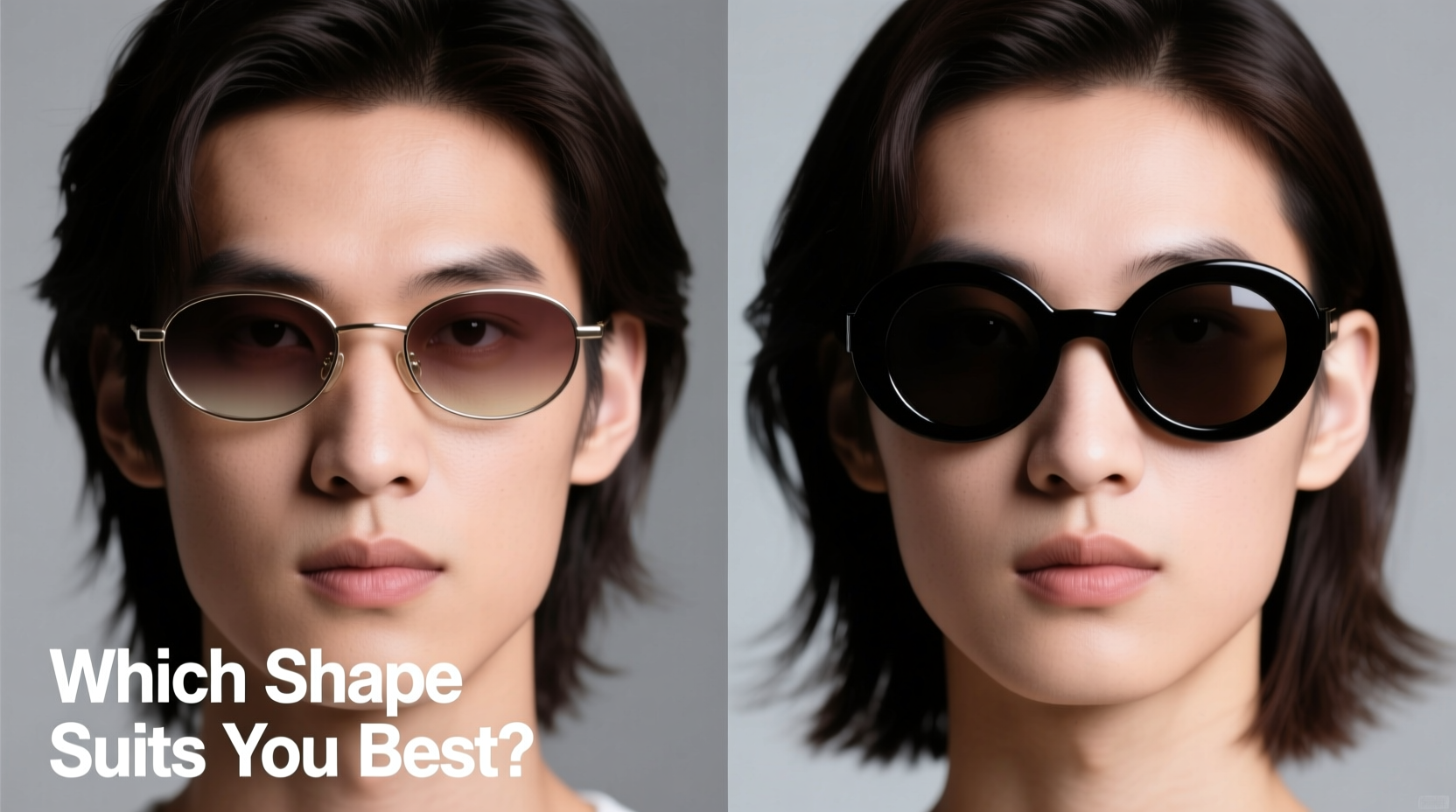
Oval sunglasses follow an elongated circular shape with gently curved edges. They’re narrower vertically than horizontally, creating a slimming effect on the face. Historically linked to classic aviators and 1950s elegance, modern oval frames blend retro charm with minimalist sophistication.
These frames work exceptionally well for round and square face shapes. On a round face, the vertical extension of oval sunglasses adds length, reducing the appearance of fullness. For square faces, the smooth curves soften strong jawlines and temples without overwhelming the features. Oval frames also sit naturally on high cheekbones, making them ideal for heart and diamond shapes when proportionally balanced.
Functionally, oval lenses offer wide peripheral vision and even light distribution, making them practical for driving and daytime wear. Their moderate size ensures coverage without dominating the face—a key advantage for those with smaller or medium-sized features.
“Oval frames are the quiet achievers of eyewear—they don’t shout, but they elevate. They add refinement while maintaining balance.” — Lena Torres, Eyewear Stylist & Fashion Consultant
Round Sunglasses: Bold Personality with Vintage Edge
Round sunglasses are defined by their near-perfect circular lenses and minimal straight lines. Popularized by icons like John Lennon and more recently embraced by fashion-forward influencers, this style exudes individuality and artistic flair.
They shine brightest on individuals with oval or rectangular (oblong) face shapes. On an oval face, round frames create contrast through geometric opposition, enhancing facial symmetry. For oblong faces—characterized by greater length than width—round sunglasses shorten the visual impression of the face, bringing it into better proportion.
However, caution is needed for those with round or square faces. Round frames on a round face can emphasize fullness, creating a visually compressed look. Similarly, pairing round sunglasses with a strong jawline may amplify angularity in an unflattering way unless offset by thin metal frames or cutaway brow lines.
Modern variations include keyhole bridges, double bridges, and mixed materials like acetate and titanium, allowing for customization based on nose fit and personal style. Despite their bold appearance, well-chosen round sunglasses can be surprisingly wearable when matched correctly.
Comparing Oval vs Round: A Practical Guide
To make an informed decision, consider not only face shape but also lifestyle, outfit compatibility, and personal expression. The following table summarizes key differences:
| Feature | Oval Sunglasses | Round Sunglasses |
|---|---|---|
| Best For Face Shapes | Round, square, heart, diamond | Oval, oblong |
| Visual Effect | Elongates, slims, balances | Shortens, softens, adds character |
| Fashion Vibe | Classic, understated, professional | Vintage, artistic, edgy |
| Lens Coverage | Moderate to high | Varies; often lower on sides |
| Wardrobe Compatibility | Office wear, casual, formal | Casual, creative, festival styles |
| Daily Wear Suitability | High—subtle and adaptable | Moderate—statement-making |
Real-Life Example: Choosing Between Styles
Sophie, a 32-year-old graphic designer with a square face and strong brows, wanted sunglasses that reflected her creativity but remained office-appropriate. She initially leaned toward bold round frames in tortoiseshell acetate. When she tried them on, however, the combination of circular lenses and her angular jaw created a top-heavy look. Her stylist suggested switching to softly oval frames with a matte black finish. The new pair softened her jawline, aligned with her cheekbones, and transitioned seamlessly from studio meetings to weekend outings. “I didn’t realize how much shape affects presence,” she said. “The oval ones just… fit me.”
Step-by-Step: How to Choose Your Ideal Shape
- Determine your face shape: Use a mirror and measuring tape to compare forehead, cheekbone, and jawline widths, along with face length.
- Analyze your dominant features: Note whether you have high cheekbones, a strong chin, or a long nose—these influence frame placement.
- Try both shapes in person: Visit an optical store or use virtual try-on tools to see how oval and round frames interact with your face.
- Assess proportion: Ensure the frame width matches or slightly exceeds your face width. Lenses should not extend beyond the outer edges of your face.
- Consider your lifestyle: If you spend time in professional settings, lean toward oval. For creative or leisure-focused routines, round may express personality more freely.
- Test for balance: Smile in the mirror. Do the frames stay centered? Do they draw attention to your eyes or overwhelm them?
Common Mistakes to Avoid
- Choosing trend over fit: Just because round sunglasses are popular doesn’t mean they suit everyone.
- Ignoring bridge fit: A poorly fitting nose bridge can tilt frames upward, distorting the intended shape effect.
- Overlooking lens color: Gray reduces glare without distorting color; brown enhances contrast. Match to your environment.
- Selecting oversized frames: Larger isn’t always better. Oversized round frames can dominate small faces.
FAQ
Can I wear round sunglasses if I have a round face?
It’s challenging but not impossible. Opt for thin wire frames, angular accents, or slightly squared-off lenses to introduce contrast. Avoid thick, fully circular designs that echo your face shape.
Are oval sunglasses outdated?
No. Oval sunglasses remain a staple in luxury and functional eyewear. Modern versions feature updated materials, tint gradients, and lightweight builds, keeping them relevant across seasons.
Do face shape rules apply to all genders?
Yes. Facial structure principles are anatomical, not gendered. Whether male, female, or non-binary, the relationship between frame shape and facial proportions remains consistent.
Final Thoughts: Confidence Begins with Fit
The choice between oval and round sunglasses ultimately comes down to alignment—between your face, your lifestyle, and your self-expression. Oval frames offer versatility and quiet sophistication, ideal for those who value subtlety and daily wearability. Round frames command attention, celebrate individuality, and thrive in expressive contexts. Neither is universally superior; the \"better\" shape is the one that makes you feel seen, balanced, and confident.
Don’t let marketing trends dictate your decision. Take the time to understand your face shape, experiment thoughtfully, and prioritize comfort alongside aesthetics. The right pair of sunglasses doesn’t just protect your eyes—it completes your presence.
💬 Found your perfect fit? Share your experience or tag a friend who’s been debating oval vs round—we could all use a little style wisdom.