
Winter transforms outdoor spaces—frost-laced branches, snow-dusted eaves, quiet neighborhoods glowing under soft light—but it also tests lighting equipment like few other seasons do. Many homeowners assume “outdoor-rated” means “winter-proof,” while others mistakenly hang indoor string lights on covered porches or enclosed patios, only to find them failing by December’s first deep freeze. The truth is more nuanced: weather resistance isn’t binary—it’s a function of engineering, certification, material science, and installation context. This article cuts through marketing ambiguity to answer one practical question: when temperatures drop below freezing, snow accumulates, and humidity soars, which string lights actually survive—and why?
Why Indoor String Lights Fail in Winter (Even Under Cover)
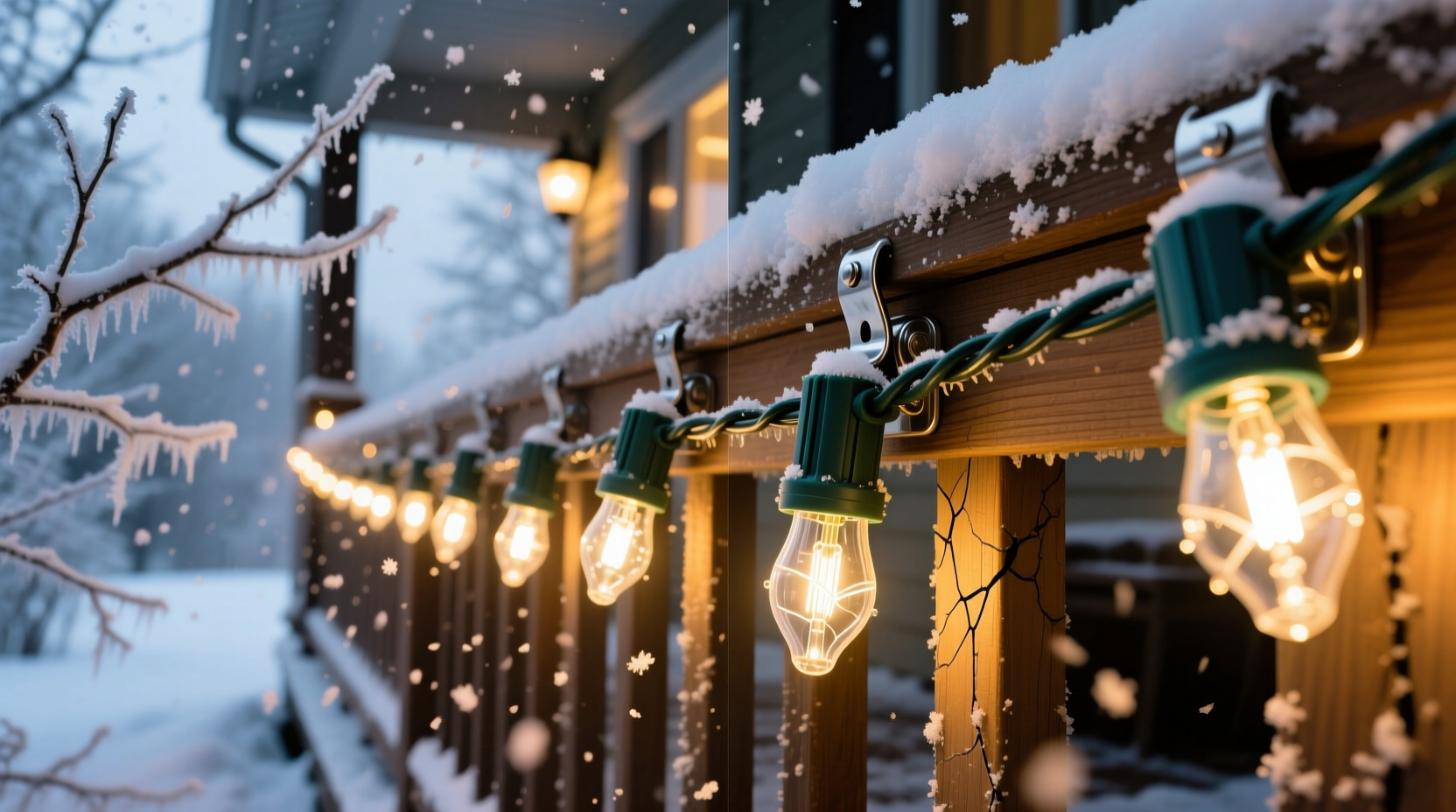
Indoor string lights are designed for controlled environments: stable temperatures (typically 64–77°F), low humidity (<60% RH), and zero exposure to condensation, UV radiation, or physical abrasion. Their construction reflects those constraints. Most use thin-gauge copper wire (often 22–24 AWG) with PVC insulation rated only for dry, indoor use. That PVC becomes brittle below 32°F—micro-fractures develop with thermal cycling, exposing conductors to moisture. Even under a covered porch, nighttime temperature swings cause dew formation. Condensation pools inside sockets, especially at connection points and end plugs, where indoor-rated seals offer no protection.
LED drivers in indoor sets are typically unencapsulated or lightly potted, making them vulnerable to thermal shock. When ambient air drops from 45°F to 18°F overnight, the rapid contraction stresses solder joints and capacitor leads. One study by the Lighting Research Center found that indoor LED strings operated outdoors during November–January showed a 63% higher failure rate in the first 90 days compared to identical units used indoors—primarily due to cold-induced solder fatigue and moisture ingress at plug interfaces.
Tip: Never assume “covered” equals “protected.” A roof overhang blocks rain but not humidity, temperature swing, or wind-driven snow dusting—conditions that still exceed indoor rating limits.The Real Meaning of “Outdoor-Rated”: IP Ratings, Not Marketing Buzzwords
True winter resilience hinges on two certified metrics: Ingress Protection (IP) rating and operating temperature range. An “outdoor” label alone is meaningless without verification. The IP code consists of two digits: the first indicates solid particle protection (e.g., dust), the second liquid protection. For winter durability, focus on the second digit—especially IP65, IP67, or IP68.
- IP65: Protected against low-pressure water jets from any direction. Suitable for most covered and semi-exposed areas (e.g., pergolas, open garages).
- IP67: Immersion-resistant up to 1 meter for 30 minutes. Handles snow accumulation, ice melt runoff, and freeze-thaw cycles reliably.
- IP68: Continuous immersion under manufacturer-specified conditions (often 3+ meters). Overkill for most residential uses—but ideal for ground-level installations near driveways or garden beds prone to slush pooling.
Critical nuance: IP rating applies only to the *entire assembled system*—lights, connectors, plugs, and controllers. A string rated IP67 loses that protection if spliced with indoor-rated extension cords or plugged into an unsealed outlet box. Also, verify the *operating temperature range*. Many “outdoor” lights list -4°F to 104°F—but that’s often the storage range, not continuous operation. Look for “Operating Temp: -22°F to 122°F” explicitly stated in technical specs.
Material Science Matters: What Makes a Light Survive Sub-Zero Conditions?
Winter survival isn’t just about sealing—it’s about how materials behave across extreme thermal gradients. Here’s what separates resilient outdoor lights from fragile imitations:
- Insulation Chemistry: Premium outdoor sets use thermoplastic elastomer (TPE) or cross-linked polyethylene (XLPE), not standard PVC. TPE remains flexible down to -40°F; XLPE resists cracking and UV degradation for 5+ years outdoors.
- Connector Design: Screw-lock or silicone-sealed connectors outperform push-in types. Look for integrated gaskets and brass contacts (not zinc-plated steel), which resist galvanic corrosion when exposed to road salt spray.
- LED Encapsulation: Outdoor LEDs embed chips in silicone gel—not epoxy—which accommodates expansion/contraction without delaminating. Epoxy yellows and cracks in UV-cold cycles.
- Wire Gauge & Stranding: 18 AWG stranded copper handles repeated bending (e.g., wrapping around railings) better than solid-core wire. Stranding also reduces cold-induced conductor fracture risk.
“Most winter failures trace back to connector integrity—not the bulbs themselves. If water enters a socket, even an IP65-rated bulb will short within days. Always inspect gaskets before installation, and re-torque screw connectors after the first freeze-thaw cycle.” — Lena Torres, Senior Electrical Engineer, UL Solutions
Side-by-Side Comparison: Key Differences That Impact Winter Performance
| Feature | Indoor String Lights | Outdoor String Lights (Winter-Grade) |
|---|---|---|
| IP Rating | No formal rating; typically IP20 (dust-protected only) | IP65 minimum; IP67 recommended for sustained sub-freezing use |
| Operating Temp Range | 32°F to 104°F (limited to stable indoor climates) | -22°F to 122°F (verified continuous operation) |
| Insulation Material | PVC (brittles below 32°F) | TPE or XLPE (flexible to -40°F) |
| Connector Type | Push-in or basic snap-fit; no gasketing | Screw-lock with silicone O-rings; brass contacts |
| Warranty Coverage | 90 days; excludes “environmental damage” | 2–3 years; explicitly covers freeze-thaw and moisture-related failure |
Real-World Case Study: A Vermont Porch Test (November–March)
In Burlington, VT, homeowner Mark R. installed two identical-looking 100-light warm white LED strings on his covered front porch in early November. One was labeled “indoor/outdoor” (but carried only an IP44 rating); the other was a commercial-grade IP67 set with TPE insulation and screw-lock connectors. Both were mounted under a 3-foot-deep overhang, shielded from direct rain but fully exposed to wind, frost, and diurnal temperature swings averaging 28°F high / 12°F low.
By mid-December, the IP44 set began flickering at the third socket from the plug—a known weak point where the cord entered the housing. By January 10, 37 bulbs were dead, and the controller emitted a faint burning odor. Upon inspection, condensation had pooled inside the plug housing, corroding contacts. The IP67 set remained fully operational. Its only maintenance was tightening the two main connector screws after the first hard freeze (per manufacturer instructions)—a 45-second task.
Mark replaced the failed set with the same IP67 model. It operated continuously through March, surviving three ice storms and one 48-hour stretch at -18°F. His takeaway: “The ‘indoor/outdoor’ label was a trap. True outdoor means engineered for physics—not just marketing.”
Step-by-Step: Installing Winter-Resistant String Lights Safely
- Verify Certification: Check packaging or spec sheet for IP65+ and explicit operating temp range (e.g., “-22°F to 122°F”). Do not rely on retailer descriptions.
- Inspect Every Connector: Ensure silicone gaskets are intact, undamaged, and seated fully. Replace any with visible cracks or compression loss.
- Use Outdoor-Rated Extensions Only: Match IP rating and temp range. Avoid daisy-chaining more than three sets unless using a heavy-duty 12 AWG outdoor-rated extension.
- Elevate Plugs and Controllers: Mount outlets and timers at least 12 inches above ground level—even under cover—to prevent slush pooling. Use weatherproof outlet boxes with gasketed covers.
- Perform a Post-First-Freeze Check: Within 48 hours of the first sub-32°F night, re-torque all screw-lock connectors and wipe away surface condensation with a dry microfiber cloth.
FAQ: Your Winter Lighting Questions, Answered
Can I use indoor string lights indoors during winter and then move them outside in spring?
No. Thermal stress from repeated indoor-to-outdoor transitions accelerates material fatigue. PVC insulation degrades faster with each cycle, and internal condensation forms even during brief outdoor exposure. Reserve indoor lights strictly for interior use year-round.
Do solar-powered string lights work reliably in winter?
Only if specifically rated for sub-zero operation and equipped with lithium iron phosphate (LiFePO4) batteries, which retain 80% capacity at 14°F. Standard lithium-ion batteries fail below 32°F. Also, snow cover on panels reduces output by up to 95%—so supplemental charging or grid-tied backup is essential for consistent winter performance.
How often should I replace outdoor string lights in snowy climates?
High-quality IP67+ lights last 3–5 winters with proper installation and seasonal inspection. Replace immediately if you notice discoloration in insulation (whitening or chalkiness), stiffness in cord flex, or intermittent operation—these signal material breakdown that precedes catastrophic failure.
Conclusion: Choose Engineering Over Aesthetics—Your Lights Will Thank You
Winter doesn’t ask for permission. It doesn’t care about your holiday timeline or aesthetic vision. It tests every assumption built into your lighting choices—down to the molecular structure of insulation and the precision of a silicone gasket. Choosing lights based solely on color temperature, bulb count, or price ignores the physics of cold, moisture, and thermal expansion. Outdoor-rated lights aren’t “more expensive”—they’re correctly engineered for the environment they’ll inhabit. Indoor lights have their place: cozy living rooms, bedrooms, and craft spaces where humidity stays low and temperatures stay steady. But when frost feathers your windowpanes and the wind carries the scent of snow, only purpose-built outdoor string lights deliver reliable, safe, and beautiful illumination—night after night, season after season.
💬 Have you weathered a harsh winter with string lights? Share your experience—what worked, what failed, and what you’d do differently next time. Your real-world insight helps others make smarter, safer choices.








