In tropical climates, summer festivals, or just on a sweltering city commute, humidity can turn even the most carefully applied makeup into a smudged, streaked mess by midday. As temperatures rise and the air thickens with moisture, many beauty enthusiasts face a critical choice: go minimalist for longevity or embrace full glam with the risk of meltdown. While aesthetics often drive this decision, durability under humid conditions is equally important—especially when you need your look to hold strong from morning meetings to evening events.
The truth is, not all makeup styles respond the same way to high humidity. Moisture in the air disrupts makeup formulation stability, triggers sebum production, and accelerates product breakdown. But beyond surface-level assumptions, what actually determines staying power? Is a sheer tint really more resilient than a full-coverage base? Does skipping eyeliner really make a difference when sweat starts forming along your hairline?
This article breaks down the science, practicality, and real-life performance of minimalist versus full glam makeup in humid environments. From ingredient behavior to skin interaction and application technique, we’ll explore what truly lasts—and how to maximize longevity regardless of your preferred style.
The Science of Humidity and Makeup Breakdown
Humidity doesn’t just make you feel sticky—it actively interferes with how makeup adheres to the skin. When relative humidity exceeds 60%, several chemical and physiological reactions begin to compromise makeup integrity:
- Emulsion destabilization: Most liquid and cream products are emulsions (oil + water). High humidity introduces external moisture that can break these bonds, causing separation and patchiness.
- Increased transepidermal water loss (TEWL): Ironically, humid air can dehydrate the skin’s outer layer, prompting it to produce more oil as a protective response—leading to shine and slippage.
- Oxidation acceleration: Warm, moist environments speed up oxidation in foundation and concealer, resulting in darkening and caking.
- Sweat-induced migration: Perspiration creates micro-channels on the skin, allowing pigments to shift, especially around eyes and mouth.
These factors affect all makeup—but their impact intensifies with product load. The more layers applied, the greater the surface area vulnerable to environmental disruption.
“In high humidity, every additional product increases the risk of interaction failure. Simpler routines inherently have fewer points of breakdown.” — Dr. Lena Torres, Cosmetic Chemist & Formulation Specialist
Minimalist Makeup: Lightweight by Design, Long-Lasting by Nature
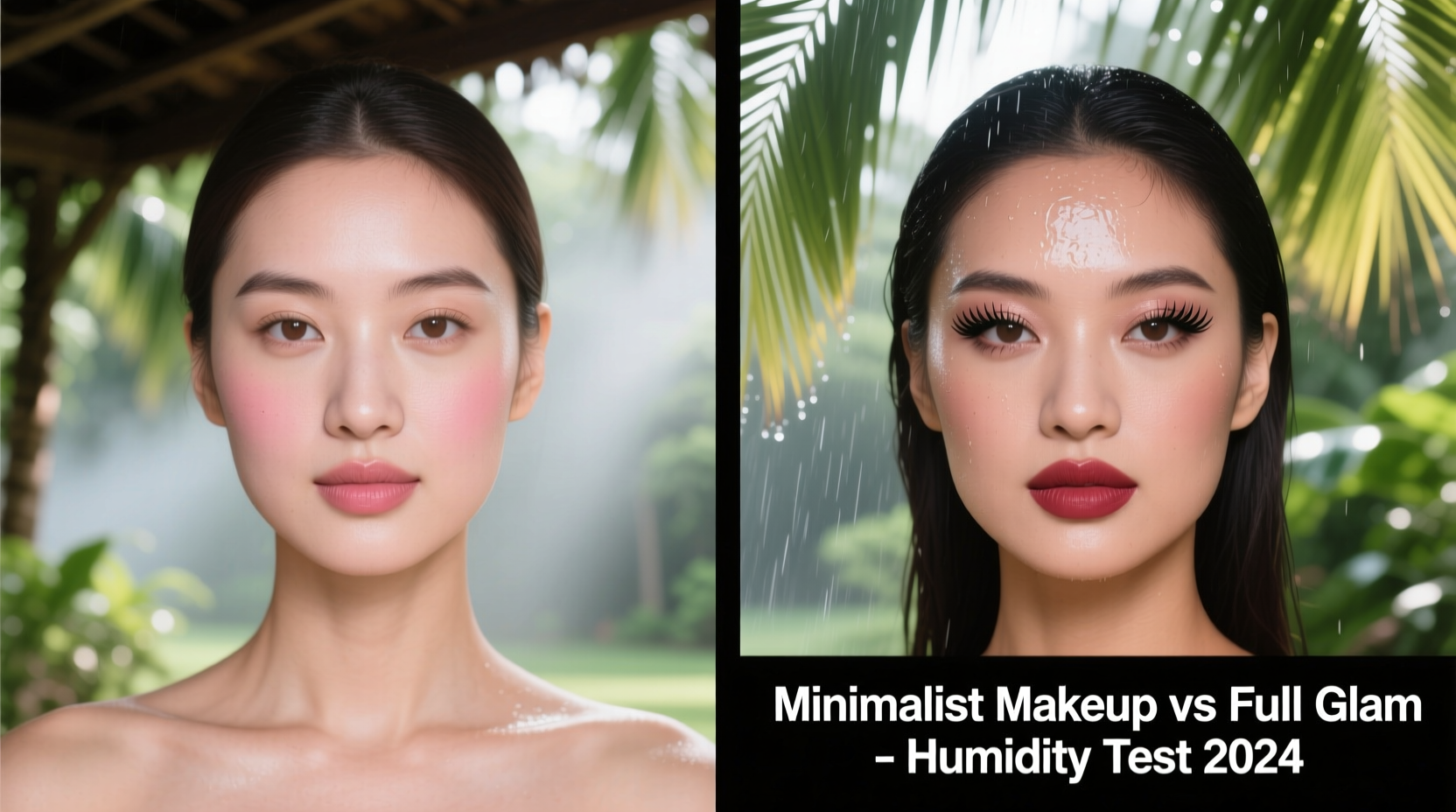
Minimalist makeup—defined as a streamlined routine using few products (e.g., tinted moisturizer, cream blush, brow gel, lip balm)—excels in humid conditions not because it’s trendy, but because it aligns with dermatological efficiency.
With fewer ingredients layered on the skin, there's less competition for adhesion and reduced chance of pilling or sliding. Products like hydrating tints and serum-based foundations absorb quickly and bond with the skin rather than sitting atop it, making them less prone to displacement by sweat.
Moreover, minimalist routines often emphasize skin prep over coverage. A well-moisturized, balanced complexion produces less excess oil, reducing one of the main catalysts for makeup failure. Ingredients like hyaluronic acid and glycerin attract water without greasiness, helping maintain a fresh appearance even in muggy conditions.
Tip: Use a lightweight primer with silica or mattifying polymers to create a smooth, sweat-resistant base—even with minimal products.Full Glam Makeup: High Impact, Higher Maintenance
Full glam—a complete transformation involving full-coverage foundation, contouring, baking, false lashes, bold eyeshadow, and intense lip color—is designed for visual drama, not environmental endurance. In humid weather, this complexity becomes its Achilles’ heel.
Each added layer introduces new variables: powder over cream can crack; waterproof mascara may resist water but still slide due to oil buildup; adhesive for lashes weakens when exposed to prolonged moisture. Even setting sprays struggle to lock down ten products simultaneously.
Furthermore, heavy use of powders—common in glam routines—can backfire in humidity. Matte powders absorb moisture over time, turning into a muddy paste that clings to pores and fine lines. Baked highlighter areas become shiny oases amid otherwise matte zones, creating an uneven finish.
Yet, full glam isn’t doomed. With strategic choices, it can survive humidity—but it requires precision, quality products, and maintenance rituals.
Comparative Performance: Minimalist vs Full Glam in Real Conditions
To assess real-world staying power, consider two scenarios based on field observations from beauty testers in Southeast Asia, where average humidity hovers between 75–90% year-round.
Mini Case Study: Wedding Guest in Bangkok (Humidity: 82%)
Alice, attending an outdoor afternoon wedding, wore full glam: full-coverage foundation, baked concealer, false lashes, winged liner, and matte lipstick. By hour three, her under-eye area began creasing severely, eyeliner softened at the outer corners, and her nose developed visible oil slicks despite blotting.
Maria, seated beside her, opted for minimalist makeup: SPF-tinted moisturizer, cream blush, groomed brows, and tinted lip oil. After four hours, she required only a single blot with tissue. Her skin appeared dewy but intact, with no noticeable fading or migration.
While Alice’s look was initially striking, Maria’s endured longer with zero touch-ups. This illustrates a key principle: longevity isn’t about effort—it’s about compatibility with environment.
Product Load and Longevity: A Direct Relationship
The number of products used correlates directly with degradation speed in humidity. To visualize this, consider the following comparison table:
| Factor | Minimalist Makeup | Full Glam Makeup |
|---|---|---|
| Average Product Count | 3–5 | 8–12+ |
| Time to First Touch-Up Needed | 4–6 hours | 1.5–3 hours |
| Sweat Resistance | High (fewer layers to displace) | Low to moderate (multiple failure points) |
| Oil Migration Risk | Low | High (especially around T-zone) |
| End-of-Day Appearance | Fresh, slightly faded but cohesive | Patchy, separated, or heavily touched-up |
This data supports a clear trend: lower product volume equals higher resilience in heat and humidity.
How to Maximize Longevity Regardless of Style
You don’t have to abandon full glam to survive humid days—but you do need strategy. Whether you lean toward natural freshness or dramatic transformation, these steps will improve staying power.
Step-by-Step Guide: Humidity-Proof Makeup Application
- Cleanse and balance: Start with a gentle cleanser and alcohol-free toner to stabilize pH and minimize excess oil.
- Hydrate wisely: Use a water-based moisturizer with niacinamide or ceramides. Avoid heavy oils that can trap heat.
- Prime selectively: Apply mattifying primer only to oily zones (T-zone, chin). Use hydrating primer on dry areas.
- Choose formulas carefully: Opt for transfer-resistant, silicone-based foundations and long-wear cream products that set to a powder-like finish.
- Layer thin, not thick: Build coverage gradually with light layers instead of packing on product. Let each layer set before adding the next.
- Set strategically: Use translucent powder only where necessary (under eyes, forehead). Skip baking unless essential.
- Lock in with spray: Finish with a humidity-resistant setting spray (look for polymer-rich formulas like those containing PVP).
- Carry emergency kit: Pack blotting papers, mini powder, Q-tip, and a small mirror for quick fixes.
Checklist: Humidity-Ready Makeup Routine
- ✅ Used non-comedogenic, water-based moisturizer
- ✅ Applied targeted primer (matte for oily zones, hydrating for dry)
- ✅ Chose long-wear, transfer-resistant foundation (liquid or cushion)
- ✅ Applied cream products before powders
- ✅ Set only high-movement areas (under eyes, sides of nose)
- ✅ Finished with anti-humidity setting spray
- ✅ Packed blotting papers and compact powder for touch-ups
- ✅ Avoided heavy occlusives (like petroleum) under makeup
Expert Insight: What Professionals Recommend
Makeup artists working in high-humidity regions—from Miami to Manila—have adapted their techniques to prioritize endurance over extravagance.
“I used to bake everything. Now I bake nothing. Instead, I press setting powder into the skin with a damp sponge, then seal with two layers of setting spray. It lasts twice as long.” — Rafael Mendez, Celebrity MUA, Philippines
Another pro tip: use waterproof products sparingly. While they resist water, many waterproof formulas contain high oil content, which attracts dust and promotes slippage when mixed with sweat.
Frequently Asked Questions
Does minimalist makeup work for oily skin in humidity?
Yes—when done correctly. Oily skin benefits from lightweight, oil-free tints and mineral-based powders. Focus on balancing sebum production through proper hydration and mattifying primers. Skipping heavy foundation reduces caking and shine.
Can full glam last all day in humid weather?
It can, but it requires meticulous preparation and maintenance. Use only high-performance, long-wear products, avoid overloading the skin, and schedule touch-ups every 3–4 hours. Even then, expect some softening around edges and eyes.
Is powder or cream better for humidity?
Creams generally perform better if they’re formulated to set down. They blend into the skin and move naturally with facial expressions. Loose powders can absorb moisture and become cakey. Pressed powders for touch-ups are acceptable, but avoid layering multiple loose powders.
Conclusion: Choosing for Durability, Not Just Drama
When humidity strikes, minimalist makeup consistently outperforms full glam in terms of longevity, comfort, and ease of maintenance. Its strength lies not in simplicity alone, but in alignment with skin biology and environmental reality. Fewer products mean fewer failure points, less oil disruption, and a more natural evolution as the day progresses.
That said, full glam has its place—even in the tropics. With advanced products, smart layering, and disciplined upkeep, dramatic looks can endure. But they demand effort, investment, and acceptance of inevitable shifts.
Ultimately, the best makeup for humid weather isn’t defined by style, but by intention. If your goal is lasting freshness, lean minimal. If you’re prioritizing impact for photos or short appearances, go glam—but plan accordingly.
💬 What’s your go-to routine for beating the heat? Share your favorite humidity-proof products or techniques in the comments—your tip might help someone survive their next sweaty summer day in style.