
When choosing the right sneaker, material matters more than many realize—especially when it comes to arch support. Mesh and knit are two of the most popular upper materials in modern athletic and lifestyle footwear, each offering distinct advantages in breathability, flexibility, and fit. But when it comes to supporting the arch—the critical curve along the bottom of your foot that absorbs impact and maintains balance—the construction beneath the surface becomes just as important as the fabric on top.
While both mesh and knit sneakers can be engineered for excellent support, their inherent structural properties influence how well they stabilize the foot over time. Understanding the differences between these materials, how they interact with midsole technology, and what real-world wearers experience can help you make a smarter choice based on your biomechanics, activity level, and comfort needs.
The Role of Arch Support in Footwear
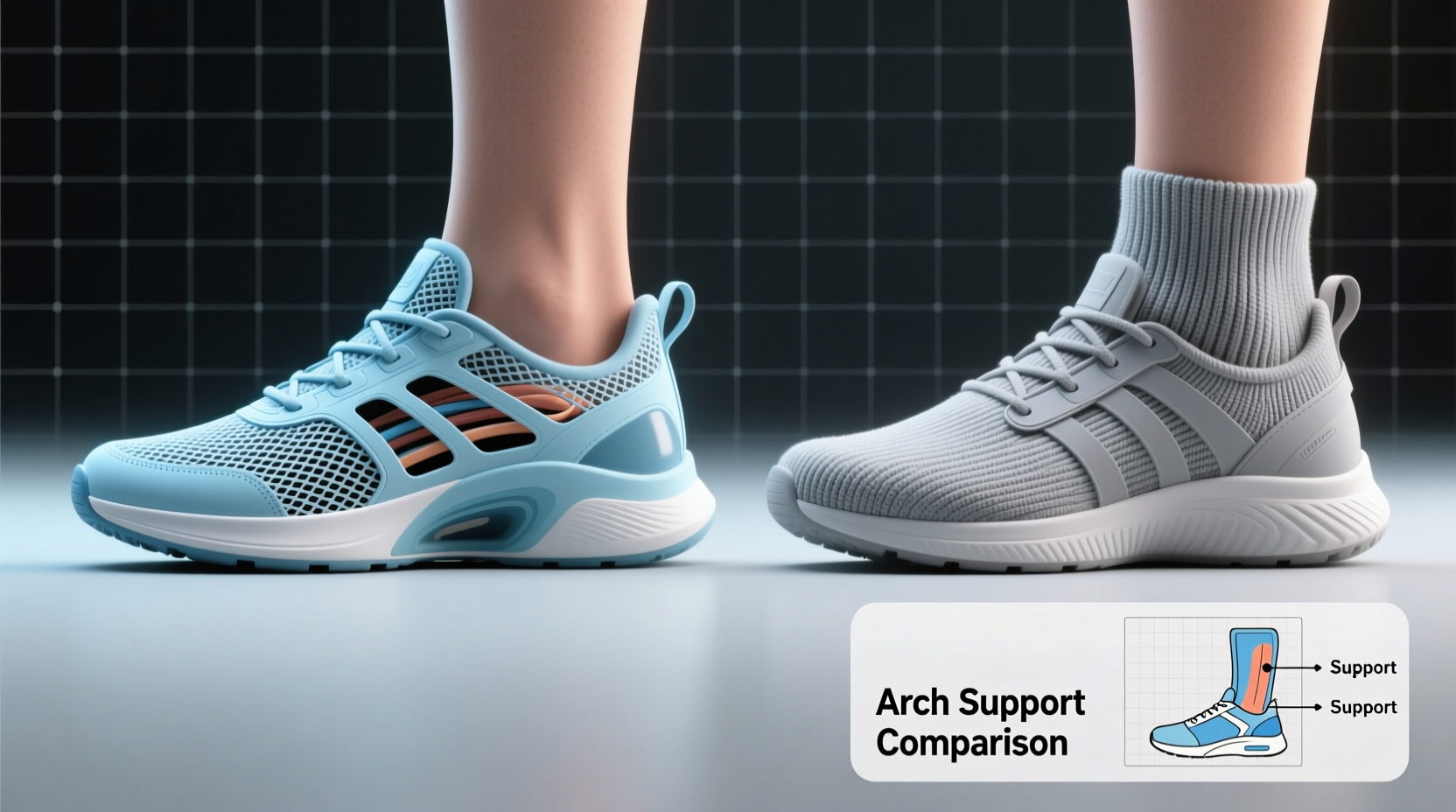
Arch support is not merely about cushioning; it's about alignment. The arch acts as a natural shock absorber during walking, running, or standing. Without proper support, excessive strain can develop in the plantar fascia, Achilles tendon, and even up into the knees and lower back. Overpronation (when the foot rolls inward too much) or flat feet often require structured support, while high arches may need additional cushioning to distribute pressure evenly.
A supportive sneaker doesn’t rely solely on insoles. It integrates three key components:
- Midsole density and geometry: Often made from EVA foam or polyurethane, this layer determines how much the shoe compresses and rebounds.
- Shank and heel counter: These internal structures stabilize the foot’s foundation by limiting excessive twisting.
- Upper material behavior: How the upper wraps and holds the foot affects how forces are transmitted through the arch.
It’s here—within the interaction between upper and midsole—that mesh and knit differ meaningfully.
Mechanical Differences: Mesh vs Knit Uppers
At first glance, mesh and knit may seem interchangeable—both lightweight, breathable, and commonly found in running shoes. However, their manufacturing processes and mechanical behaviors set them apart.
| Feature | Mesh Sneakers | Knit Sneakers |
|---|---|---|
| Material Composition | Synthetic woven fibers (often polyester or nylon) | Interlooped yarns, usually single-layer engineered knit |
| Breathability | High – open weave allows airflow | Moderate to high – depends on knit density |
| Stretch & Flexibility | Low to moderate – more rigid structure | High – conforms closely to foot shape |
| Lateral Stability | Better – resists deformation under load | Variable – depends on reinforcement zones |
| Support Integration | Easier to combine with overlays and TPU frames | Requires strategic engineering for structure |
| Durability | Generally higher – less prone to snagging | Can degrade faster if poorly reinforced |
Mechanically, mesh functions like a scaffold. It’s typically used with thermoplastic polyurethane (TPU) overlays or internal support cages that anchor the foot and reduce lateral movement. This makes it ideal for runners who need consistent containment and guidance through the gait cycle.
Knit, by contrast, behaves like a sock. Engineered knits such as Nike Flyknit or Adidas Primeknit use variable tension zones to create areas of stretch and firmness within a single piece. While this enhances comfort and reduces seams, it also means the material itself contributes less passive stability unless specifically reinforced around the midfoot.
How Upper Material Affects Arch Support
The upper does not directly support the arch—but it influences how effectively the midsole and insole do their job. If the foot shifts excessively inside the shoe, even the best orthotic-grade insole cannot compensate fully.
In mesh sneakers, the stiffer upper helps maintain a secure fit across the midfoot, reducing slippage that could destabilize the arch. Brands like Brooks and Asics often pair durable mesh with medial posts (denser foam on the inner side) to control overpronation—a feature especially beneficial for flat-footed individuals.
Knit sneakers, while adaptive, may allow subtle foot motion unless designed with targeted lockdown zones. For example, some models integrate internal heel counters or dynamic lacing systems to pull the foot into place. However, in basic or minimally constructed knit designs, the lack of rigidity can lead to “cradling without control”—a snug feel that doesn’t translate into functional support.
“An upper should complement the support system, not replace it. A soft knit might feel luxurious, but without structural integration, it won’t prevent arch collapse over long distances.” — Dr. Lena Torres, Podiatrist and Gait Analyst
This distinction is crucial for people with existing foot conditions. A runner logging 30 miles per week on pavement needs more than just comfort—they need consistency in every stride. Mesh-based shoes often deliver that predictability better than all-knit counterparts, assuming similar midsole design.
Real-World Performance: A Runner’s Experience
Consider Mark, a 42-year-old recreational marathoner with mild overpronation. After switching from a traditional mesh-supported stability shoe (Asics GT-2000) to a minimalist knit model (Nike Free RN Flyknit), he noticed immediate comfort gains—lightweight feel, no break-in period, excellent breathability. But by mile 10 of his next long run, he began experiencing sharp arch fatigue.
Upon evaluation with a gait lab, it was clear: the knit upper allowed micro-movements in the midfoot, causing his foot to work harder to stabilize itself. Despite the shoe’s flexible sole, the lack of lateral containment meant his arch wasn’t being supported through toe-off. When he returned to a mesh-supported model with a firmer heel counter and dual-density midsole, the discomfort disappeared.
Mark’s case illustrates an important point: perceived comfort doesn’t always equal biomechanical efficiency. Knit excels in adaptability, but mesh wins in maintaining structural integrity under repetitive stress—especially when paired with proven support technologies.
Tip: If you have flat feet or low arches, prioritize sneakers with firm midfoot wrapping—often achieved through mesh uppers with synthetic overlays—even if the knit version feels softer at first.Engineering Solutions: When Knit Meets Support
It would be inaccurate to say knit sneakers cannot offer good arch support. Advances in material science have enabled hybrid designs where knit is strategically reinforced.
For instance, New Balance’s FuelCell Propel v4 uses an engineered knit upper with a molded heel clip and internal saddle system that locks down the midfoot. Similarly, Hoka One One’s Arahi series—available in both mesh and knit variants—incorporates a J-frame stability system (a denser rubber section on the medial side) that guides the foot regardless of upper type.
These innovations show that support is ultimately a system-wide effort. The upper plays a role, but so do:
- Outsole geometry (wider base = more stability)
- Midsole density gradients
- Heel-to-toe drop (higher drop often reduces arch strain)
- Internal shanks or plates
Therefore, judging a shoe purely by its upper material oversimplifies the equation. What matters most is how all components work together to support your unique foot mechanics.
Checklist: Evaluating Arch Support in Any Sneaker
- Assess the heel counter: Press your thumb into the back of the shoe. It should resist compression to hold your heel stable.
- Check midfoot wrap: Look for overlays, cables, or knit zones designed to hug the arch area.
- Test torsional rigidity: Twist the shoe from heel to toe. A supportive shoe will resist twisting.
- Review the midsole: Look for visible dual-density foams or stability bars (like GuideRails or J-frames).
- Try before you buy: Walk or jog in the store if possible. Pay attention to any rolling sensation or arch pressure.
- Consider your foot type: Flat feet need motion control; neutral arches benefit from balanced cushioning; high arches require shock absorption.
Which Is Better for Arch Support? A Balanced Verdict
After analyzing materials, biomechanics, and real-world usage, the answer isn't absolute—but trends are clear.
MESH SNEAKERS generally provide better arch support due to their compatibility with structured reinforcements. Their lower elasticity allows manufacturers to integrate stability features more reliably. They’re the preferred choice for runners needing motion control, those recovering from plantar fasciitis, or anyone spending extended periods on their feet.
KNIT SNEAKERS excel in comfort and customization but require careful engineering to deliver true arch support. High-end models with integrated support systems can rival mesh shoes, but budget or fashion-focused knit sneakers often fall short in long-term structural performance.
If arch support is your primary concern, lean toward mesh-based designs—especially those labeled as “stability” or “motion control.” However, don’t dismiss knit entirely. Look for technical terms like “adaptive fit bands,” “heel lockdown zones,” or “internal support frames” that indicate added structure beyond the knit fabric.
Frequently Asked Questions
Can I add insoles to improve arch support in knit sneakers?
Yes, aftermarket orthotics or over-the-counter arch supports can enhance any shoe’s support level. However, if the upper is too stretchy, the foot may still shift despite a supportive insole. Combine inserts with lacing techniques (like skip-lacing over the midfoot) for better results.
Are knit sneakers bad for flat feet?
Not inherently. Some knit sneakers are designed specifically for flat-footed wearers, combining the material with medial post technology and rigid heel counters. Always check product specs and reviews focused on stability rather than just comfort.
Do mesh sneakers last longer than knit ones?
Typically, yes. Mesh is more resistant to abrasion and snagging. Knit uppers, particularly thin or loosely woven versions, can develop holes or lose shape after six to nine months of regular use. Reinforced knits fare better, but durability remains a consideration.
Final Recommendations by Use Case
- Running (long distance or trail): Choose mesh-supported stability shoes (e.g., Brooks Adrenaline GTS, Saucony Guide).
- Walking all day (work, travel): Opt for hybrid models with breathable mesh and firm midsoles (e.g., Clarks Unstructured series).
- Casual wear with foot pain history: Select knit sneakers with proven support systems (e.g., Allbirds Tree Dashers, ASICS Novablast with knit upper).
- Fashion-first styling: Prioritize fit and consider adding custom orthotics if wearing for extended periods.
Conclusion: Make Support Your Priority
Choosing between mesh and knit shouldn’t come down to trendiness or texture alone. When arch support is a priority—whether due to past injuries, daily demands, or long-term foot health—the decision must be grounded in function. Mesh currently holds the edge in delivering reliable, consistent support, thanks to its structural compatibility with proven stability technologies. Knit is catching up, but only in premium, well-engineered models.
Your feet carry you through life. Invest in footwear that carries them right. Don’t settle for “good enough” comfort—seek out true support, test shoes thoroughly, and let biomechanics guide your choices more than aesthetics. Whether you choose mesh, knit, or a blend of both, make sure your next pair truly has your arch covered.
🚀 Ready to find your perfectly supported step? Re-evaluate your current sneakers using the checklist above—and share your go-to supportive pair in the comments below.








