
Valence electrons are the outermost electrons in an atom, responsible for chemical bonding and reactivity. Understanding how many valence electrons an element has is fundamental to predicting its behavior in reactions, forming compounds, and even interpreting periodic trends. Despite their importance, students often struggle with locating and counting them correctly—especially across different groups and blocks of the periodic table. This guide breaks down the process into clear, logical steps, equipping you with reliable methods to identify valence electrons with confidence.
Understanding Valence Electrons: The Foundation
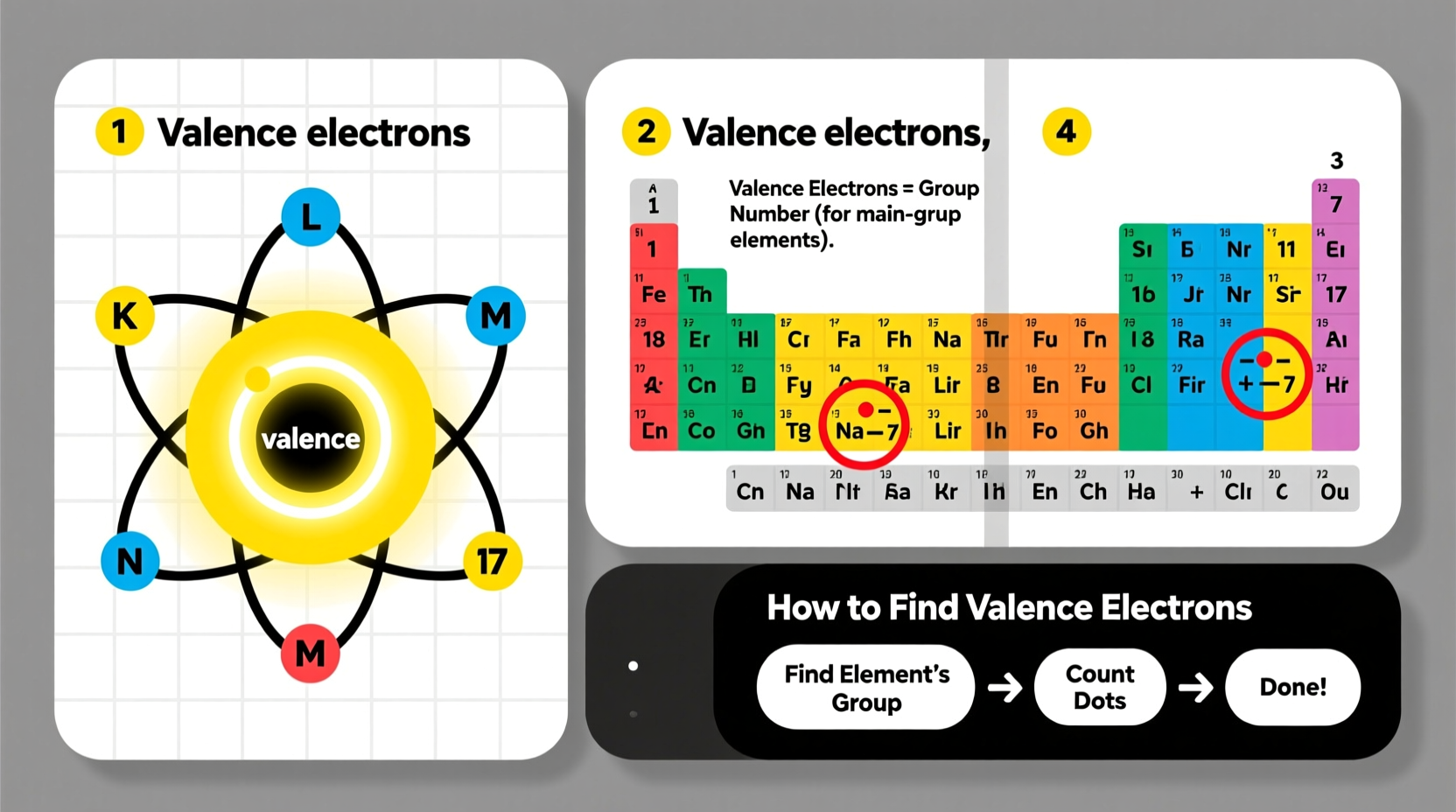
Valence electrons reside in the highest principal energy level (shell) of an atom. These electrons participate in bond formation because they are farthest from the nucleus and experience the weakest electrostatic attraction. Elements with similar numbers of valence electrons exhibit comparable chemical properties, which is why the periodic table is organized into groups (columns) that reflect these patterns.
The number of valence electrons determines whether an element tends to lose, gain, or share electrons during bonding. For example:
- Metals (like sodium) have few valence electrons and tend to lose them, forming positive ions.
- Nonmetals (like chlorine) have more valence electrons and tend to gain electrons to achieve stability.
- Noble gases already have full valence shells, making them largely unreactive.
“Valence electrons are the currency of chemical reactions—they’re what atoms use to form bonds and create new substances.” — Dr. Rebecca Lin, Physical Chemist
Step-by-Step Guide to Identifying Valence Electrons
Follow this structured approach to determine the number of valence electrons for any main-group element.
- Locate the element on the periodic table. Focus on the main-group elements (Groups 1, 2, and 13–18). Transition metals require additional considerations due to d-orbital involvement.
- Identify the group number. For Groups 1–2 and 13–18, the group number directly relates to valence electron count:
- Group 1 → 1 valence electron
- Group 2 → 2 valence electrons
- Group 13 → 3 valence electrons
- Group 14 → 4 valence electrons
- Group 15 → 5 valence electrons
- Group 16 → 6 valence electrons
- Group 17 → 7 valence electrons
- Group 18 → 8 valence electrons (except helium, which has 2)
- Adjust for exceptions in period 2. Elements like lithium and beryllium follow standard rules, but boron through neon strictly adhere to their group-based counts without d-orbital interference.
- Write the electron configuration (optional but helpful). This confirms your result. For instance, oxygen (atomic number 8) has the configuration 1s² 2s² 2p⁴. The second shell (n=2) contains 2 + 4 = 6 electrons—its valence count.
- Double-check using Lewis dot symbols. Represent the element symbol surrounded by dots equal to the number of valence electrons. Each side (top, bottom, left, right) holds up to two electrons.
Using Electron Configuration as a Verification Tool
While group number provides a quick shortcut, electron configuration offers a deeper understanding and verification method. Consider sulfur (S), atomic number 16:
- Electron configuration: 1s² 2s² 2p⁶ 3s² 3p⁴
- Highest energy level: n = 3
- Electrons in the third shell: 3s² + 3p⁴ = 6 electrons
Thus, sulfur has six valence electrons—consistent with its placement in Group 16. This method becomes essential when dealing with ions or exceptions, such as chromium or copper, where orbital stability alters expected configurations.
For ions, adjust the total electron count before determining valence electrons:
- Na⁺: Sodium loses one electron → now has 10 electrons; configuration ends in 2s² 2p⁶ → 8 valence electrons (full octet).
- O²⁻: Oxygen gains two electrons → 10 total electrons; configuration: 1s² 2s² 2p⁶ → also 8 valence electrons.
Common Pitfalls and How to Avoid Them
Misidentifying valence electrons often stems from confusion about transition metals or misreading group numbers. Below is a summary of common mistakes and corrections.
| Mistake | Why It’s Wrong | Correct Approach |
|---|---|---|
| Assuming iron has 8 valence electrons because it's in Group 8 | Transition metals don’t follow simple group-number-to-valence-electron rules due to d-electron participation | Treat transition metal valence electrons contextually—often variable depending on oxidation state |
| Counting all electrons in d-orbitals as valence electrons | d-electrons are not always part of the outermost shell | Only include electrons in the highest n-level, regardless of subshell (s, p, d, f) |
| Forgetting helium has 2 valence electrons, not 8 | Helium is in Group 18 but only has a 1s² configuration | Its first and only shell holds max 2 electrons—thus, 2 valence electrons |
Real-World Application: Predicting Compound Formation
Consider a student analyzing why magnesium (Mg) forms Mg²⁺ ions while aluminum (Al) forms Al³⁺. Both are metals, but their valence electron counts explain the difference.
Magnesium is in Group 2 with 2 valence electrons. Losing both allows it to achieve a stable noble gas configuration (neon). Aluminum, in Group 13, has 3 valence electrons and achieves stability by losing all three, forming Al³⁺.
This understanding helps predict formulas: magnesium combines with oxygen (O²⁻) to form MgO, while aluminum forms Al₂O₃ to balance charges. Without knowing valence electrons, these ratios would seem arbitrary.
Tip: When writing chemical formulas, use valence electrons to determine ion charge and apply the crisscross rule for neutral compounds.Quick Checklist: Confirming Valence Electron Count
Use this checklist whenever you're unsure about an element’s valence electrons:
- ☑ Is the element in the s-block or p-block? If yes, use group number (adjust Groups 13–18 by subtracting 10).
- ☑ Write out the electron configuration if uncertain.
- ☑ Identify the highest principal quantum number (n).
- ☑ Sum all electrons in orbitals with that n-value.
- ☑ Cross-reference with Lewis dot structure expectations.
- ☑ For ions, adjust total electrons before analysis.
Frequently Asked Questions
How many valence electrons does nitrogen have?
Nitrogen is in Group 15 and has 5 valence electrons. Its electron configuration is 1s² 2s² 2p³, so the second shell contains 5 electrons.
Do transition metals have valence electrons?
Yes, but their valence electrons can come from both s and d orbitals, leading to variable oxidation states. For example, iron can exhibit +2 or +3 oxidation states depending on how many electrons it loses.
Why do noble gases have low reactivity?
Noble gases have complete valence shells—either 2 (helium) or 8 (others)—making them energetically stable. They rarely gain, lose, or share electrons under normal conditions.
Conclusion: Take Control of Chemical Understanding
Mastering valence electrons unlocks the logic behind chemical bonding, periodic trends, and molecular geometry. By applying the systematic steps outlined here—using group numbers, verifying with electron configurations, and avoiding common traps—you build a foundation that supports advanced topics in chemistry. Whether you're preparing for exams, teaching others, or simply deepening your scientific literacy, accurate identification of valence electrons is a skill worth perfecting.
🚀 Ready to test your knowledge? Pick five random elements, determine their valence electrons using this guide, and verify with a periodic table or textbook. Practice turns theory into instinct.