Brooches are more than just accessories—they're statements of style, heritage, and personality. Whether worn on a lapel, scarf, or dress, the right brooch elevates an outfit. But behind the sparkle lies a practical concern: how well does it stay in place, and at what cost to your clothing? Traditional pin-back (often called \"diamond\") brooches have long dominated the market, but magnetic alternatives are gaining traction for their ease of use. The real question isn’t just about aesthetics—it’s about function. Which option secures your accessory firmly while preserving the integrity of your garments?
How Brooches Work: Mechanics Behind the Hold
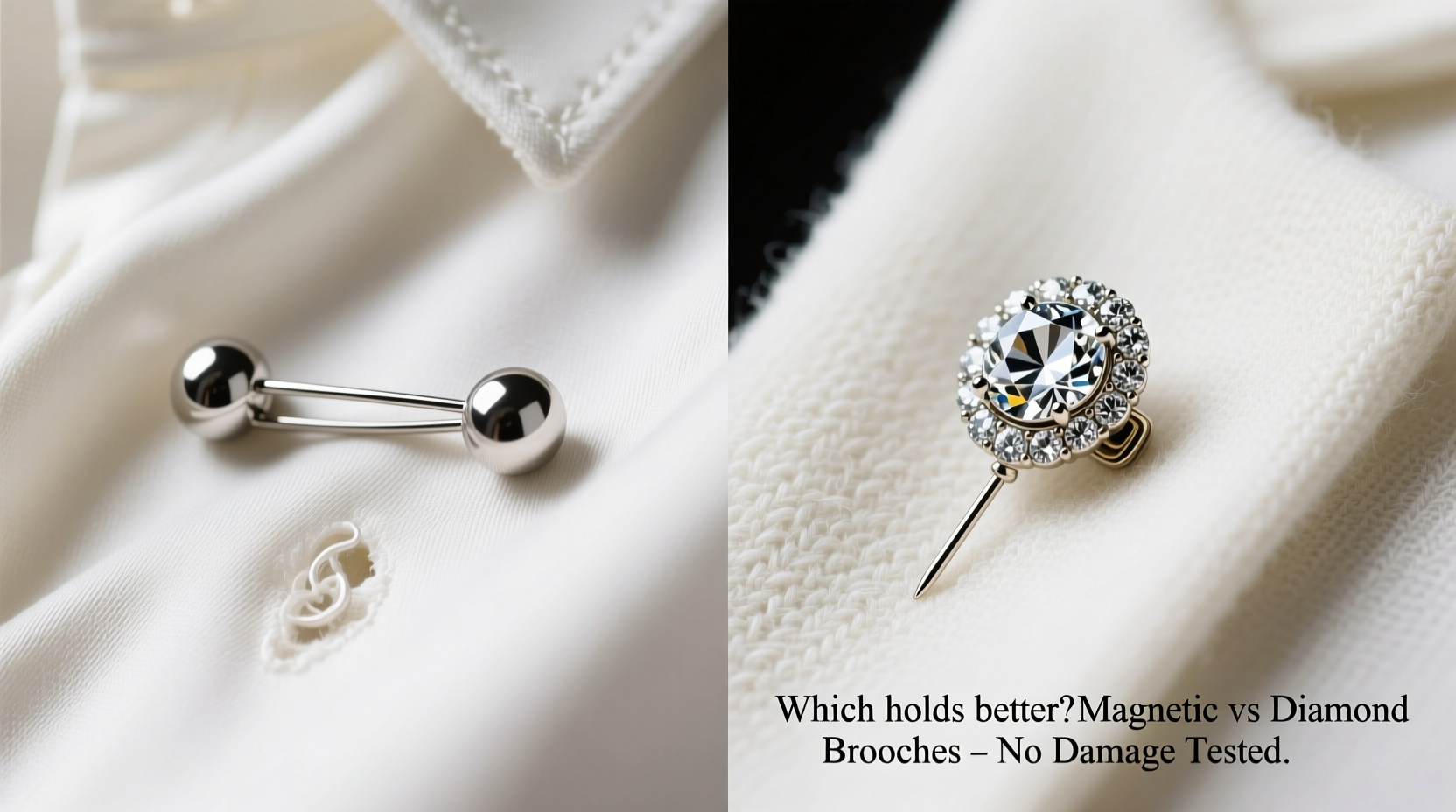
The way a brooch attaches determines not only its security but also its potential to damage fabric. Diamond brooches—named not for gemstones but for the shape of their fastening mechanism—use a sharp metal pin that pierces through fabric and locks into a catch. This provides a strong, reliable hold, especially on thicker materials like wool or tweed. However, each use introduces tiny punctures, which over time can weaken fibers, lead to snags, or leave permanent holes.
Magnetic brooches, by contrast, rely on two opposing magnets—one placed on the front, one behind the fabric—to create a clamping effect. No piercing is required. This makes them ideal for delicate fabrics such as silk, chiffon, or fine knits that tear easily. The strength of the hold depends on the magnet's pull force, typically measured in grams or ounces. High-quality magnetic brooches use rare-earth neodymium magnets, offering impressive grip without penetration.
Tip: For lightweight fabrics, always opt for magnetic brooches to avoid stress marks or tears from pin insertion.Comparing Fabric Safety: Damage Potential Side by Side
Diamond brooches may offer a classic look, but their mechanical design comes with trade-offs. Every time you fasten one, you’re essentially creating a micro-perforation. On sturdy fabrics like denim or structured jackets, this may be negligible. But on finer weaves—especially those with looser threads like linen or cashmere—the cumulative effect can lead to fraying or visible wear around the brooch site.
Magnetic brooches eliminate puncture risk entirely. Instead, their primary concern becomes pressure-related distortion. If the magnet is too strong or improperly aligned, it can stretch or compress the fabric between the two magnetic plates. This is particularly noticeable on loosely woven or elastic materials. However, modern designs often include soft silicone or fabric buffers to distribute pressure evenly and prevent marking.
“With vintage silks and heirloom garments, I never recommend pin-back closures. Even minor punctures compromise fiber longevity. Magnetic solutions are far safer when properly engineered.” — Lila Nguyen, Textile Conservator & Fashion Archivist
Hold Strength and Practical Security: Will It Stay Put?
A secure brooch shouldn’t require constant readjustment. While diamond brooches traditionally win in raw holding power, their advantage diminishes on thin or flexible fabrics where the pin may slip out due to lack of resistance.
Magnetic brooches perform best when the fabric thickness falls within the magnet’s optimal range—usually 1–3 mm. Too thin (like a single layer of silk), and the magnet might shift; too thick (like a heavy winter coat), and the magnetic force may not bridge the gap effectively. Many high-end magnetic brooches now come with adjustable spacers or layered magnetic systems to accommodate different garment weights.
| Feature | Diamond (Pin-Back) Brooch | Magnetic Brooch |
|---|---|---|
| Fabric Damage Risk | High – creates small punctures | Low – no piercing, possible pressure marks |
| Holding Strength | High – especially on thick fabrics | Moderate to High – depends on magnet quality and fabric thickness |
| Suitability for Delicate Fabrics | Poor – can snag or tear | Excellent – non-invasive |
| Ease of Use | Moderate – requires precise alignment | High – simple placement |
| Lifespan Impact on Garments | Negative – repeated use weakens fibers | Neutral to Positive – preserves fabric integrity |
Real-World Example: A Bridal Consultant’s Dilemma
Sophie Reynolds, a bridal stylist in Edinburgh, regularly advises brides on accessorizing delicate wedding gowns. One client wanted to wear her grandmother’s antique brooch—a sentimental piece with a traditional pin back—on a silk tulle overlay. Sophie knew the risk: even a single puncture could unravel the fragile netting.
Instead, she collaborated with a jeweler to retrofit the brooch with a custom magnetic backing. The front remained untouched for aesthetic continuity, while the reverse used a slim, powerful neodymium magnet paired with a padded rear plate. The result? The brooch stayed securely in place throughout the ceremony, and the gown emerged unscathed. “It was a perfect blend of tradition and innovation,” Sophie said. “The family got their emotional moment without sacrificing the dress.”
Choosing the Right Option: A Practical Checklist
Selecting between magnetic and diamond brooches shouldn’t be arbitrary. Consider these factors before making your decision:
- Evaluate fabric type: Is it delicate (silk, lace, chiffon) or robust (wool, denim, felt)?
- Assess frequency of use: Will the brooch be worn daily or occasionally?
- Check weight of the brooch: Heavier pieces need stronger fasteners—magnets must be proportionally powerful.
- Consider user comfort: Those with arthritis or limited dexterity may struggle with pin-back mechanisms.
- Preservation priority: Are you wearing a vintage or irreplaceable garment?
Expert Upgrade Tip: Hybrid Solutions
For those unwilling to sacrifice tradition or security, hybrid systems offer a middle ground. Some jewelers now offer conversion kits that replace pin stems with magnetic bases while retaining the original decorative front. These allow vintage brooches to be worn safely on modern, delicate attire. Similarly, detachable magnetic backings let users switch between pin and magnetic modes depending on the outfit.
When choosing a conversion, ensure the magnet is flush-mounted and shielded to prevent scratching. Also, verify that the magnetic pull is rated for the brooch’s weight—typically, 300 grams (about 10 oz) of holding force is sufficient for most medium-sized pieces.
FAQ: Common Questions About Brooch Fastenings
Can magnetic brooches fall off easily?
High-quality magnetic brooches with strong neodymium magnets rarely fall off when used correctly. The key is matching the magnet strength to the fabric thickness and brooch weight. Avoid using them on very slippery fabrics like satin unless the magnet has a textured or grippy surface.
Do pin-back brooches ruin clothes over time?
Yes, especially on lighter or older fabrics. Repeated use in the same spot weakens fibers, leading to enlarged holes or runs. Even on durable materials, visible wear can develop after multiple uses. Rotating attachment points helps, but doesn’t eliminate the issue.
Are magnetic brooches safe for people with pacemakers?
Strong magnets can interfere with medical devices. Individuals with pacemakers or implantable defibrillators should consult their physician before using magnetic jewelry. In most cases, moderate-strength brooch magnets pose minimal risk when worn on the upper chest, but caution is essential.
Final Recommendation: Prioritize Fabric Longevity Without Sacrificing Style
While diamond brooches carry a legacy of elegance, their functional drawbacks are hard to ignore. For everyday wear, delicate garments, or sentimental pieces, magnetic brooches offer a smarter, gentler alternative. Advances in magnet technology have closed the gap in holding strength, and thoughtful design minimizes slippage and pressure marks.
The future of brooch-wearing lies in adaptability. Whether you choose a fully magnetic design or upgrade a cherished heirloom with a modern backing, the goal remains the same: to express yourself beautifully without compromising your wardrobe.
💬 Have a favorite brooch or a fabric disaster story? Share your experience below—your insight could help others make safer, smarter choices.