The smartwatch market in the mid-2010s saw rapid innovation, with LG and Samsung leading the charge in Android Wear (now Wear OS) adoption. The LG Watch Style and the Samsung Gear S2 represent two distinct philosophies: minimalist elegance versus bold functionality. But if you already own a Gear S2, is upgrading to the LG Watch Style truly beneficial—or are you simply swapping proven performance for sleek design and brand newness?
This isn’t about marketing slogans or unboxing excitement. It’s about practicality, longevity, usability, and whether the improvements justify the cost.
Design and Build: Form vs Function
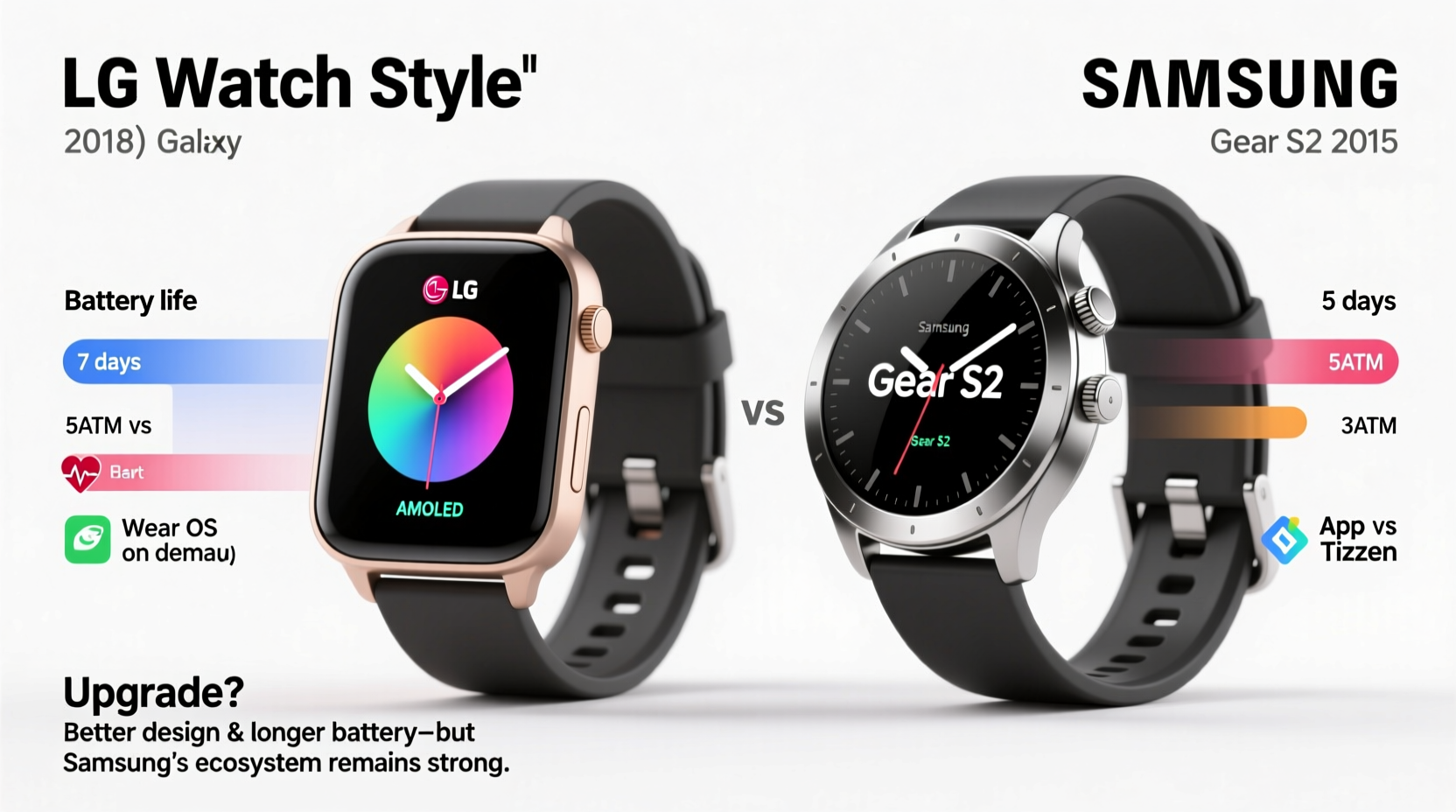
The most immediate difference between the LG Watch Style and the Samsung Gear S2 lies in their physical design. The Gear S2, released in 2015, embraced a circular face with a rotating bezel—a standout feature at the time that made navigation intuitive without relying solely on touch. Its stainless steel body and compact footprint gave it a sporty yet refined look, suitable for both casual and formal settings.
In contrast, the LG Watch Style, launched in 2017, leaned into minimalism. With its slim profile, lightweight aluminum casing, and flat display, it aimed to mimic traditional watches more closely. It was thinner, lighter, and arguably more discreet—ideal for users who wanted a smartwatch that didn’t scream “tech gadget.”
Tip: If comfort during extended wear matters most, prioritize weight and thickness—the LG Watch Style wins here.However, minimalism came at a cost. The Watch Style lacks the tactile feedback of the Gear S2’s rotating bezel, forcing all navigation through touch gestures. For many long-time Gear S2 users, this felt like a step backward in usability.
Performance and Software Experience
Both devices run Android Wear, but hardware differences impact daily performance. The Gear S2 uses an Exynos 3250 dual-core processor with 512MB RAM, while the LG Watch Style upgrades to a Snapdragon Wear 2100 with 768MB RAM. On paper, the newer chip should offer better efficiency and responsiveness.
In practice, the improvement is subtle. The Wear 2100 chipset was designed for lower power consumption, which helps battery life, but real-world UI fluidity between the two watches is nearly identical. Apps load at similar speeds, voice commands respond with comparable latency, and animations remain modest due to the limitations of early Wear OS optimization.
“Hardware upgrades in mid-tier smartwatches often don’t translate to meaningful user experience gains—especially when software lags behind.” — David Lin, Wearable Tech Analyst at MobileTrends Weekly
The LG Watch Style benefits from launching alongside Android Wear 2.0, which introduced standalone app support, improved messaging, and a redesigned interface. If your Gear S2 hasn’t been updated to Wear 2.0 (or can’t support it reliably), then the software leap alone may justify considering an upgrade.
Detailed Feature Comparison
| Feature | LG Watch Style | Samsung Gear S2 |
|---|---|---|
| Operating System | Android Wear 2.0 (upgradable) | Android Wear (initially 1.0, up to 2.0 on select models) |
| Processor | Qualcomm Snapdragon Wear 2100 | Samsung Exynos 3250 |
| RAM | 768MB | 512MB |
| Battery Capacity | 240 mAh | 300 mAh (Classic), 250 mAh (Frontier) |
| Battery Life | ~1 day | ~1.5–2 days |
| Display | 1.2” P-OLED, 360x360 | 1.2” Super AMOLED, 360x360 |
| Navigation | Touch only | Rotating bezel + touch |
| Water Resistance | IP67 | IP68 |
| Weight | 25.6g | 42g (Classic), 38g (Frontier) |
| Standalone Apps | Yes (Wear 2.0+) | Limited, depends on update status |
While the LG Watch Style has modern specs, the Gear S2 holds advantages in battery life and water resistance. IP68 means it can survive deeper, longer submersion than the IP67-rated Watch Style—useful for swimmers or outdoor enthusiasts.
Real-World User Scenario: Mark’s Upgrade Dilemma
Mark has used his Samsung Gear S2 Frontier daily for over two years. He appreciates the rotating bezel for scrolling through notifications during meetings and likes that he can go a full weekend without charging. When his device began showing minor lag after a Wear 2.0 update, he considered upgrading.
He tested the LG Watch Style at a retail store. While he loved how light and sleek it felt on his wrist, he missed the precision of the rotating bezel. Scrolling through long messages required multiple swipes, and accidental touches were more common. After borrowing a friend’s unit for a week, he found himself frustrated by the shorter battery life and lack of quick-access gestures.
Ultimately, Mark decided against upgrading. His conclusion? “The LG Watch Style looks better on paper and feels nicer physically, but I lose too much in usability. Unless my Gear S2 dies, there’s no real reason to switch.”
Is the Upgrade Worth It? A Practical Checklist
Before making the jump, ask yourself the following questions:
- Does your Gear S2 still receive software updates?
- Do you rely heavily on the rotating bezel for navigation?
- Are you frequently running out of battery before day’s end?
- Do you value a slimmer, more traditional watch aesthetic?
- Do you use standalone apps (like offline music or GPS tracking) regularly?
- Is water resistance beyond splashes important to you?
✅ You want a more understated, dress-watch appearance
✅ Your Gear S2 is outdated, unstable, or unsupported
✅ You need Wear 2.0+ features like Google Play Store on-wrist
✅ You prefer ultra-lightweight wearability over ruggedness
Frequently Asked Questions
Can the LG Watch Style last longer on a charge than the Gear S2?
No. Despite newer hardware, the LG Watch Style typically lasts about one day under regular use. The Gear S2, especially the Classic model, often achieves 1.5 to 2 days, giving it an edge in battery endurance.
Is the rotating bezel really that important?
For many users, yes. The Gear S2’s rotating bezel allows precise, eyes-free navigation—scrolling through emails, adjusting timers, or browsing playlists without constant tapping. Losing this feature reduces efficiency, especially in situations where touchscreen accuracy is limited.
Will either watch get future OS updates?
Unlikely. Both devices are based on older Wear OS foundations. While they supported Wear OS 2, neither is compatible with Wear OS 3 or later, which require more powerful hardware. Future app compatibility will gradually decline as developers optimize for newer platforms.
Final Verdict: Hype or Real Value?
The LG Watch Style is not a significant technological leap over the Gear S2. It trades bulk for thinness, durability for elegance, and tactile control for modern aesthetics. If you’re drawn to its minimalist design and your current Gear S2 is struggling with software support or performance issues, the upgrade could make sense.
But if you value usability, battery life, and robust build quality, staying with the Gear S2—or even exploring other Wear OS 2-compatible alternatives—might be smarter. The improvements in the Watch Style are largely cosmetic and incremental, not transformative.
Smartwatch upgrades in this era were often marketed as generational leaps, but in reality, they delivered marginal gains wrapped in fresh design language. Don’t confuse newness with necessity.
🚀 Think before you upgrade. Evaluate what you actually use and need—not just what looks good in ads. Share your own experience: Have you switched from Gear S2 to a newer Wear OS watch? Was it worth it?