The modern wardrobe is caught in a quiet revolution. As comfort and versatility take precedence, the tailored silhouette of the classic woven blazer faces increasing competition from the relaxed elegance of the knitted jacket. Once confined to weekend wear or informal settings, knitted outerwear has infiltrated boardrooms, creative agencies, and even hybrid workspaces. This shift raises a pressing question: Are woven blazers—longtime symbols of professionalism and structure—becoming obsolete?
The answer isn’t straightforward. While the rise of knitted jackets signals a cultural pivot toward ease and adaptability, the woven blazer remains deeply embedded in formal dress codes and sartorial tradition. To understand the current dynamics, it’s essential to examine not just fabric and construction, but also context, lifestyle changes, and evolving definitions of professionalism.
The Evolution of Structure and Comfort
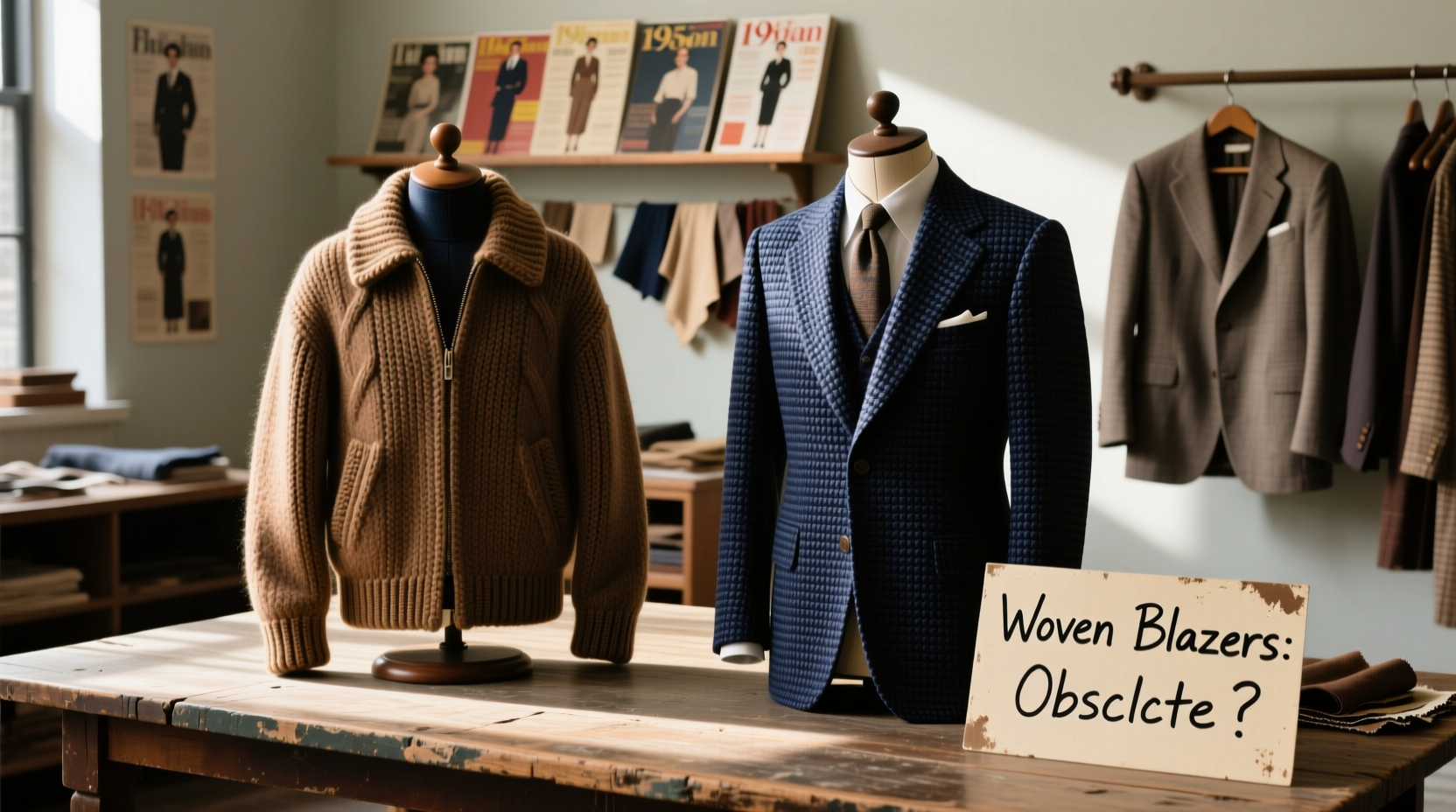
Woven blazers have historically represented order, precision, and formality. Constructed from tightly woven wool, cotton, or blends, they rely on internal canvassing, padding, and structured tailoring to create sharp lapels, defined shoulders, and clean lines. These garments were designed for environments where appearance signaled authority—law firms, financial institutions, and diplomatic circles.
In contrast, knitted jackets emerge from a different lineage—one rooted in sportswear and casual refinement. Made from interlocking loops of yarn, often in merino wool, cashmere, or technical blends, they offer natural stretch, breathability, and a softer drape. Their flexibility makes them ideal for layering over t-shirts or fine-gauge sweaters, adapting seamlessly to fluctuating temperatures and activity levels.
The pandemic accelerated a broader sartorial shift. Remote work diminished the need for rigid office attire, and employees began favoring clothing that balanced presentability on video calls with physical comfort. Knitted jackets, already associated with intellectual informality (think Steve Jobs or contemporary tech founders), gained traction as a symbol of this new equilibrium.
Tip: Pair a finely knitted jacket with chinos and loafers for a polished yet relaxed look suitable for hybrid meetings.Functional Comparison: When Each Jacket Shines
Choosing between a knitted jacket and a woven blazer often comes down to function rather than fashion alone. Each excels in specific scenarios based on durability, climate, and occasion.
| Feature | Knitted Jacket | Woven Blazer |
|---|---|---|
| Foldability | High – easily packed without creasing | Low – prone to wrinkles when folded |
| Movement & Flexibility | Excellent – stretches with body motion | Limited – structured cut may restrict motion |
| Formal Setting Suitability | Moderate – best in creative or business-casual offices | High – standard in corporate and formal environments |
| Climate Adaptability | Good – breathable and thermoregulating | Variable – heavier wools can overheat; lighter weaves perform better |
| Durability | Medium – susceptible to pilling and snagging | High – resilient to daily wear when properly maintained |
This comparison reveals a clear division: knitted jackets prioritize comfort and mobility, while woven blazers emphasize permanence and polish. The former suits dynamic lifestyles; the latter serves institutional expectations.
Real-World Shift: A Designer Studio Case Study
Consider the experience of Atelier Nova, a mid-sized design firm in Berlin. Prior to 2020, client-facing teams wore tailored blazers as part of a semi-formal dress code. After transitioning to remote operations, leadership noticed a decline in blazer usage during virtual meetings. Employees opted instead for fine-gauge knits in neutral tones—garments that looked professional on camera but didn’t require ironing or stiff lining.
When the studio reopened in 2022 with a flexible return-to-office policy, management revised its dress guidelines. The new standard: “polished but comfortable.” Woven blazers remained optional, while high-quality knitted jackets were explicitly accepted as appropriate business attire. Within six months, sales of structured blazers among staff dropped by 40%, while knitwear purchases increased by 75%.
This microcosm reflects a macro trend: organizational norms are being rewritten not by fashion editors, but by practical demands and employee well-being.
“Clothing is no longer just about how you look—it’s about how you feel throughout the day. The knitted jacket answers both needs.” — Lena Moretti, Menswear Curator at the Zurich Fashion Institute
Preserving Relevance: How Woven Blazers Are Adapting
Rather than disappearing, woven blazers are evolving. Designers are responding to consumer demand for comfort by re-engineering traditional pieces. Unstructured blazers—those without heavy canvas or shoulder padding—are gaining popularity. Fabrics like wool-silk blends, stretch twill, and lightweight flannel allow for greater movement while preserving the visual cues of formality.
Brands such as Boglioli and Incotex have pioneered the \"deconstructed\" blazer, offering soft shoulders, minimal lining, and fluid silhouettes. These hybrids blur the line between knit and weave, providing the aesthetic authority of a blazer with much of the ease associated with knits.
Additionally, sustainability concerns are influencing material choices. Woven fabrics, especially those made from natural fibers, tend to have longer lifespans and are more recyclable than synthetic knits. This durability appeals to environmentally conscious consumers who value investment dressing over fast fashion cycles.
Action Checklist: Choosing the Right Jacket for Your Lifestyle
- Evaluate your daily environment: Do you work in a formal office, hybrid setting, or fully remote?
- Assess movement needs: Will you be commuting, biking, or sitting at a desk all day?
- Consider maintenance: Are you willing to dry-clean and press a blazer regularly?
- Think long-term: Is this piece meant for frequent rotation or occasional formal use?
- Test versatility: Can it be dressed up with a tie or down with a hoodie?
FAQ: Common Questions About Knitted Jackets and Woven Blazers
Can I wear a knitted jacket to a job interview?
Yes, provided the company culture leans toward creative, tech, or business-casual environments. Opt for a dark, well-fitted knit in wool or cashmere, paired with tailored trousers and leather shoes. Avoid overly casual textures like chunky cable knits.
Do woven blazers still matter in 2024?
Absolutely. In industries like law, finance, and government, the woven blazer remains a non-negotiable element of professional attire. Even in less formal sectors, owning one high-quality blazer ensures readiness for presentations, interviews, or formal events.
How do I care for a knitted jacket?
Hand-wash or use a delicate machine cycle with cold water and mild detergent. Lay flat to dry to prevent stretching. Store folded—not on hangers—to maintain shape. Use a fabric shaver sparingly to remove pills.
Conclusion: Coexistence Over Obsolescence
The narrative of obsolescence oversimplifies a nuanced reality. Woven blazers are not vanishing; they are being repositioned. They remain indispensable in contexts where tradition, authority, and formality prevail. Yet their dominance is no longer universal. Knitted jackets have earned a permanent place in the modern wardrobe by meeting unmet needs: comfort, adaptability, and low-maintenance elegance.
The future of outerwear isn’t a winner-takes-all contest. It’s a spectrum of choice. Savvy dressers will own both—a structured wool blazer for the courtroom or gala, and a refined merino knit for the co-working space or casual dinner. The key lies in understanding context, prioritizing fit, and recognizing that true style evolves with life, not against it.
💬 What’s in your jacket rotation? Share your go-to pieces and how you balance comfort with professionalism—we’d love to hear your approach.