The beauty industry has seen a wave of high-tech hair tools promising salon-quality results at home, but few have captured attention like the Dyson Airwrap. With its sleek design, innovative airflow technology, and premium price tag—often exceeding $500—the Airwrap is positioned as a revolutionary alternative to traditional flat irons, curling wands, and blow dryers. But for many consumers, the critical question remains: Is it truly worth the investment over more affordable, time-tested styling tools?
To answer this, we need to go beyond marketing claims and examine real-world performance, long-term value, ease of use, and how it fits into different hair types and routines. The decision isn’t just about which tool styles better—it’s about efficiency, hair health, and whether the benefits justify the cost.
How the Dyson Airwrap Works: Science Over Heat
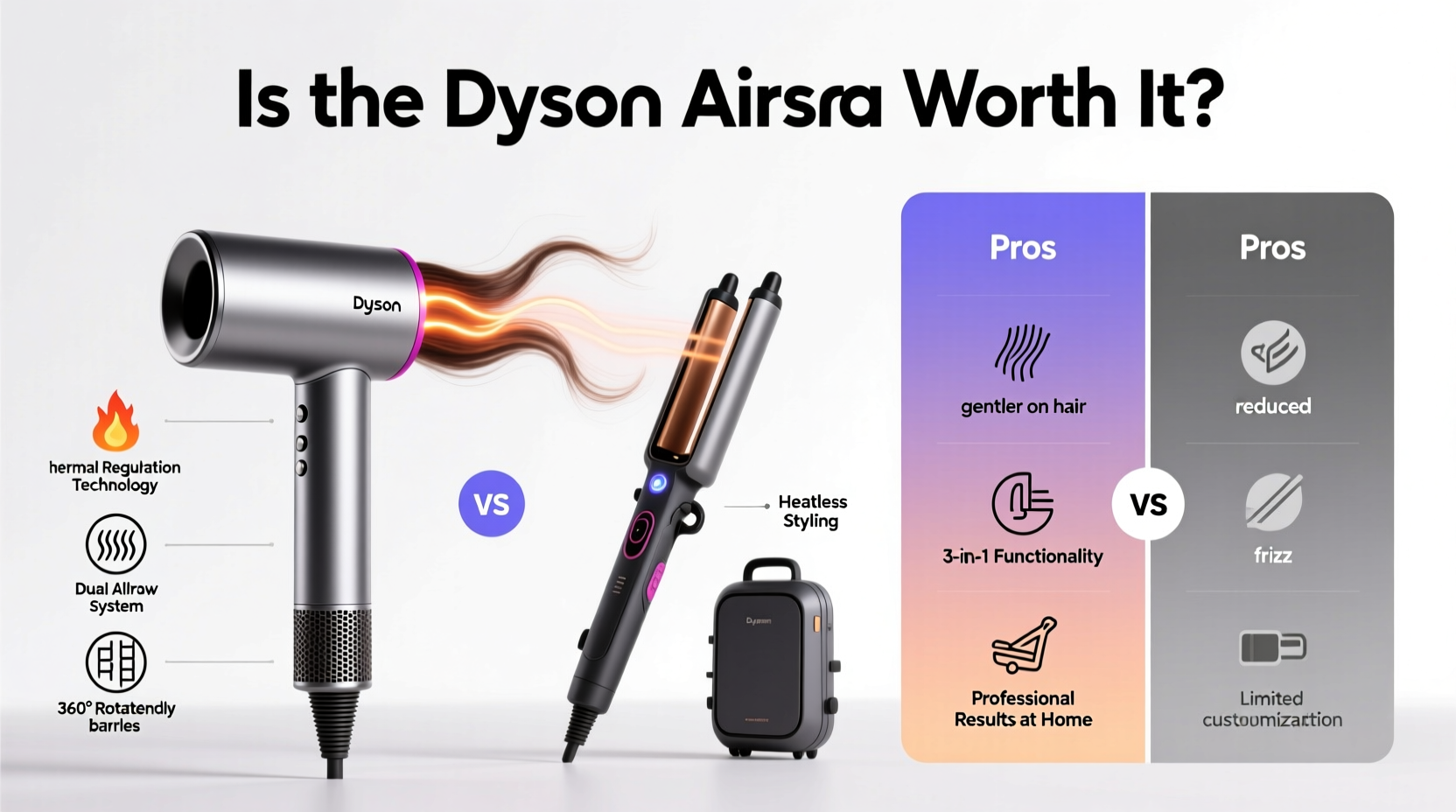
Unlike conventional styling tools that rely heavily on direct heat to reshape hair, the Dyson Airwrap uses Coanda airflow technology—a principle borrowed from aerospace engineering. This effect causes air to follow a curved surface, allowing the tool to attract and wrap hair around the barrel without requiring manual winding.
The device comes with multiple attachments: two 1.2” and 1.6” barrels for curls and waves, a smoothing brush, a volumizing brush, and a pre-styling dryer. Each attachment serves a specific function, consolidating several tools into one system. The core idea is gentler styling—less heat damage due to lower temperatures (typically between 130°C and 150°C) compared to traditional tools that often exceed 200°C.
“Dyson’s approach shifts focus from heat intensity to airflow precision. It’s not just a styling tool; it’s an engineering solution to reduce thermal stress.” — Dr. Lena Patel, Trichologist & Hair Technology Researcher
This technology particularly benefits those with fine, damaged, or heat-sensitive hair. However, effectiveness varies based on hair type, technique, and user experience. While some achieve bouncy curls in minutes, others report inconsistent results—especially with thick or coarse textures.
Performance Comparison: Airwrap vs. Traditional Tools
To assess real-world value, let’s compare the Dyson Airwrap against a standard combination of a ceramic flat iron, tourmaline curling wand, and professional-grade blow dryer—all totaling roughly $150 when purchased separately.
| Feature | Dyson Airwrap | Traditional Styling Tools |
|---|---|---|
| Average Price | $549 | $100–$150 |
| Heat Range | 130°C – 150°C (controlled) | 180°C – 230°C (user-adjusted) |
| Styling Time (avg.) | 20–30 minutes | 30–50 minutes |
| Hair Damage Risk | Lower (with consistent use) | Higher (especially above 180°C) |
| Versatility | High (drying + curling + smoothing) | Moderate (each tool has single purpose) |
| Learning Curve | Steeper (technique-dependent) | Low (intuitive use) |
| Lifespan (estimated) | 5+ years (motor durability) | 2–4 years (heating element wear) |
The data shows a trade-off: higher upfront cost for the Airwrap, but potentially longer lifespan, reduced heat exposure, and faster overall styling when mastered. For someone who styles daily, saving 15–20 minutes per session adds up to nearly 100 hours annually—time that can’t be reclaimed.
Tip: Use the Airwrap on damp (not wet) hair for best results. Towel-dry thoroughly before starting to avoid steam buildup and uneven drying.Real-World Example: A Week with the Airwrap
Samantha, a 32-year-old marketing executive with shoulder-length, color-treated wavy hair, decided to test the Dyson Airwrap for seven days after years of using a flat iron and curling wand. Her typical routine took 40 minutes: blow-dry, straighten, then curl sections for volume.
She replaced her entire toolkit with the Airwrap. By day three, she had adjusted to the technique—using the pre-styling dryer first, then alternating between the 1.2” barrel and smoothing brush. By day five, her routine dropped to 25 minutes. More importantly, she noticed less frizz and breakage at the ends, something she attributed to reduced heat exposure.
“I was skeptical at first,” she said. “It felt like I was paying for hype. But after a week, my hair looked healthier, and I saved time every morning. That alone made it feel worth it.”
However, she noted limitations: the tool struggled with her thicker roots, requiring a second pass, and the noise level was higher than expected. Still, she concluded that for her lifestyle—rushed mornings, frequent styling, and chemically treated hair—the investment paid off in both convenience and hair integrity.
When the Airwrap Makes Financial Sense
At nearly $550, the Dyson Airwrap isn’t an impulse buy. But financial value isn’t just about sticker price—it’s about cost per use, longevity, and indirect savings.
- Cost per use: If used 3 times per week for 3 years, the cost averages out to about $1.33 per use.
- Replacement frequency: Traditional tools may need replacing every 2–3 years due to worn heating plates or motor failure.
- Savings on treatments: Healthier hair may reduce spending on deep conditioning masks, keratin treatments, or trims caused by split ends.
- Time value: Saving 15 minutes daily equals 7.5 hours per month—equivalent to nearly two full workdays annually.
For professionals, parents, or anyone with a tight morning schedule, time efficiency becomes a tangible benefit. Additionally, users who frequently style their hair are more likely to see cumulative advantages in hair condition, making the Airwrap a preventive investment rather than just a cosmetic tool.
Who Should Consider Skipping It?
Despite its strengths, the Dyson Airwrap isn’t universally ideal. Certain users may find better value in traditional tools.
Those with very thick, tightly coiled, or extremely short hair often report difficulty achieving consistent results. The Coanda effect works best on medium-length, fine-to-medium hair that responds well to airflow. Users with Type 4 curls or coarse textures may still require manual manipulation or supplemental tools.
Additionally, budget-conscious buyers should consider alternatives. High-performing tools like the Bio Ionic LongZ Black Chrome Flat Iron or the T3 Whirl Trio offer strong results at a fraction of the price. If you only style occasionally or prefer simple routines, the learning curve and expense may not justify the upgrade.
“The Airwrap excels in controlled environments with proper technique. But for textured or resistant hair types, it’s not a magic solution—it’s another tool in the kit.” — Marcus Reed, Celebrity Hairstylist
Step-by-Step Guide to Maximizing Your Airwrap Results
If you decide to invest in the Dyson Airwrap, mastering the technique is essential for optimal outcomes. Follow this sequence for best results:
- Start with clean, towel-dried hair. Apply a heat protectant and light mousse for hold and volume.
- Pre-style with the dryer attachment. Use the smoothing brush to partially dry hair to about 80% dryness, focusing on the roots for lift.
- Select the right barrel size. Use the 1.2” barrel for tighter curls or shorter hair; 1.6” for loose waves and longer lengths.
- Section your hair. Clip away top layers and work from the bottom up. Smaller sections yield more consistent results.
- Hold the tool vertically and let airflow do the work. Place a small section near the barrel—hair should automatically wrap. Hold for 10–15 seconds, then switch to cool shot to set the style.
- Finish with the smoothing brush. Run through ends and flyaways for a polished look without additional heat.
- Do not touch styled hair immediately. Allow curls to cool completely to lock in shape.
Frequently Asked Questions
Can the Dyson Airwrap replace my blow dryer entirely?
Yes, the Airwrap includes a dedicated pre-styling dryer attachment designed to dry hair efficiently before styling. Many users eliminate their standalone blow dryer, especially if they style daily. However, those with very long or dense hair may still prefer a high-powered dryer for initial bulk drying.
Does the Airwrap work on short hair?
It can work on short hair, particularly pixie cuts with enough length to wrap (at least 2–3 inches). The 1.2” barrel is best suited for shorter styles. Some users with very short layers find it difficult to control airflow grip, so results vary.
Is there a significant difference between the original Airwrap and the newer models?
Yes. Newer versions include improved attachments, enhanced ergonomics, and a quieter motor. The latest model features a redesigned smoothing brush with carbonized bristles for better tension and shine. If buying new, the updated version offers subtle but meaningful upgrades.
Checklist: Is the Dyson Airwrap Right for You?
Before purchasing, ask yourself the following:
- ✅ Do I style my hair daily or multiple times per week?
- ✅ Is my hair fine, medium, or color-treated and prone to heat damage?
- ✅ Am I willing to spend 1–2 weeks learning the technique?
- ✅ Do I value time savings and multi-functionality?
- ✅ Is my budget flexible for a premium tool with long-term use?
- ❌ Do I have very thick, coarse, or tightly curled hair (Type 3C–4C)?
- ❌ Do I rarely style my hair or prefer minimalist routines?
If most of your answers align with the first five, the Airwrap is likely a sound investment. If the last two resonate more, traditional tools or lower-cost alternatives may serve you better.
Final Verdict: Value Beyond the Price Tag
The Dyson Airwrap isn’t just a styling tool—it’s a reimagining of how we approach daily hair care. Its value lies not in flashy branding, but in measurable improvements: reduced heat damage, time saved, and consolidated functionality. For the right user—someone who styles regularly, values efficiency, and prioritizes hair health—the investment pays dividends over time.
That said, it’s not a one-size-fits-all solution. It demands patience to master and performs best within specific hair parameters. When compared to traditional tools, it doesn’t always “outperform” in raw speed or curl definition, but it does offer a smarter, more sustainable approach to styling.
🚀 Ready to rethink your routine? If you’re tired of heat damage, slow mornings, or juggling multiple tools, the Dyson Airwrap might be the upgrade you’ve been waiting for. Evaluate your needs, try it if possible, and decide based on real-life fit—not just the price tag.