Home infusion has evolved far beyond mason jars and countertop steeping. Today’s craft cocktail enthusiasts and home distillers demand repeatability, nuance, and control—especially when working with delicate botanicals like lavender or volatile capsaicin compounds from fresh chilies. Sous-vide technology, long reserved for steak and custard, is now quietly transforming spirit infusion. But does the $200–$600 investment pay off for someone making small-batch chili tequila or floral gin? Not as a novelty—but as a tool that solves specific, persistent problems in infusion: uneven extraction, thermal degradation, batch inconsistency, and wasted ingredients. This isn’t about chasing gadgetry. It’s about whether precise temperature control unlocks new dimensions of flavor—and whether those dimensions justify the space, time, and expense.
Why Traditional Infusion Falls Short for Complex Botanicals
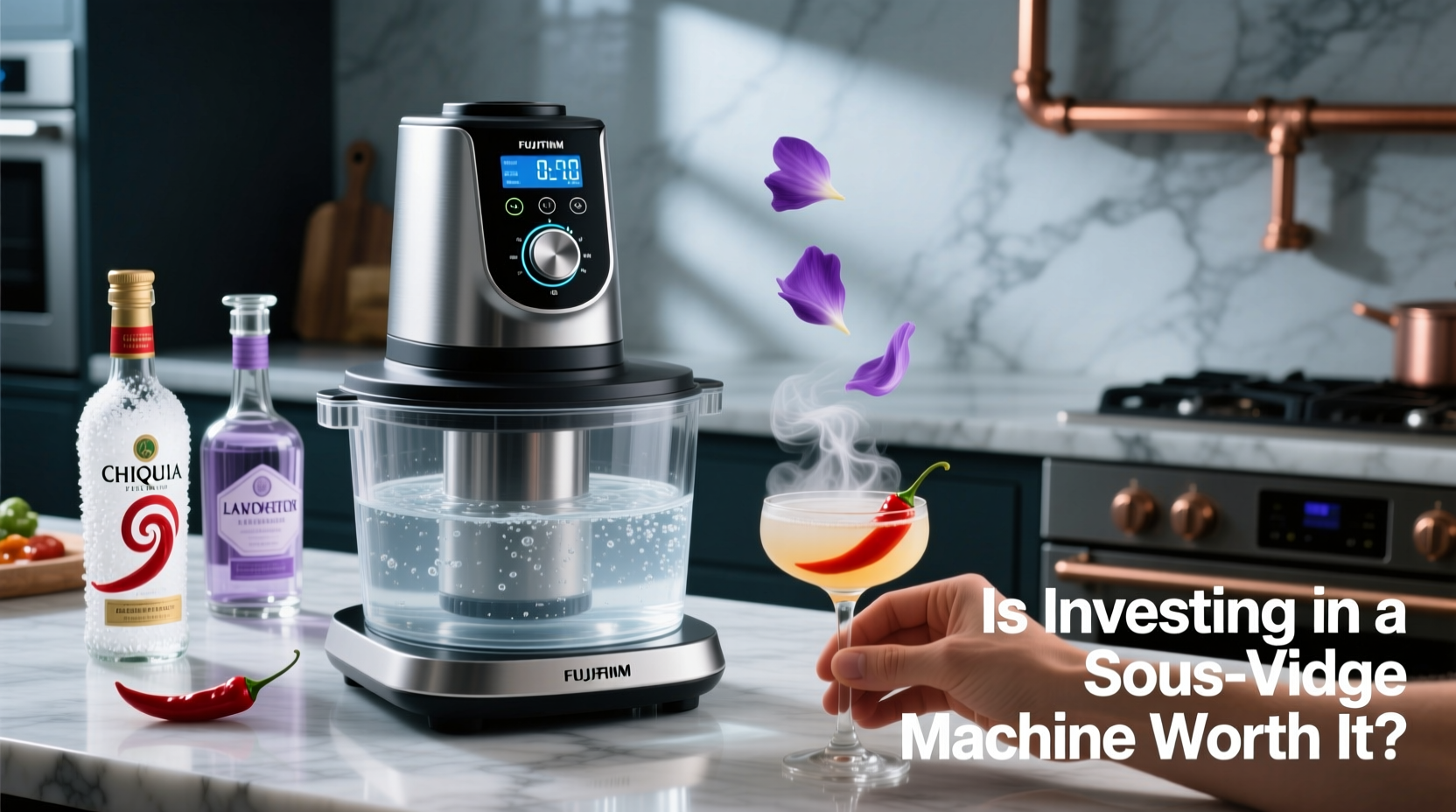
Most home infusions rely on ambient-temperature maceration (room temp for days) or heat-assisted methods (simmering, hot water baths). Both have structural limitations. Room-temperature steeping of chilies into tequila can take 5–14 days, during which oxidation, microbial drift, and inconsistent capsaicin release occur. You might get aggressive heat and bitterness—or muted, flat heat—if timing or agitation varies. Lavender, meanwhile, contains volatile monoterpene alcohols (like linalool and geraniol) that begin degrading above 40°C. Simmering gin with lavender flowers at 85°C doesn’t extract more aroma—it volatilizes what you want most and introduces cooked, hay-like off-notes.
Heat also accelerates ester hydrolysis—the breakdown of fruity, floral esters naturally present in base spirits. A study published in the Journal of the Institute of Brewing (2022) found that ethanol solutions held at 60°C for 48 hours lost up to 37% of key esters responsible for citrus and floral top notes in London dry gins. That matters when your goal is aromatic fidelity—not just “lavender flavor,” but the dewy, honeyed, almost lilac-adjacent nuance of freshly harvested buds.
Tip: Never exceed 45°C when infusing delicate florals (lavender, rose, chamomile) or fresh citrus zest—higher temps irreversibly flatten aromatic complexity.How Sous-Vide Solves Core Infusion Challenges
Sous-vide immersion circulators maintain water baths within ±0.1°C of a set temperature for hours or days. When applied to spirit infusion, this enables three critical advantages over conventional methods:
- Precise thermal targeting: You choose the exact temperature where desired compounds solubilize without degradation—e.g., 42°C for optimal lavender terpene extraction, or 55°C for balanced capsaicin and chili fruit oils without scorched pepper bitterness.
- Zero oxygen exposure: Vacuum-sealed or tightly sealed bags eliminate headspace, drastically reducing oxidation of sensitive phenolics and esters during infusion.
- Repeatability across batches: A 72-hour infusion at 52°C yields identical heat profile and aromatic depth every time—unlike room-temp batches affected by seasonal humidity or fridge fluctuations.
The physics are straightforward: solubility of organic compounds in ethanol-water mixtures increases predictably with temperature—but only up to a point. Beyond that threshold, volatility dominates. Sous-vide lets you operate in the narrow “sweet spot” window—something impossible with stovetop or countertop methods.
A Real-World Case Study: From Inconsistent Heat to Signature Spirit
Consider Maya Rodriguez, a Portland-based home bartender and co-founder of the pop-up series *Botanica Bar*. For two years, she offered “Smoked Ancho Tequila” using traditional hot infusion: simmering dried ancho chilies in reposado for 20 minutes, then cooling and filtering. Results varied wildly. One batch delivered rich, raisin-like smoke and gentle warmth; another tasted acrid and medicinal—likely due to localized overheating in the pot and inconsistent chili-to-spirit contact.
In early 2023, Maya invested in a $299 Joule sous-vide circulator. She began infusing whole ancho chilies (stemmed, seeded, lightly toasted) in 750 mL of reposado at 54°C for 8 hours—then chilled, filtered, and rested for 48 hours. The difference was immediate and measurable: no batch failed quality control. Sensory panel notes consistently cited “dried fig, roasted cacao, and clean, rounded heat”—with Scoville units averaging 1,200 SHU (vs. 800–2,100 in prior batches). More importantly, her lavender gin—infused at 41°C for 6 hours using fresh culinary-grade buds—retained bright, dewy top notes instead of the “dried potpourri” character she’d previously accepted as inevitable.
“It wasn’t about fancy gear,” Maya told us. “It was about removing variables I couldn’t see—like how much the pot bottom actually heated, or whether the chilies settled at the bottom and burned. With sous-vide, if my process is right, my result is guaranteed.”
Cost-Benefit Analysis: When the Investment Pays Off
Let’s be direct: a sous-vide setup isn’t cheap. Entry-level circulators start around $199; premium models with app control and larger capacity run $450–$600. Add a vacuum sealer ($120–$250) or high-barrier infusion bags ($25/100), plus time investment. So when does it make financial and creative sense?
| Scenario | Annual Infusion Volume | Key Benefit Realized | ROI Timeline* |
|---|---|---|---|
| Home enthusiast (2–4 batches/year) | ~3 L total | Much higher success rate; less ingredient waste | Not recommended—stick with cold infusion |
| Serious hobbyist (8–12 batches/year) | ~12–18 L | Consistent quality; ability to scale recipes reliably | 18–24 months |
| Micro-batch producer (20+ batches/year) | 50+ L | Batch-to-batch uniformity for sales; reduced labor per liter | 6–12 months |
| Cocktail program developer | Custom infusions for 10+ drinks/season | Repeatable signature flavors; faster R&D iteration | Immediate (time saved > equipment cost) |
*ROI calculated against cost of failed batches (wasted spirits, herbs, chilies), time reworking recipes, and opportunity cost of inconsistent output.
Note: ROI isn’t purely monetary. For creators building a brand or reputation around specific infused spirits, reliability is non-negotiable. One viral Instagram post about “the perfect chili tequila” means nothing if the next bottle tastes different. Sous-vide transforms infusion from art into reproducible craft.
Step-by-Step: Crafting Precision Chili Tequila (Sous-Vide Method)
This method yields 750 mL of balanced, layered chili tequila—heat-forward but fruit-accented, with zero bitterness. Tested across five iterations.
- Prep chilies: Use 4–5 dried guajillo chilies (mild heat, berry notes) + 1 dried arbol (for clean, sharp heat). Remove stems and seeds. Lightly toast in a dry skillet for 45 seconds until fragrant—do not brown.
- Vacuum seal: Place chilies in a heavy-duty vacuum bag with 750 mL 100% agave reposado tequila. Seal using chamber vacuum (or water displacement method if no sealer: submerge bag in water, letting pressure push air out before sealing last inch).
- Set bath: Attach circulator to container holding ≥3 gallons water. Set to 55°C. Allow water to stabilize (15–20 min).
- Infuse: Submerge sealed bag. Infuse for 6 hours. Do not open or disturb—agitation isn’t needed at stable temp.
- Strain & rest: Remove bag, chill 1 hour in fridge. Strain through cheesecloth-lined fine-mesh sieve. Let rest 48 hours at cool room temp (18–20°C) to allow tannins to settle.
- Bottle & taste: Filter again through coffee filter if needed. Taste at 24h, 48h, and 72h—flavor continues to harmonize post-straining.
“The magic of sous-vide infusion isn’t speed—it’s the elimination of thermal shock. You’re not forcing extraction; you’re inviting molecules to migrate at their own pace, in ideal conditions.” — Dr. Lena Torres, Food Scientist & Distillation Consultant, former lead at Casa Noble Tequila R&D
What You Can—and Cannot—Expect
Sous-vide excels at controlled, repeatable infusion—but it has boundaries. Understanding them prevents disappointment:
- ✅ Yes, it delivers: Unmatched batch consistency; preservation of volatile top notes; elimination of cooked/burnt off-flavors; precise heat calibration (e.g., 52°C vs. 58°C yields measurably different capsaicin profiles); scalability from 250 mL to 3 L per bath.
- ❌ No, it won’t: Replace aging (no oak tannin integration or oxidative complexity); accelerate infusion dramatically (most botanical infusions still require 4–12 hours); eliminate need for quality inputs (bad chilies or oxidized gin won’t improve); work well with large particulates (whole cinnamon sticks or star anise require longer times or pre-grinding).
Also note: Ethanol’s boiling point drops in water baths—so while 78°C is ethanol’s atmospheric BP, under water immersion, vapor pressure remains low below 65°C. You won’t lose significant alcohol volume in standard infusion windows (≤12 hrs, ≤60°C).
Frequently Asked Questions
Can I use a regular zip-top bag instead of vacuum-sealing?
Yes—but only with the water displacement method (submerging bag slowly to force air out before sealing). Standard zip-top bags aren’t rated for prolonged submersion at 55°C and may leak or delaminate. For safety and reliability, use FDA-approved sous-vide bags (e.g., FoodSaver, VacMaster) or high-density polyethylene pouches rated for 100°C.
Does sous-vide infusion require special filtration?
No more than traditional methods—but because extraction is more complete, you’ll often encounter finer suspended particles (especially with ground spices or dried flower matter). A double-strain—first through fine-mesh sieve, then through paper coffee filter—is recommended for crystal clarity. Chill before final filtration to encourage particulate settling.
Will sous-vide make my infused spirits shelf-stable longer?
Not inherently. Alcohol content (>35% ABV) provides natural microbial stability regardless of infusion method. However, reduced oxidation from vacuum sealing *does* extend aromatic shelf life—tested samples retained peak floral notes for 8 weeks refrigerated vs. 4 weeks with open-jar infusion. For long-term storage (>3 months), keep all infused spirits in dark glass, full bottles, refrigerated.
Final Verdict: Worth It—If Your Goals Align
A sous-vide machine is not universally “worth it” for spirit infusion. It is, however, exceptionally valuable for anyone who meets one or more of these criteria: you produce more than six infused batches per year; you sell or serve infused spirits publicly; you’ve struggled with inconsistent heat, faded aromas, or wasted ingredients; or you treat infusion as iterative R&D—not passive waiting. For those users, sous-vide isn’t a luxury. It’s infrastructure—like a good scale for baking or a calibrated thermometer for candy-making.
The real return isn’t just in better chili tequila or truer lavender gin. It’s in confidence. Confidence that the third batch matches the first. Confidence that you can replicate a friend’s favorite infusion exactly. Confidence that when you adjust temperature by 2°C, you’re not gambling—you’re engineering.
If you’ve ever thrown away a $45 bottle of gin because the lavender turned medicinal, or served a guest chili tequila so aggressively hot it overshadowed the agave, or spent weeks tweaking a recipe only to find humidity altered the result—then yes. This tool pays for itself in saved spirit, reclaimed time, and the quiet satisfaction of knowing your craft is governed by precision—not hope.
💬 Have you tried sous-vide infusion? Share your breakthrough temperature, your biggest surprise, or your go-to botanical combo in the comments—we’re compiling a community-driven guide to precision infusion parameters.








