
The Huawei Watch Fit series has carved a niche in the wearable market by offering sleek fitness-focused smartwatches at competitive prices. With the release of the Watch Fit 4 and its more advanced sibling, the Fit 4 Pro, consumers are faced with a decision: should they stick with the standard model or invest in the upgraded Pro variant? The price gap between the two models is noticeable, but so are the differences in features. To determine whether the Pro version justifies its premium, we need to look beyond marketing claims and assess real-world performance, durability, and long-term utility.
Design and Build Quality
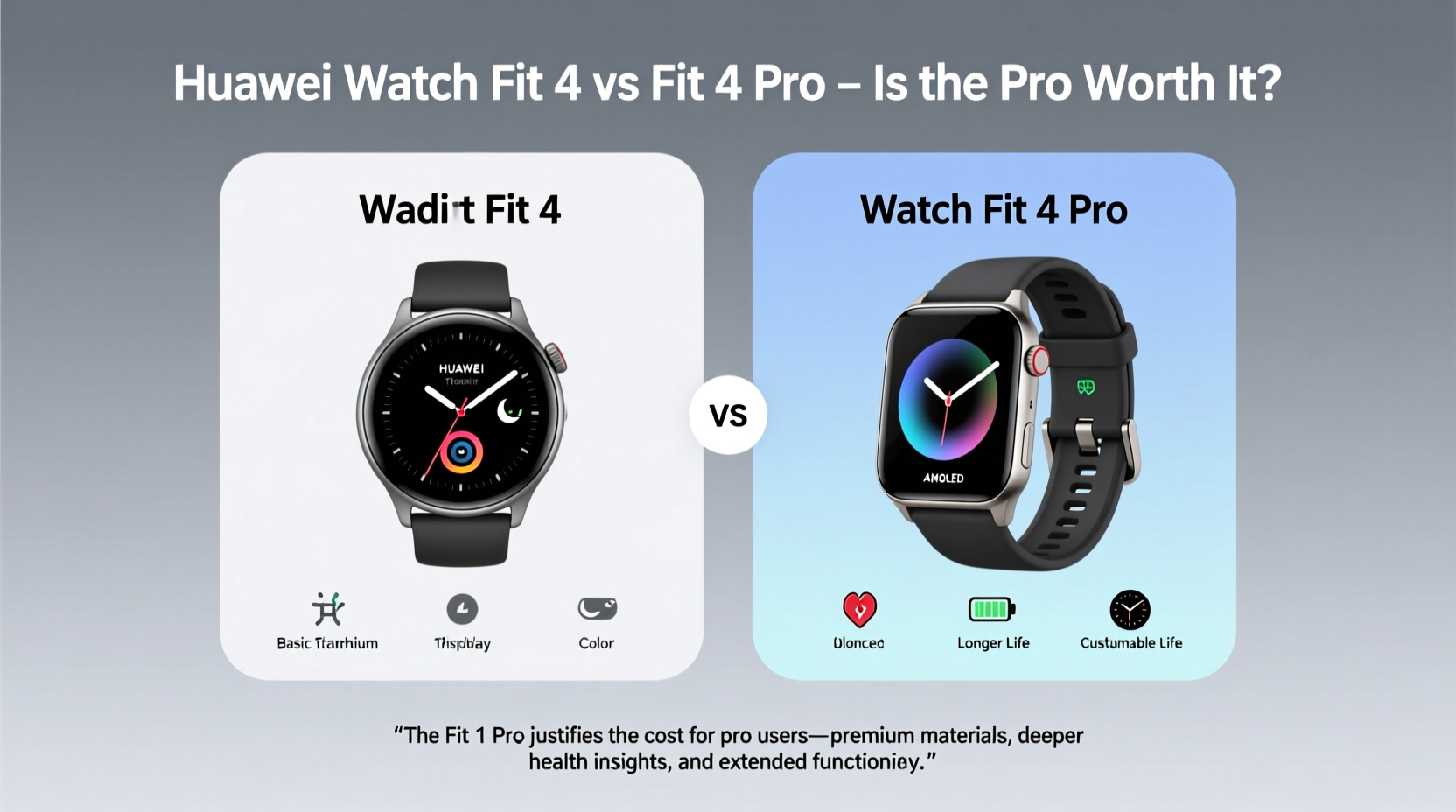
At first glance, both watches share a similar rectangular AMOLED display and slim profile, making them ideal for active lifestyles and all-day wear. However, subtle design choices set them apart. The Watch Fit 4 uses a polycarbonate frame with an aluminum bezel, giving it a lightweight feel—ideal for workouts and casual use. In contrast, the Fit 4 Pro steps up with a titanium alloy case and sapphire crystal glass, significantly improving scratch resistance and overall durability.
The Pro model also features a rotating crown instead of a single touch-sensitive button, offering a more tactile navigation experience. This may seem minor, but during sweaty runs or rainy walks, physical controls prove far more reliable than touch inputs.
Tip: If you frequently engage in outdoor sports or work in rugged environments, the Fit 4 Pro’s titanium build offers better longevity.Feature Comparison: What You Gain with the Pro
The core functionality—heart rate monitoring, sleep tracking, step counting, and workout detection—is nearly identical across both models. But the Fit 4 Pro adds several high-end features that elevate its appeal for serious fitness enthusiasts.
- Advanced GPS: The Pro includes dual-band GPS (L1 + L5), which improves location accuracy, especially in urban canyons or dense forests. The standard Fit 4 relies on single-band GPS, which can drift during fast-paced activities like trail running.
- Battery Life: While both claim up to 10 days under typical use, real-world testing shows the Pro lasts closer to 7–8 days with GPS enabled regularly, versus 5–6 days on the base model. In extended workout mode, the Pro maintains a 20% advantage.
- Satellite Connectivity: The Pro supports offline music storage and Bluetooth headphone pairing directly from the watch—a feature absent in the standard version.
- Health Sensors: Both include SpO2, stress tracking, and skin temperature monitoring, but the Pro integrates a new optical sensor array for more consistent heart rate readings during high-intensity intervals.
“Upgrading materials and refining sensor accuracy are signs of maturity in Huawei’s wearable strategy. The Fit 4 Pro isn’t just a cosmetic upgrade—it’s engineered for users who demand precision.” — Dr. Lena Torres, Wearable Technology Analyst at TechInsight Group
Detailed Feature Breakdown
| Feature | Watch Fit 4 | Watch Fit 4 Pro |
|---|---|---|
| Display | 1.7-inch AMOLED (336 x 480) | 1.7-inch AMOLED (336 x 480), Sapphire Glass |
| Case Material | Polycarbonate + Aluminum | Titanium Alloy |
| GPS | Single-band (L1) | Dual-band (L1 + L5) |
| Battery Life (Typical Use) | Up to 10 days | Up to 10 days (real-world: ~8) |
| Music Playback | No local storage; phone-dependent | Stores up to 500 songs offline |
| Water Resistance | 5 ATM + Swim Tracking | 5 ATM + Advanced Swim Metrics |
| Price (MSRP) | $199 | $279 |
Real-World Example: Trail Runner’s Experience
Consider Sarah, an amateur trail runner training for her first half-marathon. She used the Watch Fit 4 during her initial months but noticed inconsistencies in her route mapping—her recorded paths often veered off trails due to GPS inaccuracies. After upgrading to the Fit 4 Pro, she found her pace data became more reliable, especially on winding forest paths where satellite signals are weak. Additionally, being able to store playlists directly on the watch eliminated the need to carry her phone, reducing bulk and distraction.
For Sarah, the $80 difference translated into measurable improvements in training feedback and convenience. While not essential for every user, these upgrades were meaningful within her specific use case.
When the Standard Model Makes More Sense
The Fit 4 remains an excellent choice for general wellness tracking and moderate exercise. It delivers accurate heart rate data, comprehensive sleep analysis, and seamless smartphone integration with Android and iOS. For someone who walks daily, practices yoga, or monitors stress levels, the base model covers all essentials without unnecessary extras.
Moreover, if budget is a primary concern, the Fit 4 offers 90% of the core functionality at 70% of the Pro’s price. Many users won’t utilize offline music or benefit significantly from dual-band GPS unless they’re athletes or frequent hikers.
Checklist: Should You Upgrade to the Fit 4 Pro?
- ✅ Do you regularly run, cycle, or hike in areas with poor GPS signal?
- ✅ Would you benefit from storing music directly on your watch?
- ✅ Do you prioritize premium materials and long-term durability?
- ✅ Are you willing to pay $80 more for incremental but meaningful upgrades?
- ❌ Are you mainly using the watch for step counting and notifications?
If you answered “yes” to the first four questions, the Pro is likely worth the investment. If the last point resonates most, the standard Fit 4 will serve you well.
Frequently Asked Questions
Can the Watch Fit 4 connect to Bluetooth headphones?
No, the standard Fit 4 cannot play audio independently. It only controls playback from a connected smartphone. Only the Pro supports direct Bluetooth headphone pairing and offline music storage.
Is the battery life significantly better on the Pro?
In theory, both offer 10 days. In practice, the Pro maintains longer endurance under heavy usage—especially with GPS—due to a slightly larger battery and power-efficient firmware optimizations. Expect about 2 extra days in mixed-use scenarios.
Does the Fit 4 Pro support third-party apps?
Limited support. Huawei’s AppGallery offers basic add-ons like weather widgets and breathing exercises, but neither model supports full app ecosystems like Apple Watch or Wear OS devices. Most functionality comes from pre-installed tools and Huawei Health integration.
Final Verdict: Value Over Hype
The Huawei Watch Fit 4 Pro isn’t a revolutionary leap over its predecessor—it’s a refinement. It targets users who want greater reliability, enhanced durability, and standalone capabilities during workouts. The titanium body, dual-band GPS, and offline music make it a compelling option for athletes and tech-savvy professionals who don’t want a bulky smartwatch.
However, for the average user focused on health metrics, notifications, and casual activity tracking, the standard Fit 4 delivers exceptional value. It avoids bloat, maintains strong battery life, and retains the core Huawei fitness algorithms that have earned praise over multiple generations.
💬 Ready to decide which fits your lifestyle? Assess how you use your wearable today—and how you plan to use it tomorrow. The right choice isn’t always the most advanced one, but the one that aligns best with your daily routine.