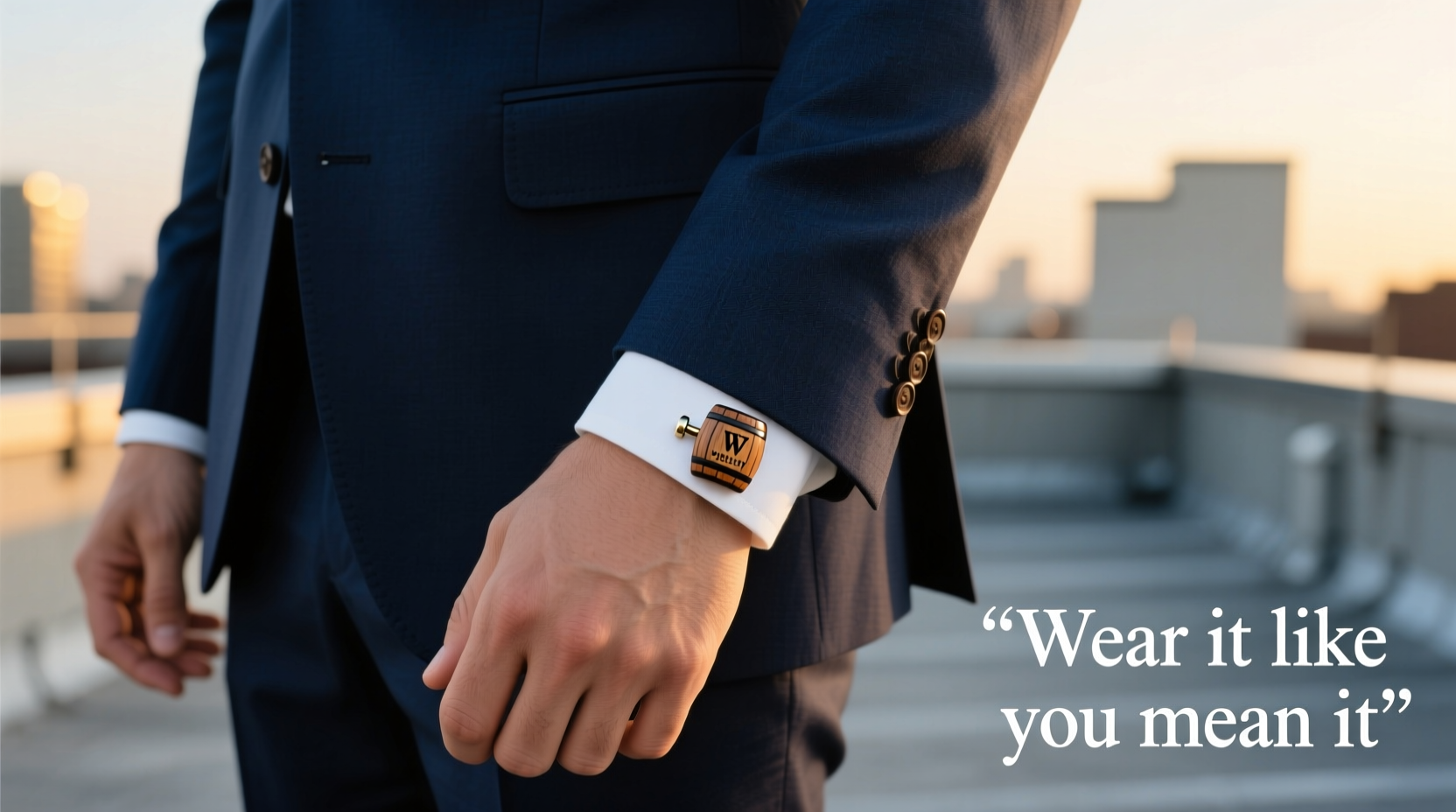
Whiskey barrel cufflinks—crafted from charred oak staves sourced from bourbon or Scotch casks—carry undeniable gravitas. They whisper of craftsmanship, time, and terroir. But they also carry risk: worn carelessly, they can tip from refined conversation starter to novelty costume piece. The line between “I appreciate artisanal heritage” and “I’m cosplaying as a Kentucky tour guide” is thinner than a copper still’s seam. This isn’t about rejecting the material—it’s about mastering its language. Barrel wood is dense, aromatic, and visually assertive. It demands context, restraint, and intentionality. Below are field-tested principles drawn from years of observing how seasoned professionals, bespoke tailors, and collectors integrate these pieces into serious wardrobes—without irony, apology, or barrel-shaped business cards.
The Material Reality: Why Barrel Wood Is Different
Unlike mother-of-pearl, onyx, or even brushed steel, whiskey barrel wood arrives with built-in narrative weight. Its surface bears visible charring (the “alligator char” essential for bourbon maturation), grain patterns intensified by heat and humidity cycles, and often subtle residual tannins that deepen in color over time. It’s not inert—it’s seasoned, literally and figuratively. That means it responds to light, skin oils, and ambient moisture. A 2023 study by the Scottish Whisky Association found that stave-sourced accessories retain measurable vanillin compounds for up to 18 months post-harvest, contributing to a faint, sweet-woody scent detectable at close range. This sensory layer adds dimension—but only when balanced. Overemphasize it, and you shift from elegance to exhibition.
“Barrel wood cufflinks succeed when they’re treated as heirloom-grade timber—not as branded merch. Their power lies in quiet provenance, not loud provenance.” — Fiona McLeod, Head of Accessories Design at Anderson & Sheppard, Savile Row
5 Non-Negotiable Styling Rules
These aren’t suggestions. They’re thresholds. Cross any one, and the risk of “distillery ad” perception rises sharply.
- One pair per ensemble—never more. No matching barrel-wood tie bar, pocket square corner, or lapel pin. Cufflinks are the punctuation, not the entire sentence.
- Wear them exclusively with formal or semi-formal shirts. Never with henleys, flannels, or denim. The shirt must have French cuffs and a structured collar (spread or cutaway preferred). A soft camp collar undermines the wood’s gravity.
- Anchor them with neutral, matte metals. Brass, oxidized silver, or gunmetal settings work. Polished gold or chrome? Too flashy. The wood should dominate the visual weight—not the hardware.
- Keep the rest of your accessories monochromatic and low-luster. Leather belts and shoes in oxblood, charcoal, or espresso—not burgundy patent or two-tone brogues. Watches with matte dials and leather straps, never metal bracelets.
- Avoid thematic reinforcement. No whiskey-themed pocket squares, no “Old Fashioned” enamel lapel pins, no Glencairn glass cufflink holders on your desk during meetings. Let the wood speak for itself.
What to Wear Them With: A Contextual Guide
Cufflinks live or die by their sartorial ecosystem. Below is a precise breakdown of compatible garments, ranked by confidence level. “High Confidence” means the pairing has been verified across multiple professional settings (boardrooms, gallery openings, diplomatic receptions) without triggering unintended associations.
| Garment | Confidence Level | Why It Works | Risk Factor |
|---|---|---|---|
| Midnight blue or charcoal wool suit + white cotton poplin shirt | High | Deep, cool tones recede; crisp white creates clean contrast for wood texture. Wool absorbs ambient light, preventing glare competition. | Low — only if shirt collar is stiff and cuffs precisely aligned. |
| Charcoal herringbone sport coat + ivory linen shirt (summer) | Medium-High | Linen’s natural slub echoes wood grain; ivory provides warmth without competing. Herringbone adds subtle movement, keeping focus on wrist detail. | Moderate — avoid if linen is overly rumpled or shirt has visible sweat marks. |
| Black tuxedo with pleated front shirt | Medium | Formal rigidity balances organic wood. Pleats add vertical rhythm that harmonizes with barrel stave lines. | Moderate — only with matte black horn or matte onyx studs elsewhere; no satin lapels. |
| Grey flannel trousers + navy cashmere sweater (no shirt) | Low | Sweaters lack cuff structure; French cuffs disappear under knitwear. Visual hierarchy collapses. | High — appears costumey and ill-considered. |
| Denim jacket + chambray shirt | Very Low | No shared language of formality or material integrity. Barrel wood reads as ironic prop, not intentional accent. | Very High — actively undermines credibility in most professional or creative contexts. |
Mini Case Study: The Edinburgh Architect
When architect Alistair Finch presented his award-winning restoration of the 1892 Leith Distillery warehouse, he wore a charcoal Donegal tweed suit, a white shirt with double cuffs, and cufflinks made from reclaimed staves of the very barrels once stored in that building. No one mistook him for marketing staff. Why? First, the wood was cut thin (1.8mm) and sealed with food-grade walnut oil—not glossy polyurethane—preserving tactile authenticity. Second, the settings were unpolished palladium, nearly invisible against the wood’s edge. Third, he carried no other whiskey-related item: his notebook was leather-bound in undyed calf, his pen was matte black titanium. Post-presentation, three clients commissioned him specifically because “those cufflinks told me he understood material memory—not just aesthetics.” His success wasn’t in the origin of the wood, but in his refusal to explain it. He let the context do the talking.
Your 7-Step Integration Timeline
Adopting barrel cufflinks meaningfully isn’t instant. It’s a calibration process. Follow this sequence over four weeks to build instinctive fluency.
- Week 1, Day 1–3: Wear them at home while reviewing documents or sketching. Observe how light hits the grain at different times of day. Note where reflections occur—and eliminate those angles in future wear.
- Week 1, Day 4–7: Pair them with your most neutral, well-fitting shirt and suit. Stand before a full-length mirror. Ask: “Does my eye go to my face first, then my hands—or straight to my wrists?” If wrists win, adjust collar height or cuff length.
- Week 2: Wear them to one low-stakes professional setting (e.g., internal team meeting). Pay attention to where colleagues’ eyes land during handshakes. Do they glance, pause, or linger? Lingering suggests imbalance.
- Week 3: Introduce one variable: swap your usual watch for a matte-dial model with a brown leather strap. Assess cohesion. Does the wood now feel integrated—or isolated?
- Week 4, Day 1–3: Wear them with a high-confidence ensemble (see table above) in a public, semi-formal setting (e.g., gallery opening, wine bar with linen napkins). No explanations. No anecdotes. Just presence.
- Week 4, Day 4–5: Photograph yourself in natural light, front and three-quarter profile. Crop tightly to shoulders and hands. Does the composition feel intentional—or like a product shot?
- Week 4, Day 6–7: Decide: Keep them in rotation, rotate them seasonally (barrel wood reads warmer in autumn/winter), or retire them. Honesty here prevents long-term misalignment.
FAQ: Real Questions from Discerning Clients
Can I wear whiskey barrel cufflinks with a patterned shirt?
Only if the pattern is micro-scale and tonal—think tiny charcoal pinstripes on white, or a barely-there houndstooth in slate grey. Anything larger than 1mm repeat competes with wood grain. Avoid checks, florals, or geometrics entirely. The wood needs breathing room, not visual counterpoint.
What if my cufflinks have visible branding—like a distillery logo laser-etched on the back?
Remove it. Permanently. A reputable jeweler can gently sand and re-oil the reverse side without affecting front integrity. Branding transforms an heirloom object into licensed merchandise. Provenance matters; advertising does not. As one master goldsmith in Speyside told us: “If the wood speaks, the logo shouts. One silences the other.”
How do I clean them without damaging the finish?
Never use alcohol, vinegar, or commercial jewelry cleaners. Dampen a 100% cotton swab with distilled water, squeeze out excess, and gently roll—not wipe—along the grain. Dry immediately with a lint-free cloth. Once quarterly, apply one drop of pure tung oil with fingertip pressure, then buff with microfiber. This replenishes natural oils lost to skin contact without buildup.
The Final Calibration: When Less Is Not Just More—It’s Essential
There’s a quiet confidence in knowing when not to wear something. Whiskey barrel cufflinks earn respect not through frequency, but through selectivity. They belong on days when your agenda requires grounded authority—contract negotiations, client presentations, jury duty, or delivering difficult feedback. They have no place on casual Fridays, Zoom calls where only your face is visible, or when you’re wearing anything with visible logos, slogans, or ironic graphics. Their strength is in their silence: the weight of oak aged in rickhouses, the patience of slow fermentation, the dignity of craft passed down generations. Wearing them well means honoring that lineage—not exploiting it for whimsy.
Think of them as the final, unspoken clause in your personal dress code: a commitment to materials with history, handled with humility. Not every outfit needs a story—but when you choose to tell one, make sure the wood does the speaking, and your judgment does the editing.
💬 Your turn. Have you worn barrel cufflinks in a way that surprised even you—with quiet impact, not cliché? Share your most unexpected success story in the comments. Let’s build a library of real-world wisdom—not marketing copy.