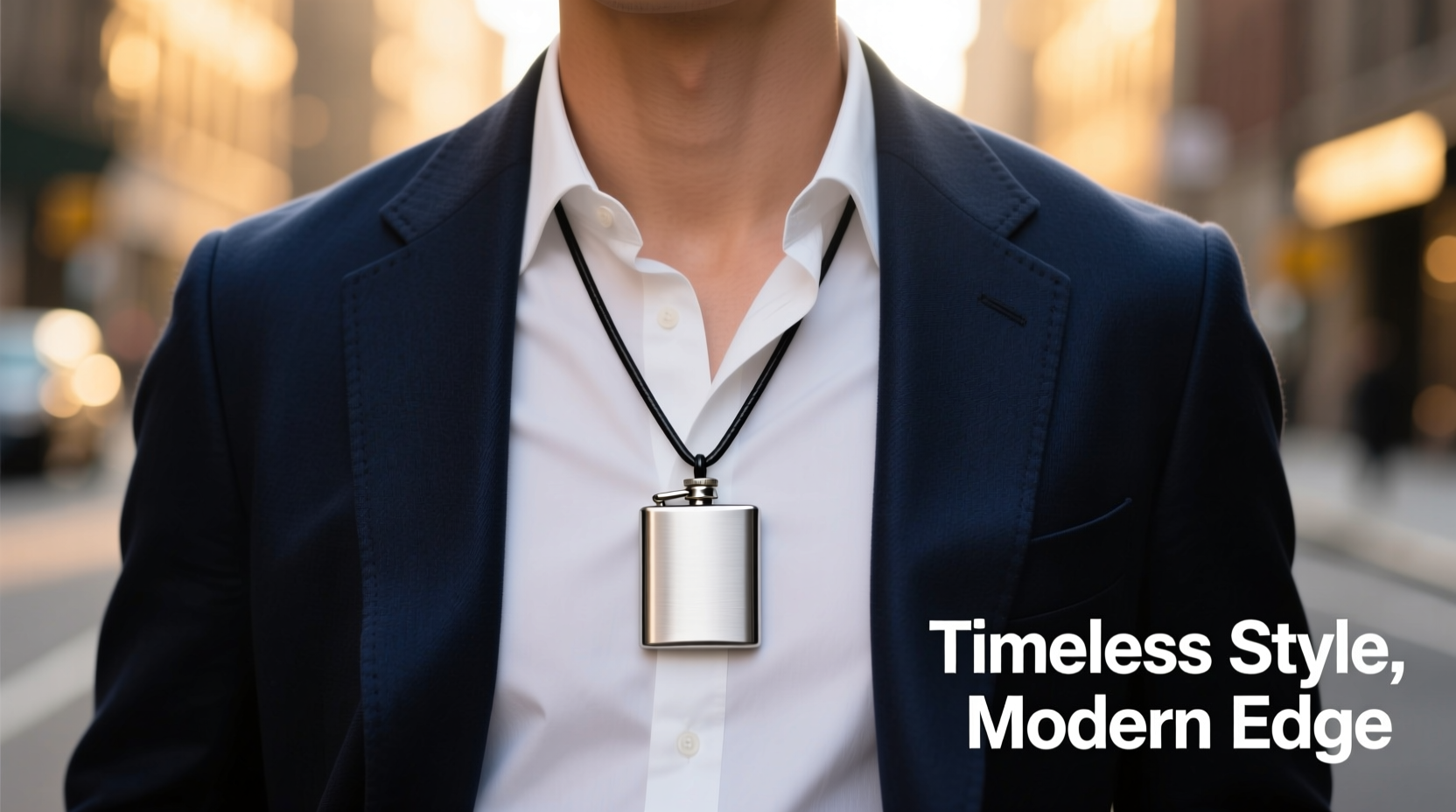
A flask pendant—once relegated to frat-house novelty or vintage costume jewelry—has quietly reemerged as a nuanced accessory in contemporary wardrobes. But its revival isn’t about irony or nostalgia alone. It’s about intentionality: choosing form, proportion, and context with the same care you’d apply to a well-cut blazer or a minimalist watch. The difference between looking like you’re wearing a prop versus a personal signature lies in three things: restraint, relevance, and refinement. This isn’t about hiding the flask—it’s about honoring its function while elevating its presence.
Why the Flask Pendant Deserves a Second Look
Historically, flask pendants served practical purposes: soldiers carried them for morale, travelers for convenience, and artisans for measured precision (think ink or spirit-based pigments). Today, they’ve evolved into hybrid objects—part utility, part heirloom, part quiet statement. Unlike mass-produced “novelty” jewelry, modern flask pendants are crafted in solid sterling silver, matte-finish titanium, or even ethically sourced recycled brass. Their appeal lies in authenticity—not theatricality. When worn deliberately, they signal self-awareness: an appreciation for ritual, craftsmanship, and understated utility.
But missteps are common. A bulky, chrome-plated flask dangling from a thin chain reads like a caricature. A mismatched chain length or clashing metal tone undermines cohesion. Worse, treating it as a standalone “conversation starter” rather than an integrated element of personal style invites dated associations—think 2000s-era ironic accessories or poorly curated steampunk cosplay.
Five Foundational Styling Principles
Styling a flask pendant successfully hinges on consistency—not trends. These principles anchor every decision:
- Proportion over prominence: The pendant should harmonize with your neckline, collar, and overall silhouette—not dominate it.
- Material continuity: Match metals to other visible hardware (watches, eyeglass frames, belt buckles) and avoid mixing brushed and polished finishes unless intentionally contrasted.
- Functional discretion: Refill discreetly; avoid overt handling or frequent unscrewing in public settings. Its utility is private, its presence is aesthetic.
- Contextual alignment: A matte-black titanium flask works seamlessly with tailored workwear or monochrome streetwear—but clashes with floral sundresses or formal black-tie attire.
- Ageless framing: Avoid motifs that date quickly—no engraved slogans, cartoonish silhouettes, or neon enamel fills. Opt instead for clean lines, subtle texture (e.g., hammered silver), or minimal engraving (a single initial, coordinates, or a meaningful date).
Step-by-Step: Building a Modern Flask Pendant Look
Follow this sequence—not as rigid rules, but as calibrated adjustments that build confidence and cohesion:
- Select your base outfit first. Begin with a neutral, structured foundation: a charcoal turtleneck, olive chore jacket, or ivory linen shirt. Let the flask enhance—not interrupt—the outfit’s rhythm.
- Choose chain length based on neckline.
- V-neck or open collar? Go 22–24 inches—pendant rests at mid-chest, anchoring vertical lines.
- Turtleneck or high collar? Stick to 16–18 inches—pendant rests just above the fabric edge, creating a subtle focal point.
- Layered look (e.g., undershirt + overshirt)? Use a 16-inch chain with a delicate curb link—keeps it visible but unobtrusive between layers.
- Match metal tones across accessories. If your watch case is rose gold, choose a warm-toned brass or gold-filled flask. If your eyeglass temples are gunmetal, opt for brushed stainless steel or matte titanium.
- Limit competing neckwear. Skip scarves, chokers, or layered chains when wearing the flask. One intentional piece > three competing elements.
- Refine the finish. Wipe the flask with a microfiber cloth before wearing. A slight sheen (not mirror polish) signals care without flashiness. For matte finishes, avoid abrasive cleaners—use only pH-neutral soap and water.
Do’s and Don’ts: A Practical Comparison
| Action | Do | Don’t |
|---|---|---|
| Chain selection | Use a 1.2–1.8mm cable or curb chain in matching metal; ensure clasp is secure and low-profile. | Pair with oversized rope chains, beaded strands, or mixed-metal multi-layer necklaces. |
| Flask size | Choose 25–35mm height; capacity 30–45ml balances utility and subtlety. | Select anything over 40mm or under 20mm—too bulky or too fragile-looking. |
| Engraving | Opt for single-line sans-serif font, placed on the back or base; limit to 6 characters (e.g., “JUL23”, “LXVII”). | Engrave full names, quotes, or decorative borders—these age poorly and distract from clean design. |
| Occasion pairing | Wear with smart-casual, utilitarian, or minimalist aesthetics: think wool trousers + oxford shoes, or wide-leg denim + leather sneakers. | Wear to formal galas, weddings (unless specified as “black-tie optional”), or corporate presentations where accessories are expected to be invisible. |
| Care routine | Rinse with lukewarm water after use; dry thoroughly; store flat in anti-tarnish pouch. | Leave filled overnight, submerge in alcohol-based cleaners, or store tangled with other jewelry. |
Real-World Example: Maya’s Transition from “Costume” to “Signature”
Maya, 34, a graphic designer in Portland, bought her first flask pendant—a polished stainless steel piece with a screw-top cap—as a gift for her 30th birthday. She wore it daily for two years but felt self-conscious: coworkers mistook it for a “joke,” and photos made her look costumed, not composed. She paused usage for six months, then revisited it with fresh criteria. She swapped the original 2mm box chain for a 1.4mm matte-finish curb chain in matching steel. She shortened it from 24\" to 18\", so it sat precisely at the hollow of her collarbone over crewnecks and fine-gauge merino sweaters. She refilled it only with cold-brew concentrate (never liquor in professional settings), and always wiped it down before meetings. Most importantly, she stopped explaining it. When asked, she’d say, “It’s my portable ritual—like carrying my favorite tea bag.” Within three months, colleagues began complimenting its “quiet confidence.” Last year, she gifted identical pendants—custom-engraved with latitude/longitude coordinates of meaningful places—to her two closest friends. No one called it kitschy. They called it hers.
“Accessories gain authority when they reflect habit, not hype. A flask pendant becomes timeless not because it’s antique, but because it’s used with consistency and quiet purpose.” — Lena Torres, Curator of Contemporary Adornment, Museum of Craft & Design
FAQ: Addressing Common Concerns
Can I wear a flask pendant if I don’t drink alcohol?
Absolutely—and increasingly, people don’t. Modern users fill theirs with cold brew, herbal tinctures, electrolyte mixes, or even essential oil blends (using food-grade carriers). The vessel’s value lies in its precision, portability, and tactile satisfaction—not its contents. Choose a flask with a leak-proof, child-safe cap and FDA-compliant interior lining regardless of what you carry.
Is it appropriate for professional environments?
Yes—if styled with discipline. In creative, tech, or academic fields, it reads as thoughtful individuality. In conservative finance or law, reserve it for casual Fridays or off-site events. Key indicators of appropriateness: no visible branding, no audible “click” when handling, and no scent transfer. When in doubt, observe senior colleagues’ accessory choices—especially those known for quiet influence, not loud statements.
How do I choose between screw-top and flip-top closures?
Screw-tops offer superior leak resistance and a cleaner silhouette—they’re ideal for daily wear and active lifestyles. Flip-tops provide faster access but often feature visible hinges or springs that disrupt minimalism. For style-first wearers, screw-top is the default recommendation. Ensure threads are stainless steel (not plated zinc) and test seal integrity by filling with water and inverting for 60 seconds before first use.
The Psychology of the Pendant: Beyond Aesthetics
What makes a flask pendant feel “current” isn’t its shape—it’s its relationship to the wearer’s values. In an era of digital saturation, tactile, analog objects carry weight. Carrying a small, measured amount of something meaningful—whether coffee, medicine, or ceremony—creates micro-moments of agency. That resonance translates visually: when an object serves real need, its presence feels grounded, not performative. Styling it well isn’t about masking function—it’s about clarifying it. You’re not wearing a flask *instead* of a necklace. You’re wearing a tool that has earned its place in your visual language through repetition, respect, and restraint.
This shifts the focus from “how do I make this look cool?” to “how does this align with how I move through the world?” A well-worn leather jacket gains character through creases; a flask pendant gains dignity through consistent, unhurried use. There’s no shortcut—only accumulation of small, deliberate choices.
Conclusion: Your Next Step Starts With One Intentional Choice
You don’t need to overhaul your wardrobe or adopt a new identity to wear a flask pendant with quiet authority. Begin with one adjustment: replace your current chain with one that matches your watch band’s metal tone and lengthens or shortens it to land exactly where your collarbone meets your sternum. Wear it three days this week—not as a statement, but as a habit. Notice how it feels against your skin, how light catches its curve, how little attention it draws when styled with coherence. That’s the pivot: from novelty to nuance, from accessory to extension of self.
Style endures not because it shouts, but because it settles—in the drape of fabric, the weight of metal, the rhythm of repeated gesture. Your flask pendant isn’t waiting for permission to belong. It’s waiting for you to claim it—not as a relic or a joke, but as a small, steady companion in your daily architecture.
💬 Have you reimagined a “dated” accessory into something deeply personal? Share your story—or your best flask-pendant styling hack—in the comments. Let’s build a library of real, human approaches—not trends, but truths.








