Silk scarves have long been a hallmark of effortless elegance. From Audrey Hepburn’s iconic looks to modern-day street style in Paris and Milan, the silk scarf remains a versatile accessory that transcends trends. Yet, many own one—or several—and rarely wear them, unsure how to integrate them into everyday outfits without appearing costumey or outdated. The truth is, when styled with intention, a silk scarf can elevate even the most basic ensemble, adding color, texture, and personality. Whether it’s winter layering or summer accessorizing, mastering the silk scarf isn’t about following rules—it’s about understanding rhythm, proportion, and context.
The Timeless Appeal of Silk Scarves
Silk, as a fabric, carries an inherent luxury. Its natural sheen, soft drape, and temperature-regulating properties make it ideal across seasons. Historically worn as head coverings, neck adornments, or bag accents, silk scarves today serve both functional and expressive roles. Designers like Hermès, Gucci, and vintage Chanel have turned scarves into collectible art, often featuring intricate prints that tell stories through pattern and palette.
Fashion insiders don’t treat scarves as mere accessories—they use them as punctuation marks in an outfit. A pop of floral print against a neutral coat, a nautical stripe knotted at the wrist, or a vintage paisley tied around a ponytail: each gesture signals confidence and attention to detail.
“Silk scarves are the jewelry of outerwear. They don’t just complement an outfit—they complete it.” — Camille Charrière, Fashion Editor & Style Influencer
Essential Scarf Styling Principles
Before diving into seasonal applications, understand the foundational elements of scarf styling:
- Scale matters: Larger scarves (90x90 cm or bigger) offer more versatility for draping and knotting; smaller ones (70x70 cm) work best for delicate neck ties or wrist accents.
- Pattern balance: Pair bold prints with solid colors. If your scarf has vivid florals, keep clothing minimal. Conversely, a plain silk scarf can be paired with textured or patterned garments.
- Knots define attitude: A loose knot reads relaxed; a tight bow feels polished. Avoid over-tightening, which can distort the fabric.
- Color coordination: Pull one secondary color from the scarf into your outfit—say, matching your shoes or earrings to a subtle green in the print—to create cohesion.
Seasonal Styling Strategies
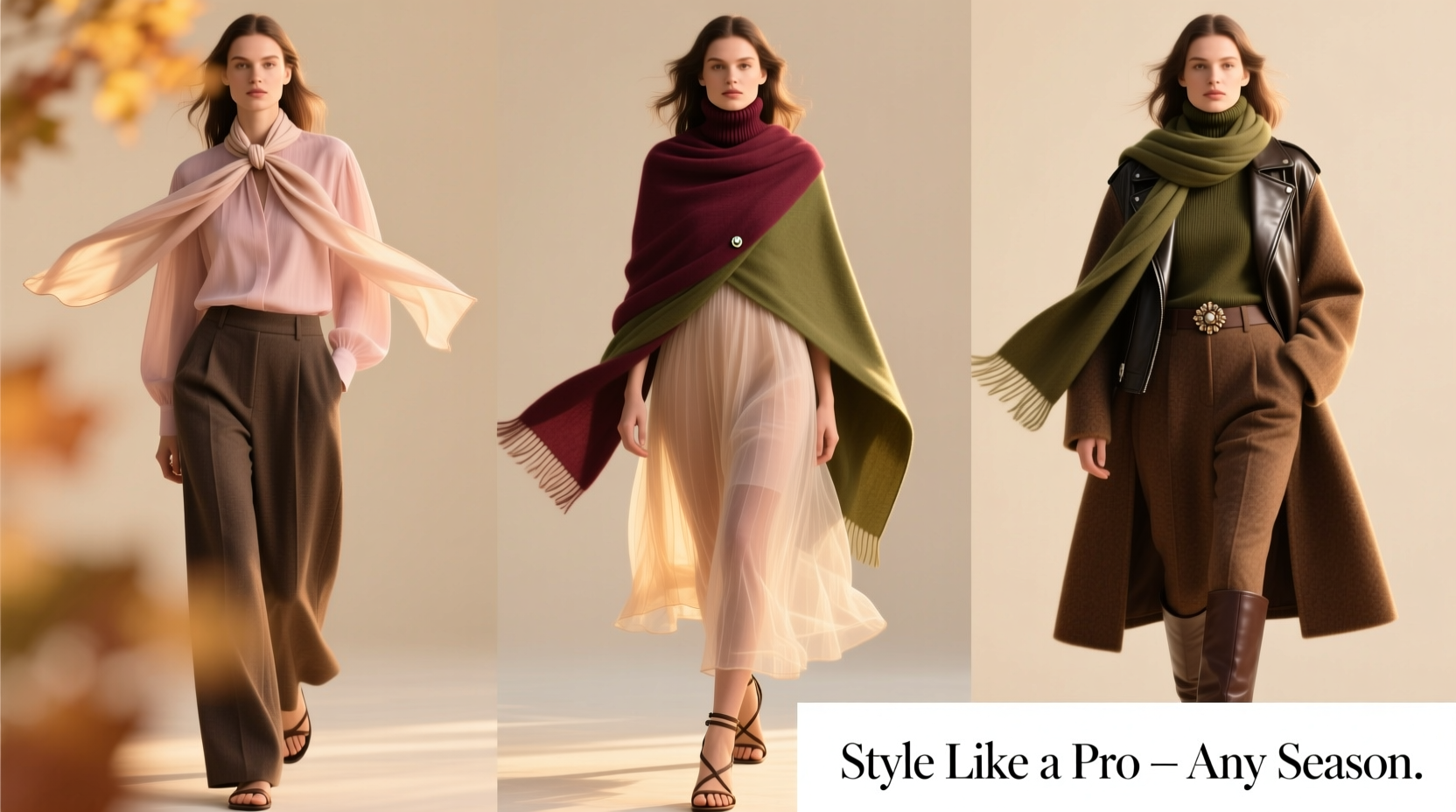
The beauty of silk lies in its adaptability. With slight adjustments in technique and placement, the same scarf can transition seamlessly from frosty mornings to humid afternoons.
Winter: Layering with Luxe Warmth
In colder months, silk scarves aren't meant to replace wool or cashmere but to enhance layered looks. Worn beneath a heavy coat or tucked into a turtleneck, silk adds a whisper of color and prevents neck chafing.
Try the “inner scarf” technique: fold a medium-sized square scarf diagonally and tie it loosely around the neck under a coat. Let the pointed ends drape down the front. This creates visual interest without bulk.
Another insider move: use a long rectangular scarf as a hair wrap under a hat. Fold it into a band, secure at the nape, and let the ends peek out. It protects hair while adding refinement.
Spring: Lightweight Elegance in Motion
As temperatures rise, silk shines in open-air settings. Drape a large square scarf over the shoulders like a shawl during transitional weather. Secure with a vintage brooch at one shoulder for asymmetry.
For daytime ease, try the “loop and tuck” at the neck: fold a long scarf lengthwise, loop around the neck, pull both ends through the loop, then tuck the excess inside your jacket or dress. It stays secure and looks effortlessly chic.
Summer: Breathable Color and Sun Protection
Silk’s natural breathability makes it surprisingly suitable for warm weather. Use it as a sun shield: tie a lightweight scarf around the head, covering ears and nape, in a retro-inspired turban or loose knot.
Wrap it around a topknot to absorb sweat while keeping hair off the face. Choose scarves with UV-resistant dyes—many high-end brands treat their silks for sun protection.
For beach-to-bar moments, drape a printed scarf over a simple linen dress. Knot it at one shoulder or belt it at the waist for definition.
Autumn: Texture and Transition
When layers begin piling on again, silk reintroduces vibrancy to darker wardrobes. Tie a paisley or abstract-print scarf around the handle of your tote or crossbody bag. Not only does this personalize your accessory, but it also protects leather from scratches.
Another fall favorite: the “belted scarf.” Take a large square, fold into a triangle, drape over the chest, and fasten with a slim belt at the waist over a trench coat or blazer. Instant structure and flair.
| Season | Best Scarf Size | Top Styling Move | Avoid |
|---|---|---|---|
| Winter | Medium-Large Square (90x90 cm) | Inner layer under coat | Wearing alone for warmth |
| Spring | Large Square or Long Rectangle | Shoulder drape or neck loop | Over-accessorizing |
| Summer | Lightweight Square or Bandana | Head wrap or hair accent | Tight knots causing tension |
| Autumn | Any size with rich prints | Bag charm or belted drape | Mixing too many patterns |
Step-by-Step Guide: The Classic Neck Knot (Parisian Style)
One of the most emulated yet misunderstood techniques is the French woman’s neck knot. It appears casual but requires precision. Follow these steps for authentic execution:
- Select your scarf: Use a 90x90 cm square in a mid-weight silk with a balanced print.
- Fold diagonally: Turn it into a triangle, then roll from the wide end toward the point until you achieve a 2–3 inch width.
- Position: Place the center of the rolled scarf at the back of your neck, letting equal lengths hang on each side.
- Knot once: Bring both ends to the front, cross them, and thread one end through the loop. Do not tighten fully.
- Adjust: Slide the knot slightly off-center to the left or right. Tug gently on the ends to loosen the knot and allow volume.
- Final touch: Fluff the ends so they frame your face naturally. The goal is asymmetry with effortlessness.
Unexpected Uses Beyond the Neck
True fashion insiders repurpose scarves in inventive ways that extend far beyond traditional wrapping.
- Bag accessory: Tie a small knot around the strap of a handbag or weave a long scarf through the handles for a personalized touch.
- Hair ribbon: Replace elastics with a thin silk strip. Braid it into a ponytail or use it to bind a low bun.
- Belt alternative: Loop a long scarf through belt loops and tie at the side for a soft waist definition.
- Top refashion: In summer, tie a large square at the bust and shoulders to create a halter top over a swimsuit or tank.
- Pocket accent: Fold a small scarf into a rectangle and tuck it into a blazer pocket like a pocket square.
“I once saw a woman in Florence tie her scarf around her wrist like a bracelet, then use it to wipe her sunglasses. Practical, poetic, perfect.” — Luca Moretti, Menswear & Accessory Designer
Mini Case Study: Anna’s Capsule Wardrobe Upgrade
Anna, a 38-year-old architect in Toronto, owned three silk scarves gifted over the years but wore them only twice. Her wardrobe was minimalist—mostly black, gray, and navy—with little variation. After consulting a stylist, she learned to use her scarves as “color anchors.”
She began by pairing a crimson-and-gold Hermès scarf with her charcoal wool coat. She used the classic neck knot, allowing the warm tones to contrast against the cool outerwear. Next, she wrapped the same scarf around her leather tote, tying it near the zipper pull. Finally, she experimented with tying it in her hair during spring meetings.
Within weeks, colleagues complimented her “new sense of polish.” The scarves didn’t change her clothes—they changed her presence. By rotating just three scarves across different roles, she created the illusion of a much larger wardrobe.
Care and Maintenance: Preserving Your Investment
Silk is durable but delicate. Improper care leads to snags, fading, and fraying. Follow these guidelines to maintain vibrancy and longevity:
- Hand wash in cold water with pH-neutral detergent or dry clean only if necessary.
- Never wring or twist—press water out gently between clean towels.
- Dry flat away from direct sunlight to prevent color degradation.
- Store folded in a drawer with tissue paper, not hung, to avoid stretching.
- Keep away from perfumes and hairsprays, which can stain silk.
Checklist: Mastering Silk Scarf Styling in 7 Steps
Use this checklist to build confidence and consistency:
- Invest in 1–2 high-quality silk scarves in versatile sizes (90x90 cm square and 90x180 cm rectangle).
- Learn at least two knot styles: the classic neck knot and the loop-and-tuck.
- Practice seasonal adaptations—layer in winter, air-light in summer.
- Experiment with non-traditional uses: bag wraps, hair ribbons, belts.
- Match one color from the scarf to another element in your outfit.
- Steam before wearing to restore drape and remove creases.
- Rotate and store properly to extend lifespan.
FAQ
Can I wear a silk scarf in the rain?
Silk absorbs moisture and can spot or warp when wet. While brief exposure isn’t catastrophic, avoid wearing silk scarves in heavy rain. If dampened, blot dry immediately and reshape before air drying.
How do I choose a scarf that suits my skin tone?
Warm undertones pair well with golds, corals, and deep reds. Cool undertones shine with sapphire, emerald, or rose pink. Neutral tones can carry both. Hold potential scarves near your face in natural light to test radiance.
Are vintage silk scarves safe to wear?
Yes, if stored well. Inspect for brittle fabric, holes, or musty smells. Gently steam and lay flat to assess integrity. Vintage scarves often have unique prints worth preserving and styling carefully.
Conclusion
Styling a silk scarf like a fashion insider isn’t about replicating runway looks—it’s about developing a personal rhythm with fabric, color, and movement. The most compelling style moments happen when a scarf feels like an extension of self: a flick of print at the collarbone, a whisper of pattern at the wrist, a burst of joy in an otherwise quiet outfit. These gestures don’t require money, only mindfulness.
Start with one scarf. Try one new knot. Wear it three different ways across the week. Notice how it changes your posture, your mood, the way people respond to you. Silk doesn’t shout—it suggests. And in suggestion lies true sophistication.
💬 Which scarf styling trick will you try first? Share your go-to look or a memory tied to a favorite scarf in the comments—let’s inspire each other to wear silk with confidence, all year round.