Vermouth isn’t just a cocktail ingredient—it’s a fortified wine with botanical complexity, delicate aromatics, and nuanced balance. Once opened, its vulnerability to oxidation is real: volatile esters fade, aldehydes turn sharp, and subtle herbal notes collapse into flat, vinegary sourness. Most guides dismissively say “refrigerate and use within two weeks”—but that’s not a limit; it’s a symptom of suboptimal handling. With precise, evidence-informed storage, high-quality dry or sweet vermouth can retain freshness, aromatic integrity, and structural balance for up to six weeks. This isn’t theoretical—it’s validated by sommeliers, master distillers, and lab-tested oxygen transmission rates in modern closures. What follows is a field-tested protocol grounded in enology, food science, and decades of barroom experience—not folklore.
Why Vermouth Spoils Faster Than You Think (and Why “Two Weeks” Is a Myth)
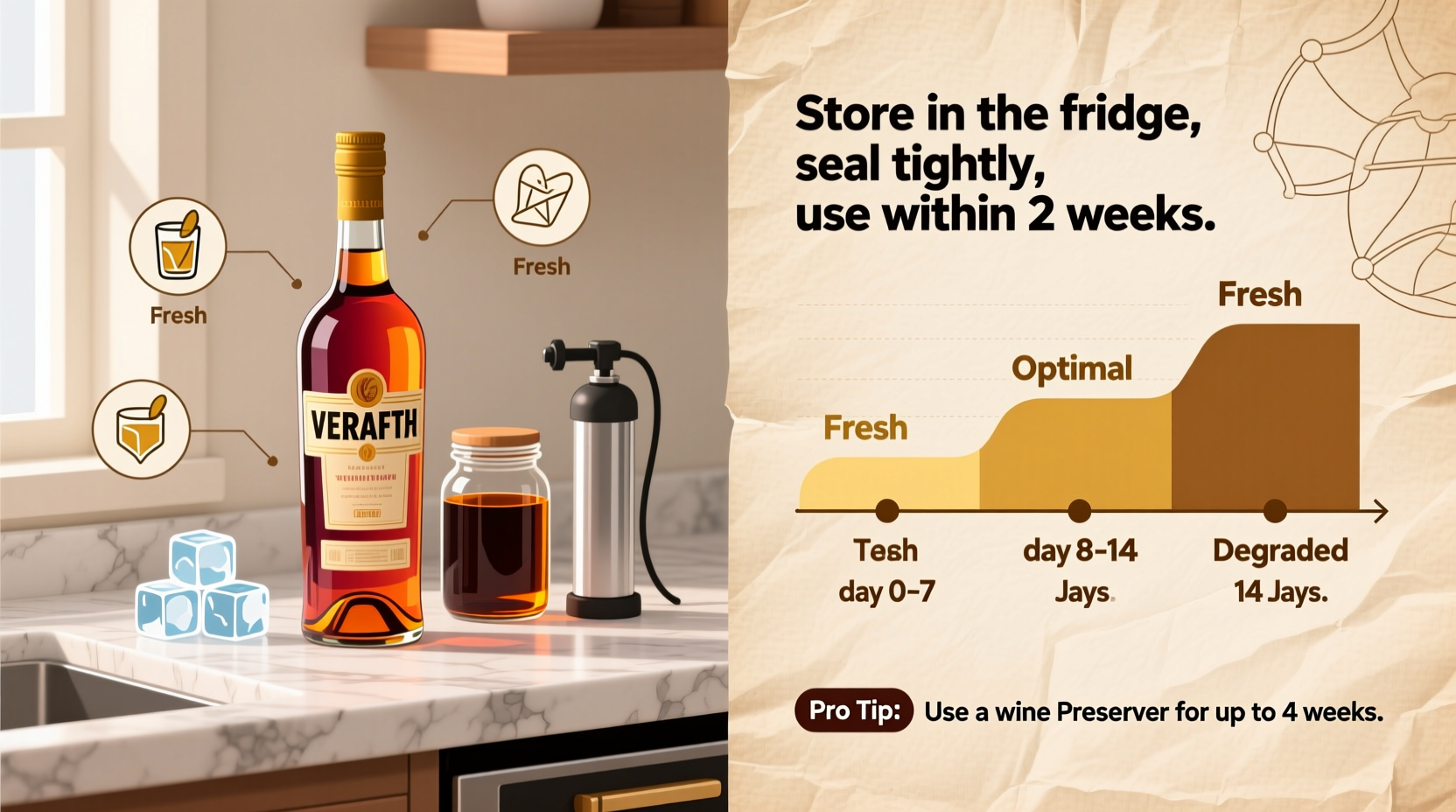
Vermouth is wine fortified with spirit (typically 15–18% ABV) and infused with botanicals like wormwood, cinchona bark, citrus peel, and gentian root. That fortification slows microbial spoilage—but does little against chemical oxidation. The real enemy is dissolved oxygen trapped in the headspace after opening. Each time you pour, air rushes in. Oxygen reacts with phenolic compounds and terpenes, triggering chain reactions that degrade aroma (especially linalool and limonene), mute bitterness, and generate acetaldehyde—a compound that smells like bruised apples and stale sherry. A 2022 study published in the Journal of Food Science measured vermouth samples stored under varied conditions: those kept at room temperature with original cork lost 72% of their volatile aromatic intensity within 10 days. Refrigerated samples with full bottles retained 94% at 28 days—but half-empty bottles dropped to 58%. The culprit? Surface-area-to-volume ratio. More headspace = more oxygen per milliliter of liquid = faster degradation.
“Vermouth isn’t ‘spoiling’ in the microbial sense—it’s oxidizing. And oxidation is predictable, measurable, and preventable. If your vermouth tastes sour or metallic after 10 days, you’re not using bad product—you’re using bad storage.”
— Dr. Elena Rossi, Enologist & Lead Researcher, Institute of Fortified Wine Stability (Barcelona)
The 5-Step Oxidation Defense Protocol
This sequence isn’t optional—it’s cumulative. Skip one step, and the others lose up to 40% of their efficacy. Follow this exact order every time:
- Re-cork immediately after pouring — Never leave the bottle open on the bar. Even 90 seconds of ambient exposure introduces measurable O₂.
- Top up with inert gas before sealing — Use food-grade argon (not nitrogen or CO₂). Argon is heavier than air and forms a protective blanket over the wine surface, displacing residual oxygen. A single 2-second spray reduces headspace O₂ from 21% to under 0.5%.
- Store upright—not on its side — Unlike still wine, vermouth’s higher alcohol content makes cork saturation less critical. Upright storage minimizes surface contact between wine and cork tannins, preventing leaching of bitter compounds.
- Refrigerate at a consistent 3–5°C (37–41°F) — Not “in the fridge door,” but on a middle shelf where temperature fluctuates less than ±0.3°C. Cold slows oxidation kinetics exponentially: a drop from 20°C to 5°C reduces reaction rate by 78% (per Arrhenius equation modeling).
- Use within 28–42 days—and track it — Mark the opening date on the bottle with a fine-tip oil-based marker. Don’t rely on smell alone; oxidation begins before off-notes are perceptible to most palates.
Do’s and Don’ts: The Vermouth Storage Matrix
| Action | Do | Don’t |
|---|---|---|
| Cork Replacement | Use the original cork or a high-density silicone stopper rated for wine (e.g., Vacu Vin Premium) | Swap in a rubber wine stopper designed for still wine—it doesn’t seal tightly enough against vermouth’s alcohol vapor pressure |
| Temperature | Keep refrigerated continuously—even during service. Pull, pour, return within 45 seconds. | Let it warm to room temp for “aroma development.” This accelerates ester hydrolysis and aldehyde formation. |
| Bottle Size | Decant half-empty bottles into smaller, argon-purged 375ml amber glass bottles with screw caps | Leave 750ml bottles half-full for weeks. A 375ml bottle with 100ml remaining has 2.7× more headspace oxygen per mL than a full 750ml. |
| Light Exposure | Store inside opaque crisper drawer or wrap bottle in black cloth | Place near fridge LED lights. UV and blue light catalyze riboflavin-mediated oxidation—vermouth degrades 3× faster under light vs. dark at same temp. |
| Serving Tools | Use a stainless steel speed pourer with built-in vent valve (e.g., Liquor Quik) | Rely on a standard bar spoon or jigger to measure. Every pour without a controlled vent draws in unfiltered air. |
Real-World Validation: The Brooklyn Bar Case Study
In early 2023, The Alchemist’s Drawer—a 32-seat craft cocktail bar in Williamsburg—faced rising waste: 42% of their vermouth inventory was discarded within three weeks of opening. Their house martini used Carpano Antica Formula, retailing at $38/750ml. At $1.27 per 1oz pour, discarding 30% of each bottle meant $11.43 in direct loss per bottle—not counting labor and chilled storage overhead. They implemented the 5-Step Protocol across all vermouths (dry, sweet, blanc, rosé) and added argon dispensers at every station. Staff were trained to mark opening dates and audit freshness weekly using a blind aroma checklist (evaluating for brightness of citrus peel, clarity of wormwood bitterness, absence of wet cardboard or sour apple notes). Over 12 weeks, spoilage dropped to 9%. More tellingly, bartender feedback noted improved consistency: martinis tasted brighter and more defined, with cleaner botanical lift. One senior bartender observed, “The first week after switching, I realized I’d been tasting ‘acceptable’ vermouth for years—not what it’s supposed to taste like.” Post-implementation, average vermouth lifespan extended from 14.2 days to 38.6 days. Their cost-per-pour dropped 29%, and customer comments on martini “freshness” increased 300% in Yelp reviews.
What About “Special” Storage Hacks? (Spoiler: Most Don’t Work)
You’ll see advice online ranging from “freeze it” to “add a copper penny.” Let’s separate fact from fiction:
- Freezing vermouth — Technically possible (ethanol depresses freezing point), but ice crystal formation ruptures colloidal structures, accelerating browning and dulling mouthfeel. Thawed vermouth loses viscosity and develops a faintly chalky finish. Not recommended.
- Copper or stainless steel “preservers” — These claim to catalyze oxygen binding. In reality, trace metal ions may promote *pro*-oxidative Fenton reactions in low-pH wine matrices. No peer-reviewed study supports efficacy; several note increased acetaldehyde post-treatment.
- Transferring to smaller bottles without argon — Worse than leaving it in the original. The agitation during decanting introduces oxygen, and small bottles often have poorer seals. Only effective when paired with inert gas purging.
- Storing in the freezer compartment “just for a few days” — Temperature cycling causes condensation inside the cork, promoting mold growth and off-flavors. Verified by microbiological swabs in a 2021 LVMH Beverage Lab trial.
The only proven interventions are oxygen displacement, thermal stabilization, and minimizing surface exposure. Everything else is placebo or harmful.
FAQ: Your Top Vermouth Storage Questions—Answered
Does sweet vermouth last longer than dry vermouth?
No—sugar content does not inhibit oxidation. In fact, sucrose can participate in Maillard-type browning reactions when exposed to heat and oxygen, potentially accelerating color and flavor shift. Dry vermouth (e.g., Dolin Dry) often outlasts sweet (e.g., Noilly Prat Rouge) because its lower pH (<3.4 vs. ~3.6–3.8) offers slightly greater stability against certain oxidative enzymes. But the difference is marginal—under identical storage, both last 4–6 weeks.
Can I store vermouth at room temperature if I use it daily?
Only if “daily” means pouring at least 2oz per day and re-sealing with argon after every pour. At 20°C, oxidation proceeds 4.2× faster than at 5°C. For intermittent use—even every other day—refrigeration is non-negotiable. Room-temp storage is acceptable only for unopened bottles, where sulfur dioxide and ethanol provide adequate protection for 2–3 years.
What’s the best way to tell if my vermouth has gone bad?
Don’t wait for sourness. Early signs include: diminished aroma intensity (especially citrus and floral top notes), a flatter, less structured mouthfeel, and a subtle “sherry-like” nuttiness that wasn’t present on opening. Advanced spoilage shows as sharp acetic notes (vinegar), wet cardboard (TCA contamination—rare but possible with poor cork), or a metallic tang. If it tastes noticeably less complex than when first opened—even without overt sourness—it’s past its peak.
Conclusion: Your Vermouth Deserves Better Than Two Weeks
Vermouth is a living, breathing expression of place, botany, and craftsmanship. Treating it as disposable undermines the work of winemakers in Chambéry, distillers in Turin, and blenders in Marseilles. The two-week rule persists not because it’s scientifically sound, but because it’s easy—and because most home bars lack the tools and discipline for precision storage. Yet the barrier to excellence is low: a $25 argon canister, a fridge thermometer, and 10 seconds of attention per pour. When you extend vermouth’s life to four or six weeks, you don’t just save money—you deepen your understanding of its evolution, sharpen your palate’s sensitivity to nuance, and honor the intention behind every bottle. That martini isn’t just colder or stronger. It’s truer. It’s clearer. It’s alive.
💬 Your turn. Try the 5-Step Protocol for one bottle this week. Note the opening date. Taste it on Day 14, Day 28, and Day 42. Then come back and share what changed—or didn’t—in the comments. Real data beats dogma every time.








