Designer scarves are more than just accessories—they're investments in elegance, craftsmanship, and timeless style. Whether it's a silk Hermès Carré, a wool-cashmere blend from Burberry, or a vibrant print from Gucci, these pieces command high prices for good reason. Unfortunately, their desirability also makes them prime targets for counterfeiters. Every year, consumers spend thousands on what they believe to be authentic luxury scarves—only to discover later that they’ve been sold convincing fakes.
Spotting a counterfeit isn’t always easy. Modern replicas can mimic logos, packaging, and even price points so closely that even seasoned shoppers get fooled. But with the right knowledge, you can protect your investment and wear with confidence. This guide walks you through the key indicators of authenticity, from fabric texture to label details, and gives you practical tools to verify what’s real—and what’s not.
Know the Brand’s Signature Traits
Each luxury brand has distinct design codes, materials, and production standards. Familiarizing yourself with these traits is the first line of defense against counterfeits.
For example:
- Hermès: Known for hand-rolled hems and perfectly aligned prints across the entire scarf surface. Their iconic \"H\" logo is never stamped—it's woven into the border.
- Burberry: Uses a tightly regulated tartan pattern (Nova Check) with precise color ratios. Authentic scarves feature clean, symmetrical checks and no bleeding at seams.
- Gucci: Often incorporates interlocking “GG” motifs or floral patterns with rich color saturation. The edges are typically finished with fine overlocking or hand-stitched hems.
Counterfeiters may replicate the overall look but often miss subtle nuances like thread count, dye consistency, or pattern alignment. A mismatch in any of these areas should raise red flags.
Tip: Visit the brand’s official website and study product images closely. Note font styles, logo placement, and fabric drape. Compare these details side-by-side when evaluating a potential purchase.Analyze the Fabric and Drape
The feel and fall of a scarf reveal more than photos ever can. Genuine designer scarves use premium materials—typically 100% mulberry silk, high-grade cashmere, or fine wool blends. These fabrics have a soft, smooth texture with a natural sheen and fluid drape.
Fake versions often substitute cheaper alternatives like polyester-silk blends or synthetic viscose. While they may look shiny under store lighting, they lack breathability and tend to feel stiff, plasticky, or overly slippery.
To test authenticity:
- Run your fingers across the surface. Real silk feels cool and slightly grippy—not slick or greasy.
- Hold the scarf up and let it fall naturally. Authentic scarves drape gracefully; fakes often hang awkwardly or crease sharply.
- Perform a “crinkle test”: Gently scrunch the fabric in your hand. Genuine silk will crumple softly and release quickly. Synthetic fibers retain folds longer and may produce static.
Some sellers claim their scarves are “high-quality replicas” made with “silk-like” fabric. Be wary—luxury brands don’t compromise on material integrity. If it’s not labeled as pure silk or the specified blend, assume it’s not authentic.
“Fabric tells the truth. No amount of printing can disguise low thread count or poor fiber quality.” — Clara Moretti, Textile Authentication Specialist
Inspect the Print and Pattern Alignment
Luxury scarves undergo precise printing processes to ensure crisp, vibrant designs. Misaligned patterns, blurred edges, or inconsistent colors are telltale signs of mass-produced fakes.
Take the Hermès Carré, for instance—a 90 cm square scarf where the central motif must align perfectly with the corners and borders. In an authentic piece, the image flows seamlessly across the fabric. Counterfeits often shift the print off-center or stretch it unevenly to fit the dimensions.
Check for:
- Consistent color saturation (no patchy areas)
- Crisp lines and defined edges in intricate details
- Symmetry in repeating patterns (especially along borders)
- Registration accuracy—does the front match the back when held to light?
| Feature | Authentic Scarf | Fake Scarf |
|---|---|---|
| Print Clarity | Sharp, detailed, no pixelation | Blurred, smudged, or fuzzy |
| Color Consistency | Even dye, true to brand palette | Inconsistent shades, oversaturated or dull |
| Pattern Alignment | Perfectly centered and mirrored | Misaligned, cropped, or skewed |
| Edge-to-Edge Match | Design continues smoothly | Gaps or abrupt cutoffs |
Examine Stitching, Hemming, and Finishing
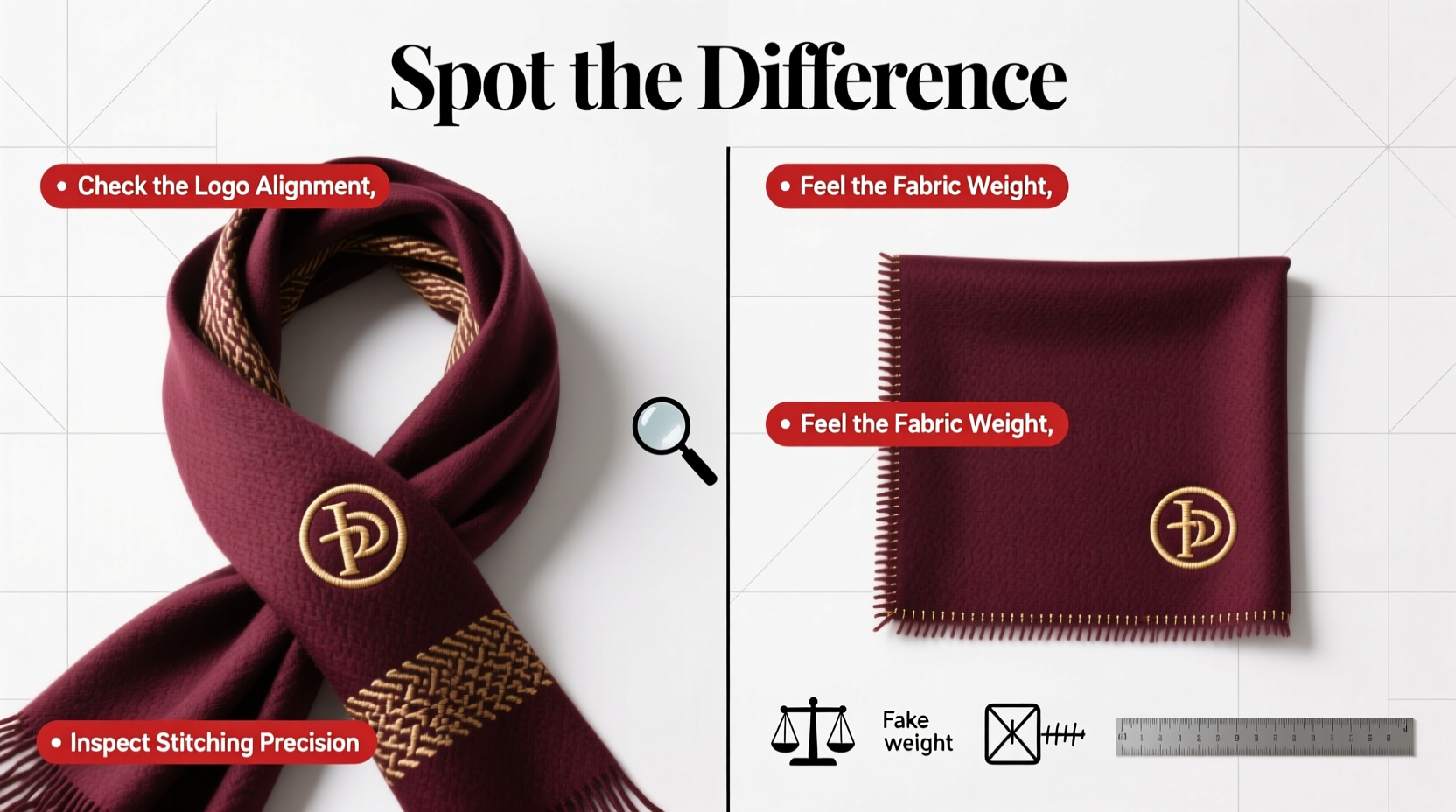
Hand-rolled hems are a hallmark of high-end scarves, particularly from French and Italian houses. These delicate edges are rolled manually using fine thread and take hours to complete. They result in a soft, rounded border that doesn’t flatten under pressure.
Machine-stitched hems, by contrast, are straight, rigid, and often double-folded. While some authentic scarves do use machine finishing (especially wool styles), hand-rolling remains a gold standard for silk pieces.
Other signs of quality include:
- Even, tight stitches with no loose threads
- No visible glue residue along edges
- Smooth transitions between printed zones and blank borders
- Consistent thickness throughout the scarf
Fakes frequently exhibit crooked stitching, fraying threads, or glue spots used to secure unraveling fabric. Some even apply fake “hand-rolled” texture by twisting the edge with heat tools—a technique easily exposed upon close inspection.
Step-by-Step: How to Inspect the Hem
- Pinch the edge gently between thumb and forefinger.
- Roll it slightly—if it bends smoothly into a tube, it may be hand-finished.
- Look under magnification: hand-rolled hems show irregular, organic stitching; machine work is uniform and robotic.
- Press lightly: if the hem flattens permanently, it’s likely glued or poorly constructed.
“At Hermès, each scarf hem takes a skilled artisan 30 minutes to roll and stitch. You can’t rush that kind of craftsmanship.” — Luc Bernard, Former Atelier Technician
Verify Labels, Tags, and Packaging
Authentic designer scarves come with specific labeling that includes care instructions, fiber content, country of manufacture, and sometimes a unique serial number. These tags are usually sewn in discreetly and made from soft cotton or silk ribbon—not plastic or cardboard.
Common red flags:
- Spelling errors (“Silk” spelled “Slik”)
- Vague wording like “Made in Asia” instead of “Made in France/Italy/Scotland”
- Fonts that don’t match the brand’s official typeface
- Overly large or garish branding on tags
Packaging is another clue. Hermès scarves arrive in signature orange boxes with tissue paper and a branded sticker. Burberry uses navy blue boxes with gold foil lettering. Fakes often skimp on packaging or use flimsy substitutes.
Also beware of missing certificates of authenticity. While not all brands include them, many limited editions or high-value items do. If a seller claims a certificate was “lost,” treat that as a warning sign.
Checklist: Quick Authentication Steps
Before You Buy:- Research the exact model online via the brand’s official site.
- Ask for high-resolution photos of the front, back, hem, and label.
- Request a video showing drape and movement.
- Verify the seller’s return policy and reputation.
- Compare price: if it’s significantly below retail, suspect foul play.
Real Example: The $500 Hermès That Wasn’t
Jessica, a fashion enthusiast from Chicago, found what appeared to be a vintage Hermès “Brides de Gala” scarf on a popular resale platform. Listed at $500—less than half retail—the seller claimed it was a gift from Paris and included original packaging.
She requested photos and noticed two issues: the print didn’t align at the corners, and the hem looked too uniform. She sent the images to a third-party authenticator who confirmed her suspicions: the scarf had been printed on polyester, machine-hemmed, and came with a replica box purchased separately.
Though disappointed, Jessica avoided a costly mistake. “I almost bought it because the photos looked great,” she said. “But once I learned about pattern alignment, it was obvious.”
Her experience underscores a critical point: emotional appeal can cloud judgment. Always prioritize objective verification over desire.
When in Doubt, Use Professional Authentication
If you’re uncertain about a scarf’s authenticity—especially with high-value purchases—third-party verification services offer peace of mind. Companies like Entrupy, Vestiaire Collective, and FashionPhile employ experts trained in luxury textile analysis.
These platforms typically require:
- Clear macro photos of the fabric, hem, and label
- Video footage showing texture and drape
- Detailed information about purchase source
Many charge a small fee (usually $20–$50), which pales in comparison to the cost of a counterfeit. Some even provide insurance-backed certificates accepted by resellers and auction houses.
Keep in mind: no AI tool or app can fully replace human expertise, especially with nuanced textiles. Avoid free “instant authentication” apps—they often rely on image matching and can be easily fooled by high-quality fakes.
Frequently Asked Questions
Can a fake scarf still be high quality?
Yes, some replicas use decent materials and printing techniques. However, they lack provenance, ethical production, and long-term value. Even if well-made, a fake won’t appreciate in worth and may degrade faster due to inferior finishing.
Do all designer scarves have labels?
Most do, but not all. Vintage pieces or limited editions may have minimal branding. In such cases, focus on construction, fabric, and provenance. Absence of a label isn’t automatic proof of a fake—but it warrants deeper scrutiny.
Is it safe to buy designer scarves from online marketplaces?
It can be, provided you follow strict verification steps. Stick to sellers with strong ratings, clear return policies, and willingness to provide detailed media. When buying rare or expensive items, opt for platforms with built-in authentication.
Final Thoughts: Confidence Starts with Knowledge
A genuine designer scarf is more than a fashion statement—it’s a piece of artistry, heritage, and meticulous craftsmanship. Protecting yourself from counterfeits isn’t about suspicion; it’s about respect—for the artisans who make these pieces, for the brands that uphold standards, and for your own discernment as a consumer.
You don’t need a degree in fashion to spot a fake. With attention to fabric, print, stitching, and provenance, you can navigate the market with confidence. Remember: authenticity isn’t hidden in logos alone. It lives in the details—the way the silk catches light, the whisper of a hand-rolled hem, the perfect symmetry of a centuries-old pattern.
💬 Have you ever spotted a fake—or narrowly avoided one? Share your story in the comments and help others stay vigilant in the world of luxury fashion.