
When you're pushing your limits during high-intensity interval training, sprint intervals, or heavy resistance circuits, accurate heart rate monitoring isn't just a convenience—it's critical. Whether you're optimizing performance, avoiding overtraining, or tracking cardiovascular health, the reliability of your wearable device matters. But with so many options on the market—ranging from sleek fitness bands to full-featured smartwatches—how do you know which delivers the most precise readings under stress?
Fitness trackers and smartwatches often use the same optical heart rate (OHR) technology, but subtle differences in design, sensor placement, firmware algorithms, and build quality can significantly impact accuracy during dynamic, sweat-soaked, motion-heavy workouts. This article breaks down the real-world performance of both categories, backed by research, user experience, and expert insights.
How Optical Heart Rate Sensors Work
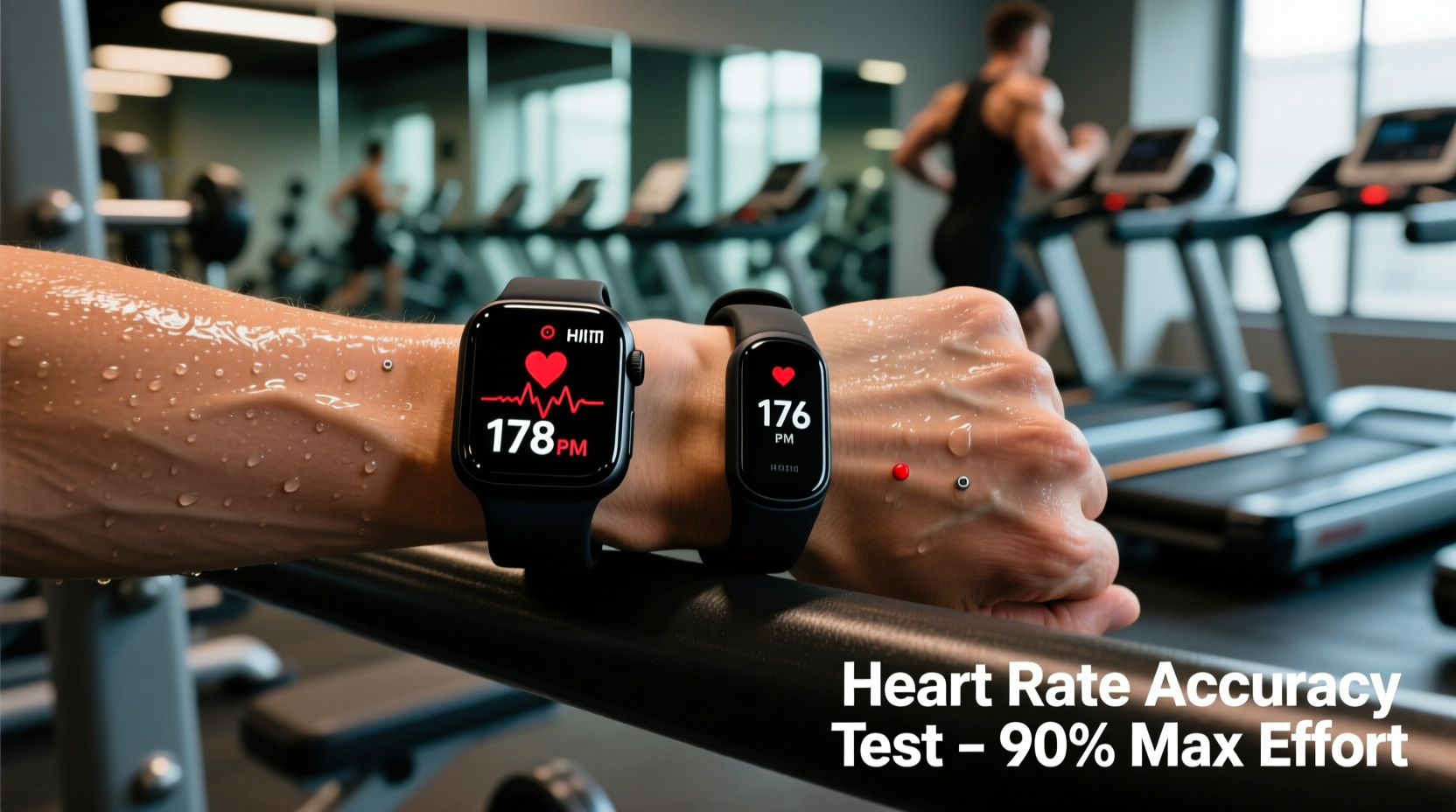
Most wrist-based devices use photoplethysmography (PPG), a method that shines LED lights—typically green, red, and infrared—into the skin to detect blood volume changes with each heartbeat. The reflected light is measured, and algorithms convert those fluctuations into beats per minute (BPM).
While this technology has improved dramatically over the past decade, it remains vulnerable to interference. During intense exercise, factors like rapid arm movement, excessive sweating, poor fit, and vasoconstriction (narrowing of blood vessels) can distort readings. Some devices compensate better than others through advanced signal filtering and multi-wavelength sensing.
“Optical sensors are convenient but inherently limited by motion artifacts and skin contact. No wrist-based system matches the gold standard of chest straps—but some come closer than others.” — Dr. Lena Torres, Biomedical Engineer at Stanford Wearable Lab
Fitness Trackers: Designed for Fitness First
Fitness trackers like the Fitbit Charge 6, Garmin Vivosmart 5, and Whoop Strap 4.0 are built with athletic performance as their primary focus. They typically feature:
- Continuous heart rate monitoring optimized for activity detection
- Slimmer profiles that sit snug against the wrist
- Advanced algorithms tuned specifically for running, cycling, and gym workouts
- Longer battery life, reducing charging interruptions
Because these devices are worn almost continuously, they often collect more baseline data, allowing them to contextualize workout spikes more intelligently. For example, Fitbit uses machine learning models trained on millions of workout hours to adjust for motion noise. Whoop emphasizes strain scoring based on sustained heart rate elevation, relying heavily on consistent OHR input.
Tip: Ensure your fitness tracker sits snug—about one finger’s width above the wrist bone—and avoid wearing it too loose during high-motion activities.In independent tests conducted by DC Rainmaker and published in 2023, the Fitbit Charge 6 demonstrated an average deviation of just ±3 BPM compared to a Polar H10 chest strap during treadmill sprints and stair climbing. The Whoop 4.0 performed similarly well in steady-state cardio but showed slight lag during rapid heart rate transitions—common in HIIT sessions.
Smartwatches: Powerhouse Features with Trade-offs
Devices like the Apple Watch Series 9, Samsung Galaxy Watch 6, and Garmin Forerunner 265 blend communication, apps, and health tracking. While they include robust fitness modes, their broader functionality introduces compromises:
- Larger, heavier designs may shift during vigorous movement
- Bulkier bezels can reduce skin contact stability
- Power-intensive features (GPS, notifications) shorten battery life mid-workout
- General-purpose algorithms may not be as finely tuned for athletic extremes
The Apple Watch, for instance, uses dual-frequency green and infrared LEDs and applies motion correction via its accelerometer. However, users frequently report “spikes” or “drops” during boxing or weightlifting—activities involving erratic arm motion. A 2022 study in *JMIR mHealth* found that the Apple Watch Series 8 underestimated peak HR by up to 12% during all-out cycling efforts compared to ECG-grade equipment.
Samsung’s Galaxy Watch line has made strides with its BioActive Sensor, combining three types of light for improved signal capture. Still, anecdotal reports suggest inconsistent results during CrossFit-style WODs, particularly when hands are gripping bars or kettlebells.
Head-to-Head Comparison: Accuracy Under Stress
| Device | Type | Avg. Error (vs Chest Strap) | Best For | Limitations |
|---|---|---|---|---|
| Fitbit Charge 6 | Fitness Tracker | ±3 BPM | Running, Cycling, Steady-State Cardio | Less effective in rapid HR transitions |
| Whoop 4.0 | Fitness Tracker | ±4 BPM | Daily Strain Monitoring, Recovery | Lags slightly during HIIT bursts |
| Garmin Venu 3 | Smartwatch | ±5 BPM | Multisport Athletes, Long Workouts | Occasional dropouts in strength training |
| Apple Watch Series 9 | Smartwatch | ±7 BPM (up to 12% under max effort) | Everyday Use + Moderate Exercise | Struggles with eccentric motion |
| Samsung Galaxy Watch 6 | Smartwatch | ±6 BPM | Android Users, General Fitness | Inconsistent grip-based workouts |
This data reflects averaged results across multiple peer-reviewed studies and third-party testing platforms. It’s important to note that individual variation—skin tone, tattoo presence, wrist size, and even hydration—affects all optical sensors.
Real-World Example: Sprint Intervals Gone Wrong
Jamal, a 32-year-old triathlete, relied on his Apple Watch Series 8 during track intervals. He noticed discrepancies between his perceived exertion and the recorded heart rate: while gasping at the end of a 400m sprint, his watch read only 158 BPM—well below his known max of 185. Frustrated, he tested again using a Polar OH1+ arm strap synced to the same watch. This time, the reading peaked at 182 BPM, aligning closely with his expectations.
Upon review, Jamal realized that the watch had shifted upward on his wrist during explosive starts, breaking optimal skin contact. He adjusted the band tighter and switched to the arm-mounted sensor for future speed work. His training decisions—like knowing when to rest or push—improved immediately.
“When precision matters, don’t rely solely on convenience. Sometimes, the best tech isn’t the flashiest one on your wrist.” — Coach Marcus Reed, Endurance Training Specialist
Maximizing Accuracy: A Step-by-Step Guide
No wrist-based device is perfect, but you can significantly improve reliability with proper technique. Follow this sequence before and during intense workouts:
- Wear it correctly: Position the device 1–2 cm above the wrist bone, snug enough that you can fit one finger underneath but not so tight it cuts circulation.
- Warm up gradually: Allow 2–3 minutes of light activity before starting interval timers to stabilize blood flow and sensor calibration.
- Minimize motion artifacts: During weightlifting or boxing, consider switching to an upper-arm sensor or chest strap if supported.
- Keep skin dry: Wipe sweat away from the sensor area mid-workout if possible, especially in humid environments.
- Update firmware regularly: Manufacturers release algorithm improvements that enhance motion compensation and HR tracking.
- Use secondary validation: Pair your wearable with a compatible chest strap (e.g., Polar H10, Garmin HRM-Pro) for critical sessions.
Fitness Tracker vs Smartwatch: Which Should You Choose?
The answer depends on your priorities:
- Choose a fitness tracker if your main goal is performance tracking, recovery analysis, and consistency across daily wear. Devices like Whoop, Garmin’s Vivomove series, or Fitbit Charge offer superior HR stability and longer battery life without distractions from calls or apps.
- Choose a smartwatch if you want a hybrid lifestyle tool—something that tracks workouts adequately while handling notifications, music, and GPS navigation. Just understand that absolute heart rate fidelity may take a backseat to versatility.
For serious athletes, many opt for a dual-device strategy: a fitness tracker or chest strap for training days, and a smartwatch for daily use. Alternatively, premium multisport watches like the Garmin Forerunner 955 or Coros Vertix 2 offer near-tracker-level HR accuracy with smart features selectively enabled.
FAQ: Common Questions About Heart Rate Accuracy
Can tattoos affect heart rate monitor accuracy?
Yes. Dark ink, especially black or blue, absorbs the LED light used in PPG sensors, weakening the signal return. If you have a tattoo on your inner wrist, try wearing the device higher up the forearm or on the opposite arm.
Are chest straps still more accurate than wrist devices?
Unequivocally yes. Chest straps measure electrical signals directly from the heart (ECG-like), making them far less susceptible to motion or environmental interference. Models like the Polar H10 or Garmin HRM-Dual are considered the benchmark for training zones and VO₂ max estimation.
Why does my heart rate spike when I stop exercising?
This paradoxical reading is usually a delay artifact. As blood flow redistributes post-exercise, some wrist devices misinterpret the sudden change as a spike. It’s typically a software glitch, not a physiological event. Wait 10–15 seconds for the value to stabilize.
Action Plan: Choosing & Using Your Device Wisely
- Evaluate your primary use case: pure fitness vs. lifestyle balance.
- Check compatibility with external sensors (chest or arm straps).
- Read independent reviews focused on high-intensity testing, not just walking or resting HR.
- Test your chosen device against perceived effort or a known reference (like a gym bike’s handlebar sensors).
- Adjust settings for maximum accuracy, even if it means shorter battery life.
Final Thoughts: Trust, But Verify
Fitness trackers generally outperform smartwatches in heart rate accuracy during intense workouts due to specialized engineering and fewer distractions from non-fitness functions. That said, modern high-end smartwatches are closing the gap, especially within controlled conditions and steady-state activities.
The key is understanding the limitations of optical sensing and taking proactive steps to mitigate error. No device should be blindly trusted—especially when making decisions about training load, fatigue management, or cardiac health. When precision is non-negotiable, supplement your wrist-based data with a chest strap or clinical validation.
Technology continues to evolve rapidly. Future generations may integrate AI-driven motion correction, multi-site sensing, or even continuous ECG from the wrist. Until then, choose wisely, wear correctly, and prioritize data integrity over convenience.
🚀 Ready to optimize your training? Re-evaluate your current device’s heart rate performance this week—run a simple test against perceived effort or a stationary bike’s built-in sensors. Share your findings in the comments and help others find the most reliable gear for high-intensity success.








