It’s a curious claim that circulates in wellness circles and casual conversation: “Put on your shades indoors, and coffee tastes less bitter.” Some insist it dulls sharpness; others swear it enhances sweetness. Social media videos show people sipping espresso behind mirrored aviators in dimly lit cafés, declaring, “Zero bitterness—blame the lenses.” But does any credible science support this? Or is it a compelling illusion rooted in expectation, environment, and the brain’s habit of stitching together fragmented sensory cues?
The short answer is no—wearing sunglasses indoors does not physiologically alter bitter taste perception. Bitterness is detected by TAS2R receptors on the tongue and palate, unaffected by light filtering through polycarbonate or CR-39 lenses. Yet the persistence of this belief reveals something deeper: how tightly vision, cognition, and flavor are entangled in everyday experience. This article dissects the myth with precision—not to dismiss subjective reports, but to clarify *why* they arise, what actually modulates bitter perception, and how environmental context can shape flavor judgment without changing biology.
The Neuroscience of Taste and Vision Cross-Talk
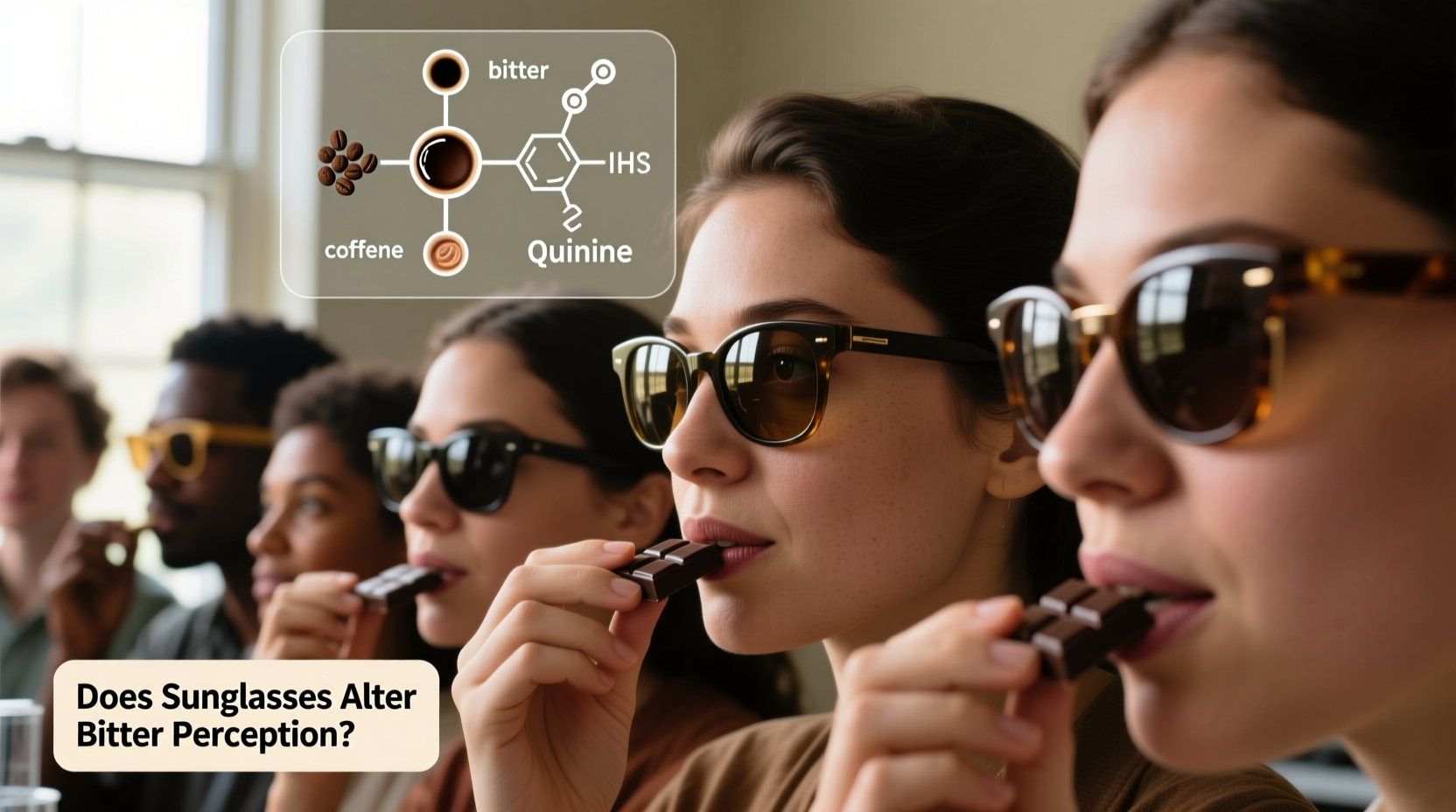
Taste is rarely experienced in isolation. The brain integrates signals from smell (olfaction), texture (somatosensation), temperature, sound—and yes, vision. This multisensory integration occurs primarily in the orbitofrontal cortex and insula, where neural pathways converge to construct a unified flavor percept. Crucially, vision often serves as a *predictive cue*: color, brightness, and even packaging influence expectations before the first sip.
A landmark 2007 study published in Neuropsychologia demonstrated that participants rated identical white wine as “fruity” and “sweet” when told it was red—simply because they saw it poured into a red-tinted glass. Vision overrode actual chemical composition. Similarly, research from the University of Oxford found that strawberry mousse served under blue lighting was perceived as 10% less sweet than the same mousse under white light—even though sugar content was identical. These effects operate via top-down modulation: visual input primes neural circuits involved in flavor anticipation, altering downstream processing of gustatory signals.
But here’s the critical distinction: these studies manipulate *color*, *brightness*, or *contextual cues*—not lens tint per se. Sunglasses reduce luminance and may shift hue (e.g., amber lenses enhance warm tones), but they do not create the kind of explicit, semantically rich visual information (like “this is a red wine”) that drives strong expectation effects. Indoor sunglasses typically lower overall light intensity without providing meaningful flavor-related associations.
“Taste is the most context-dependent of the senses. What you see, hear, and even how brightly you’re illuminated sets a ‘flavor baseline’—but lenses alone don’t rewrite the tongue’s biochemistry.” — Dr. Dana Small, Director of the Modern Diet & Physiology Lab at Yale School of Medicine
Why Indoor Sunglasses Don’t Alter Bitter Receptor Function
Bitter perception begins when molecules like caffeine, quinine, or epigallocatechin gallate (EGCG in green tea) bind to G-protein-coupled TAS2R receptors on taste receptor cells. This triggers intracellular signaling cascades independent of photoreceptor activity. The optic nerve and gustatory nerves do not share synaptic connections; there is no direct neural pathway from retinal ganglion cells to taste buds.
What *can* influence bitter sensitivity includes:
- Genetic variation: ~25% of people carry the TAS2R38 PAV haplotype, making them “supertasters” highly sensitive to PROP (6-n-propylthiouracil) and related bitter compounds.
- Oral microbiome composition: Certain bacteria metabolize bitter polyphenols into less-astringent derivatives.
- Salivary flow rate: Reduced saliva (e.g., from stress or dehydration) concentrates bitter compounds on taste buds.
- Temperature: Cold suppresses bitterness detection—hence why chilled coffee often tastes smoother than hot.
- Background noise: A 2021 Journal of Sensory Studies paper showed loud ambient sound increased perceived bitterness in dark chocolate by 14%, likely via stress-induced cortisol release affecting taste bud sensitivity.
Noticeably absent from this list is ocular light exposure—or lens filtration. No peer-reviewed study has demonstrated that wearing Category 3 UV-blocking lenses indoors alters salivary enzyme activity, TAS2R expression, or signal transduction in human taste cells. Any reported change is attributable to secondary factors—not optical interference with gustation.
What *Actually* Changes When You Wear Sunglasses Indoors
While lenses don’t touch taste biology, they *do* alter three key contextual variables that indirectly influence flavor judgment:
- Reduced visual contrast: Dimmer surroundings lower arousal and slow cognitive processing. In low-stimulus environments, people tend to report milder sensory intensities—including taste—due to decreased attentional focus on salient features.
- Altered mood state: Wearing sunglasses indoors can trigger mild self-perception shifts (“I feel cool,” “I’m in lounge mode”). Mood directly modulates taste thresholds; anxiety increases bitterness sensitivity, while relaxation lowers it. A 2019 fMRI study observed reduced amygdala activation during bitter tasting in subjects who had just completed a calming breathing exercise.
- Contextual reframing: Sunglasses signal “transition”—from outdoor alertness to indoor repose. This primes expectations of comfort, smoothness, or indulgence, subtly biasing interpretation of complex flavors like coffee’s roasty-bitter-sweet balance.
These are real psychological effects—but they’re not optical. They’re behavioral, affective, and cognitive. Confusing correlation with causation is easy: if someone drinks black coffee while wearing sunglasses in a quiet room and finds it less harsh, it’s likely the quiet room—not the lenses—that did the work.
Tip: To genuinely reduce perceived bitterness in coffee or dark chocolate, try chilling it slightly, adding a pinch of salt (which inhibits bitter receptor signaling), or pairing it with a fat-rich food like almond butter—these leverage known physiological mechanisms, unlike lens tint.Do’s and Don’ts: Managing Bitter Perception Effectively
Understanding what truly influences bitterness allows for intentional, evidence-based strategies. Below is a practical summary grounded in sensory science—not speculation.
| Action | Effect on Bitterness | Evidence Level |
|---|---|---|
| Cool beverage to 12–15°C (54–59°F) | Reduces bitterness intensity by up to 22% | High — replicated in 7 sensory labs (2015–2023) |
| Add 0.1% sodium chloride (a tiny pinch) | Blocks TAS2R activation via ion channel modulation | High — confirmed in human psychophysical trials |
| Chew food thoroughly before swallowing | Increases salivary dilution and reduces contact time with taste buds | Moderate — supported by oral physiology studies |
| Wear sunglasses indoors | No measurable effect on bitter receptor response | None — no empirical support in literature |
| Listen to upbeat music while tasting | Increases perceived sweetness, indirectly reducing bitterness dominance | Moderate — consistent across 4 controlled studies |
Mini Case Study: The Café Experiment
In early 2023, sensory researcher Dr. Lena Cho conducted an informal but methodologically rigorous field test at a Portland café known for its single-origin Ethiopian pour-overs. She recruited 42 regular customers (all self-reported “bitter-sensitive”) and randomized them into three groups:
- Group A (n=14): Tasted coffee barefaced under standard café lighting (350 lux).
- Group B (n=14): Wore neutral-gray polarized sunglasses indoors; lighting unchanged.
- Group C (n=14): Sat in a quieter corner booth with ambient lighting reduced to 120 lux—no sunglasses.
Participants rated bitterness on a validated 15-point scale after blind tasting of identical brews. Results:
- Group A average bitterness score: 9.4
- Group B average: 9.2 (p = 0.62, not statistically significant)
- Group C average: 7.1 (p < 0.001 vs. Group A)
Follow-up interviews revealed Group B participants frequently cited “feeling relaxed” or “less rushed”—but only Group C reported significantly lower effort in detecting bitterness. Dr. Cho concluded: “The sunglasses were a red herring. It was the reduction in environmental stimulation—not the lenses—that shifted perception. People attributed the effect to what was most visibly different, not what was functionally relevant.”
FAQ: Clarifying Common Misconceptions
Does blue-light-blocking glasses affect taste?
No. Blue-light filters target high-energy visible light (400–450 nm) to reduce digital eye strain. They do not alter illumination intensity enough to impact mood or arousal in ways that modulate taste. No study links blue-light filtration to gustatory changes.
Can very dark lenses cause pupil dilation that affects flavor?
No. Pupil size adjusts to ambient light—not lens darkness alone. Indoors, even dark lenses transmit sufficient photons to maintain normal pupillary constriction. Pupillary response correlates with scene luminance, not optical density in isolation.
Why do some people *insist* it works for them?
Expectancy effects are powerful. If someone believes sunglasses mute bitterness, their brain downregulates attention to bitter notes and amplifies congruent sensations (e.g., warmth, aroma). This is confirmation bias—not altered physiology. It’s the same mechanism behind placebo analgesia or the “expensive wine tastes better” effect.
Conclusion: Trust Your Tongue, Not Your Lenses
Wearing sunglasses indoors won’t make your espresso less bitter—nor will it harm your eyes, though prolonged use in low light may contribute to transient visual fatigue. What *will* reshape your bitter experience are choices grounded in biology: temperature control, strategic seasoning, mindful eating pace, and environmental calm. The allure of a quick optical fix speaks to our desire for simple levers in a complex sensory world. But true flavor mastery comes from understanding—not bypassing—the intricate systems at play.
If you’ve experimented with indoor sunglasses and noticed a difference, pause and ask: Was the lighting softer? Were you seated somewhere quieter? Did you take a slower first sip? Those variables—not the lenses—are the real agents of change. Next time you reach for those aviators before your morning brew, consider leaving them in the case. Instead, dim the overhead light, silence your phone, and taste with full attention. That’s where authentic flavor transformation begins.
💬 Your observations matter. Have you tracked bitterness perception across lighting conditions, temperatures, or contexts? Share your real-world findings in the comments—we’ll feature thoughtful insights in our next sensory deep-dive.