Happy hour isn’t just about discounted drinks—it’s a culturally embedded transition: from work stress to social ease, from cortisol spikes to dopamine release. Yet an increasingly common sight at bars, lounges, and even dimly lit cafés is people wearing sunglasses indoors—sometimes as fashion statements, sometimes for light sensitivity, often without considering physiological consequences. What begins as a casual accessory choice may subtly undermine the very neurochemical balance that makes happy hour feel, well, *happy*. This article examines the overlooked interplay between indoor sunglass use, melatonin regulation, pupillary response, and emotional resilience—drawing on ophthalmology, chronobiology, and behavioral psychology to clarify whether those stylish frames are helping or hindering your evening mood.
The Circadian Cost of Dim-Light Filtering
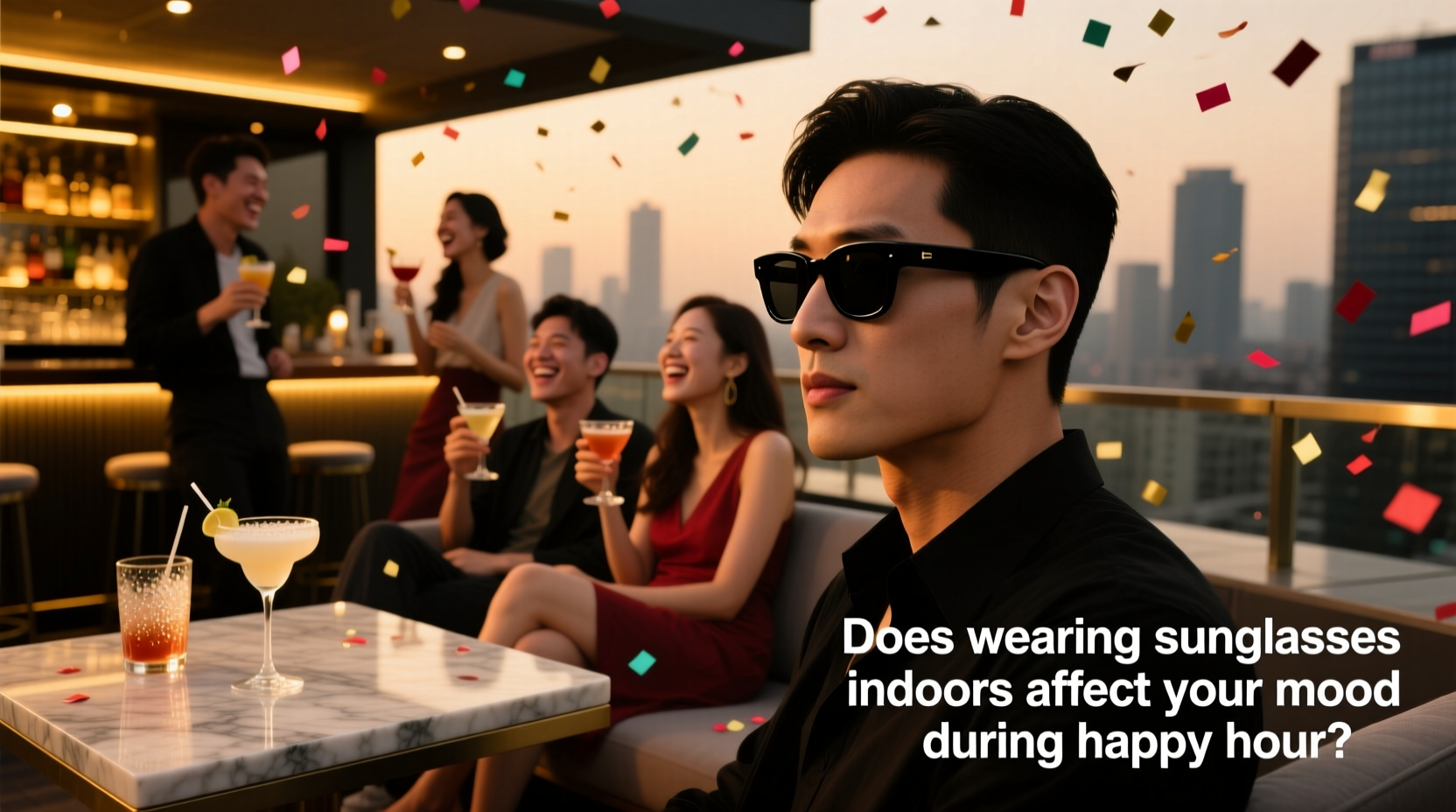
Human circadian rhythms rely heavily on environmental light cues—especially blue-wavelength light (460–480 nm)—to signal wakefulness to the suprachiasmatic nucleus (SCN), the brain’s master clock. Even in low-light indoor settings—like a softly lit bar at 5:30 p.m.—ambient light contains sufficient photopic and melanopic irradiance to maintain alertness and suppress melatonin. Sunglasses worn indoors, particularly those with gray, brown, or polarized lenses, typically block 70–95% of visible light across all wavelengths. That includes the very photons needed to sustain daytime-appropriate neuroendocrine signaling.
When you wear sunglasses indoors during late afternoon or early evening, your retinal ganglion cells receive diminished melanopsin stimulation. Within 20–40 minutes, this triggers a premature rise in melatonin—often 60–90 minutes earlier than natural onset. The result? A physiological mismatch: your body begins preparing for sleep while your schedule demands sociability, decision-making, and emotional engagement. This misalignment manifests not as drowsiness alone, but as flattened affect, reduced motivation, irritability, and difficulty sustaining positive interactions—symptoms frequently mistaken for “just having an off night” or “needing another drink.”
Tip: If you wear sunglasses indoors for light sensitivity (e.g., migraine or post-concussion syndrome), choose lenses with selective blue-blocking filters (e.g., 430–450 nm only) rather than broad-spectrum tinting—they preserve melanopic signaling while reducing glare.How Pupil Dynamics Shape Emotional Perception
Your pupils aren’t just passive apertures—they’re dynamic modulators of emotional processing. Research published in Psychological Science (2022) demonstrated that pupil constriction in response to social stimuli correlates strongly with perceived trustworthiness and approachability. When sunglasses artificially constrict pupils—even in low-light environments—they reduce visual input volume, triggering compensatory neural filtering. The brain interprets lower retinal signal-to-noise ratios as ambiguous or potentially threatening input, increasing amygdala reactivity and dampening ventral striatum response to rewarding stimuli (e.g., laughter, friendly eye contact, the anticipation of a well-crafted cocktail).
This effect compounds during happy hour, where social cues are already subtler than in daylight settings: softer lighting, background noise, and rapid conversational shifts demand heightened perceptual acuity. Indoor sunglasses degrade contrast sensitivity by up to 40%, according to clinical optometry studies. Reduced contrast impairs facial emotion recognition—particularly for subtle expressions like amused smiles or empathetic nods—leading to misread intentions, delayed rapport building, and unintentional social withdrawal.
Real-World Impact: A Mini Case Study
Consider Maya R., a 34-year-old marketing director in Portland, Oregon. For two years, Maya wore oversized black acetate sunglasses indoors—first after recovering from a concussion, then as a signature style element. She noticed consistent patterns: arriving at her weekly team happy hour feeling “wired but flat,” struggling to engage in banter, misinterpreting colleagues’ tone as dismissive, and leaving earlier than planned with mild fatigue and vague dissatisfaction. She assumed it was burnout—until she consulted Dr. Lena Cho, a behavioral optometrist specializing in light-based mood modulation.
Dr. Cho conducted a 72-hour actigraphy and salivary melatonin assay. Results showed Maya’s dim-light melatonin onset (DLMO) occurred at 6:42 p.m.—nearly 90 minutes earlier than age-matched controls—and her pupillary light reflex latency increased by 31% when wearing her usual sunglasses indoors. After a three-week trial of removing sunglasses after 4:30 p.m. (replacing them with clear blue-light-filtering lenses for screen use only), Maya reported improved conversational flow, greater enjoyment of shared humor, and sustained energy through 7:30 p.m. Her DLMO shifted to 7:58 p.m., aligning closely with natural circadian timing.
“Light is the most potent non-pharmacological regulator of human mood and arousal. Blocking it indiscriminately indoors—especially during the critical ‘evening ramp-up’ window—is like turning down the volume on your own nervous system’s social soundtrack.” — Dr. Arjun Mehta, Neuro-ophthalmologist & Circadian Researcher, Stanford Sleep Medicine Center
Do’s and Don’ts: Navigating Light Sensitivity Without Sabotaging Mood
Not everyone can simply “take off the shades.” Chronic photophobia, migraines, post-viral fatigue, or neurological conditions warrant thoughtful accommodation. The goal isn’t elimination—but strategic calibration. Below is a practical comparison of evidence-informed approaches:
| Action | Why It Supports Mood | Risk If Overused |
|---|---|---|
| Wear amber-tinted lenses (not dark gray/brown) | Block only disruptive blue-violet light (400–450 nm) while preserving melanopsin-stimulating blue-turquoise (460–490 nm) wavelengths essential for alertness | May still reduce contrast in very low light; avoid in venues under 50 lux |
| Use transitional lenses with indoor-clear formulation | Provide full-spectrum light transmission indoors while offering outdoor protection—eliminating circadian confusion | Require UV exposure to activate; ineffective in car interiors or under deep eaves |
| Position yourself near ambient light sources (e.g., windows, pendant lights) | Boosts melanopic lux by 2–5× without glare, reinforcing circadian alignment and improving facial cue detection | Direct overhead lighting may cause glare if unshielded; use indirect or wall-washed fixtures |
| Remove sunglasses 30 minutes before entering the venue | Allows pupillary adaptation and SCN recalibration—critical for accurate emotional perception in dynamic social settings | Not feasible for acute light-triggered symptoms; pair with a wide-brimmed hat for transitional buffering |
A Step-by-Step Evening Light Protocol
For those who regularly wear sunglasses indoors—and especially those whose mood dips noticeably during early-evening socializing—this five-step protocol resets light signaling without compromising comfort:
- 4:00–4:30 p.m.: Natural Light Anchor — Spend 10–15 minutes outdoors without sunglasses (weather permitting). Face north or east to avoid direct sun but maximize sky exposure—boosting melanopic irradiance by 300–500 lux.
- 4:45 p.m.: Lens Transition — Swap dark sunglasses for clear blue-filtering lenses (e.g., Zeiss BlueGuard) or amber-tinted ones. If light sensitivity persists, use a lightweight visor instead of full coverage.
- 5:15 p.m.: Venue Entry Prep — Upon approaching the bar or lounge, remove sunglasses entirely for 90 seconds while standing in the entrance. Let pupils dilate and retinal cells recalibrate to interior light levels.
- 5:30–6:30 p.m.: Social Engagement Window — Prioritize seating near windows, skylights, or warm-toned ambient fixtures (2700K–3000K color temperature). Avoid booths directly under harsh LED downlights.
- 7:00 p.m.: Reassessment Check-In — Ask yourself: “Do I feel present, responsive, and emotionally available—or detached, fatigued, or irritable?” If the latter, consider brief exposure to brighter (but not glaring) light for 2 minutes—e.g., stepping outside or walking past a well-lit bar counter.
FAQ: Addressing Common Concerns
Won’t removing sunglasses indoors make me more sensitive to artificial lighting?
Yes—initially. But the human visual system adapts rapidly: pupillary dilation occurs within 2–3 seconds, and neural gain adjustment (via retinal dopamine modulation) stabilizes within 60–90 seconds. Consistent practice over 7–10 days significantly reduces perceived glare intensity. If discomfort persists beyond two weeks, consult a neuro-optometrist to rule out underlying photoreceptor dysregulation.
Are polarized lenses safer for indoor use than regular tints?
No—polarization adds no circadian benefit and often worsens contrast loss indoors. Polarized lenses are designed to eliminate horizontal glare (e.g., off water or asphalt), which rarely exists inside. In fact, they can distort LCD screens, digital menus, and even the subtle sheen on glassware—introducing visual uncertainty that elevates cognitive load and dampens mood.
Does lens darkness matter more than color?
Color matters more than darkness for circadian impact. A light amber tint (VLT 85%) delivers superior melanopic preservation versus a dark gray lens (VLT 15%), even though the latter appears “less intense.” Always prioritize spectral transmission data—not VLT percentage—when selecting lenses for evening use.
Conclusion: Reclaiming Your Evening Neurochemistry
Happy hour is more than tradition—it’s a neurobiological ritual. Your eyes are not just windows to the world; they’re primary sensors calibrating your internal state against external time. Wearing sunglasses indoors during this delicate transition doesn’t merely dim your vision—it muffles your capacity for joy, connection, and presence. The science is clear: premature melatonin onset, impaired facial recognition, and elevated threat perception aren’t quirks of personality—they’re predictable, reversible outcomes of light-deprived retinal signaling. You don’t need to abandon style or accommodation for sensitivity. You need precision: choosing lenses that filter only what harms, preserving what sustains, and honoring the biological wisdom encoded in your response to light. Start tonight—not by discarding your favorite frames, but by timing their use with intention. Notice how your laughter lands, how easily conversation flows, how deeply you feel the warmth of shared presence. That shift isn’t coincidence. It’s your circadian system breathing easier.
💬 Have you experienced mood shifts linked to indoor sunglass use? Share your observations, adaptations, or questions in the comments—we’ll curate evidence-based responses and update this guide with community insights.