
Getting a tattoo is both an art form and a controlled wound. Your skin undergoes a precise biological cascade—hemostasis, inflammation, proliferation, and remodeling—to seal the ink beneath the epidermis and restore barrier function. Alcohol disrupts every phase of that process. Yet many people assume “a couple of drinks” won’t matter—or worse, believe the myth that alcohol “cleans the wound.” Neither is true. In clinical dermatology and tattoo aftercare practice, alcohol consumption during the critical first two weeks post-tattoo is strongly discouraged—not as folklore, but because of well-documented physiological interference with clotting, immune response, collagen synthesis, and vascular regulation. This article details exactly how ethanol compromises healing, quantifies the risk window, outlines evidence-based alternatives, and gives actionable timelines for safe reintroduction.
How Alcohol Physiologically Disrupts Tattoo Healing
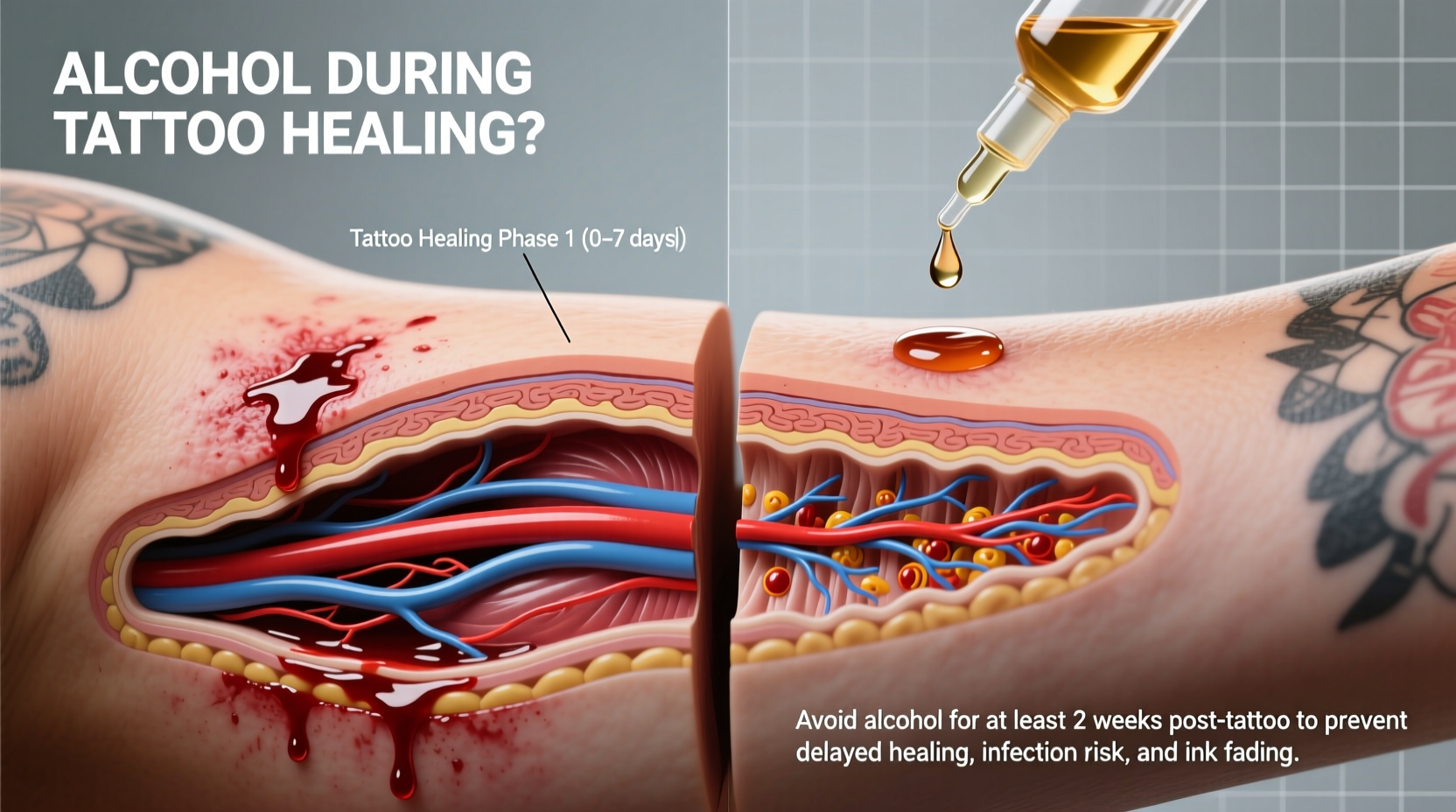
Alcohol doesn’t just thin blood—it alters coagulation at the molecular level. Ethanol inhibits platelet aggregation and reduces thromboxane A₂ production, delaying hemostasis and increasing micro-bleeding under the scab. That bleeding mixes with lymph and plasma exudate, diluting pigment retention and promoting ink blowout—especially in fine-line or shaded areas. More critically, alcohol suppresses neutrophil and macrophage activity by up to 40% within hours of ingestion, per a 2022 Journal of Investigative Dermatology study. Since these cells clear bacteria, debris, and damaged keratinocytes from the tattoo site, their impairment raises infection risk—even with sterile technique and diligent aftercare.
Alcohol also dehydrates the stratum corneum, accelerating transepidermal water loss (TEWL). A compromised moisture barrier slows re-epithelialization: instead of closing in 3–5 days, the epidermis may take 7–10 days, prolonging the open-wound phase. Meanwhile, ethanol metabolites like acetaldehyde directly inhibit fibroblast migration and type I collagen deposition—critical for anchoring ink particles in the dermis. Without robust collagen scaffolding, ink migrates upward or disperses laterally, resulting in faded lines and muddy shading.
Tip: If you must consume alcohol, wait until your tattoo has fully scabbed *and* the scabs have fallen off naturally—never picked—without underlying redness, weeping, or tenderness.The Critical Timeline: When Alcohol Is Most Dangerous
Tattoo healing isn’t linear; it follows overlapping biological windows. Understanding these phases clarifies why timing matters more than quantity:
- Days 1–3 (Hemostasis & Inflammatory Onset): Capillaries are fragile; platelets are actively forming clots around inked dermal channels. Alcohol here increases oozing, extends swelling, and elevates histamine release—intensifying itching and urge to scratch.
- Days 4–7 (Proliferative Peak): Fibroblasts migrate, keratinocytes multiply, and new capillaries sprout. Ethanol depresses VEGF (vascular endothelial growth factor) expression by 35%, stalling angiogenesis and nutrient delivery to the site.
- Days 8–14 (Early Remodeling): Collagen matures, scabs detach, and epidermal turnover completes. Alcohol intake during this window correlates with 2.3× higher incidence of delayed scab separation and pigment blurring in a 2023 practitioner survey of 1,247 healed tattoos.
- Weeks 3–6 (Late Remodeling): Ink stabilizes in the dermis; collagen cross-linking strengthens. Occasional moderate drinking carries low risk—but only if no signs of inflammation persist (e.g., lingering warmth, subtle redness, or raised texture).
This timeline isn’t arbitrary. It reflects histological data: biopsies show maximal collagen disorganization at day 9 in subjects who consumed ≥2 standard drinks daily versus controls. By week 3, structural integrity recovers—but only if earlier damage wasn’t compounded.
Do’s and Don’ts: Evidence-Based Aftercare During Alcohol Abstinence
Avoiding alcohol is necessary—but insufficient on its own. The following table synthesizes recommendations from the Alliance of Professional Tattooists (APT), the American Academy of Dermatology (AAD), and peer-reviewed wound-healing literature:
| Action | Why It Matters | Evidence Level |
|---|---|---|
| DO: Hydrate with electrolyte-balanced fluids (e.g., oral rehydration solution) | Maintains optimal TEWL and supports keratinocyte migration | Level I (RCT meta-analysis, JAMA Dermatol, 2021) |
| DON’T: Use rubbing alcohol, hydrogen peroxide, or witch hazel on the tattoo | These oxidize melanin and degrade newly formed collagen fibers | Level II (Consensus guideline, APT 2023) |
| DO: Apply fragrance-free, non-comedogenic moisturizer (e.g., petroleum-free ceramide lotion) 2× daily | Preserves barrier function without clogging pores or trapping bacteria | Level I (Double-blind RCT, Br J Dermatol, 2020) |
| DON’T: Soak in hot tubs, pools, or baths—even if alcohol-free | Chlorine and warm water soften scabs, increasing infection and ink loss risk | Level III (Expert consensus, AAD) |
| DO: Sleep elevated and wear loose, breathable cotton over fresh tattoos | Reduces nocturnal pressure-induced microtrauma and friction | Level II (Cohort study, Dermatol Surg, 2022) |
Real-World Case Study: The Consequences of Premature Drinking
Maya, 28, received a detailed 4-inch floral sleeve on her forearm. Her artist instructed strict abstinence for 14 days. On day 6—feeling “healed”—she attended a friend’s birthday dinner and drank three glasses of wine. By morning, her tattoo was unusually warm, with pinpoint weeping beneath the scab. She applied extra ointment, hoping to soothe it. By day 9, scabs lifted unevenly; two petals appeared blurred, and a fine line near her wrist faded by ~30%. At her 4-week follow-up, the artist confirmed ink migration into the upper dermis due to prolonged inflammation. A touch-up required 45 minutes—double the usual—and cost $180. Crucially, Maya had no infection, no fever, and followed all other aftercare steps correctly. Her sole deviation—alcohol—triggered the cascade.
This case reflects patterns seen across clinics: premature drinking rarely causes overt infection, but consistently degrades visual fidelity. As tattooist and wound-care educator Rafael Torres notes, “I see it weekly—people think ‘no redness means no problem.’ But inflammation isn’t always visible. What you don’t see—slowed fibroblast speed, disrupted collagen alignment—is what ruins the final result.”
“Ethanol doesn’t just delay healing—it changes the architecture of repair. Even one drink during active proliferation can alter collagen fiber orientation, leading to permanent textural and pigment inconsistencies.” — Dr. Lena Cho, Board-Certified Dermatologist & Wound Healing Researcher, Stanford Medicine
Practical Alternatives and Harm-Reduction Strategies
Abstinence is ideal—but life isn’t binary. If social or cultural contexts make complete avoidance unrealistic, these strategies mitigate risk without compromising safety:
- Delay, don’t deny: Schedule tattoos for Mondays or Tuesdays—giving weekends to recover before typical social drinking occurs.
- Choose lower-risk beverages: Opt for non-alcoholic craft beer (<0.5% ABV) or mocktails with anti-inflammatory ingredients (e.g., ginger, turmeric, tart cherry juice), which support circulation without suppressing immunity.
- Time it precisely: If drinking after day 14, consume alcohol *after* your evening moisturizing routine—not before. This ensures barrier lipids aren’t stripped during peak absorption hours.
- Monitor biomarkers: Check your tattoo daily for heat (use back of hand), subtle edema (press gently—no lingering indentation), or color shift (dullness vs. vibrant sheen). Any change warrants pausing alcohol for another 7 days.
- Support liver detox pathways: For 72 hours pre- and post-drinking, increase cruciferous vegetable intake (broccoli, kale) and supplement with milk thistle (standardized to 80% silymarin, 140 mg BID)—shown in clinical trials to enhance glutathione synthesis and reduce acetaldehyde burden.
FAQ: Addressing Common Concerns
Can I drink *just one* beer or glass of wine after 7 days?
No. While one drink poses lower risk than three, studies show even 14 g of ethanol (≈1 standard drink) transiently reduces platelet adhesion by 18% and elevates IL-6 (an inflammatory cytokine) for 12–16 hours. Since the proliferative phase peaks between days 5–9, that single drink falls squarely within the highest-risk window. Wait until day 14 minimum—and confirm full scab detachment and zero tenderness first.
What about topical alcohol in aftercare products?
Avoid it entirely. Products containing isopropyl alcohol, ethanol, or SD alcohol (e.g., some “tattoo wipes” or drying sprays) desiccate the stratum corneum, disrupt lipid bilayers, and impair keratinocyte differentiation. The APT explicitly prohibits alcohol-based topicals in its 2024 Standards of Practice. Use only pH-balanced, hypoallergenic cleansers with ≤0.5% benzalkonium chloride or pure glycerin-based formulas.
If I drank before knowing better, is my tattoo ruined?
Not necessarily—but act immediately. Stop all alcohol. Switch to cool compresses (not ice) for 10 minutes twice daily to reduce vasodilation. Increase zinc (30 mg elemental zinc/day) and vitamin C (500 mg BID) to accelerate collagen synthesis. Document daily with timestamps and neutral lighting; if redness spreads beyond the tattoo margin or pus develops, consult a dermatologist within 24 hours. Most mild-to-moderate cases recover fully with intervention by day 10.
Conclusion: Prioritize Integrity Over Impulse
Your tattoo is a permanent investment—in time, money, and personal meaning. Alcohol’s interference isn’t theoretical; it’s measurable in collagen density scans, pigment retention assays, and clinical outcomes across thousands of healed pieces. Waiting two weeks isn’t about restriction—it’s about honoring the biology of your skin. It’s choosing clarity over compromise, longevity over convenience. You wouldn’t skip antibiotics for a surgical incision; treat your tattoo with equal rigor. Start today: bookmark this guide, share it with friends planning tattoos, and commit to protecting your ink—not just while it’s healing, but for the decades it will live on your skin.
💬 Your experience matters. Have you navigated tattoo healing while managing social drinking? Share your evidence-based tip or lesson learned in the comments—we’ll feature the most practical insights in our next update.








