When it comes to footwear designed for extended wear—whether you're on your feet at work, traveling, or simply running daily errands—two brands consistently dominate conversations about comfort: Crocs and Birkenstock. Both have built loyal followings by prioritizing cushioning, support, and ease of wear. But when forced to choose between them for all-day use, which truly delivers superior performance?
This isn’t just a matter of personal preference. The right shoe can reduce fatigue, prevent foot pain, and even improve posture over long hours. To help you make an informed decision, we’ll compare Crocs and Birkenstocks across key factors like arch support, materials, durability, versatility, and user experience—backed by expert insights, real-world scenarios, and direct comparisons.
Comfort Anatomy: What Makes a Shoe Ideal for All-Day Wear?
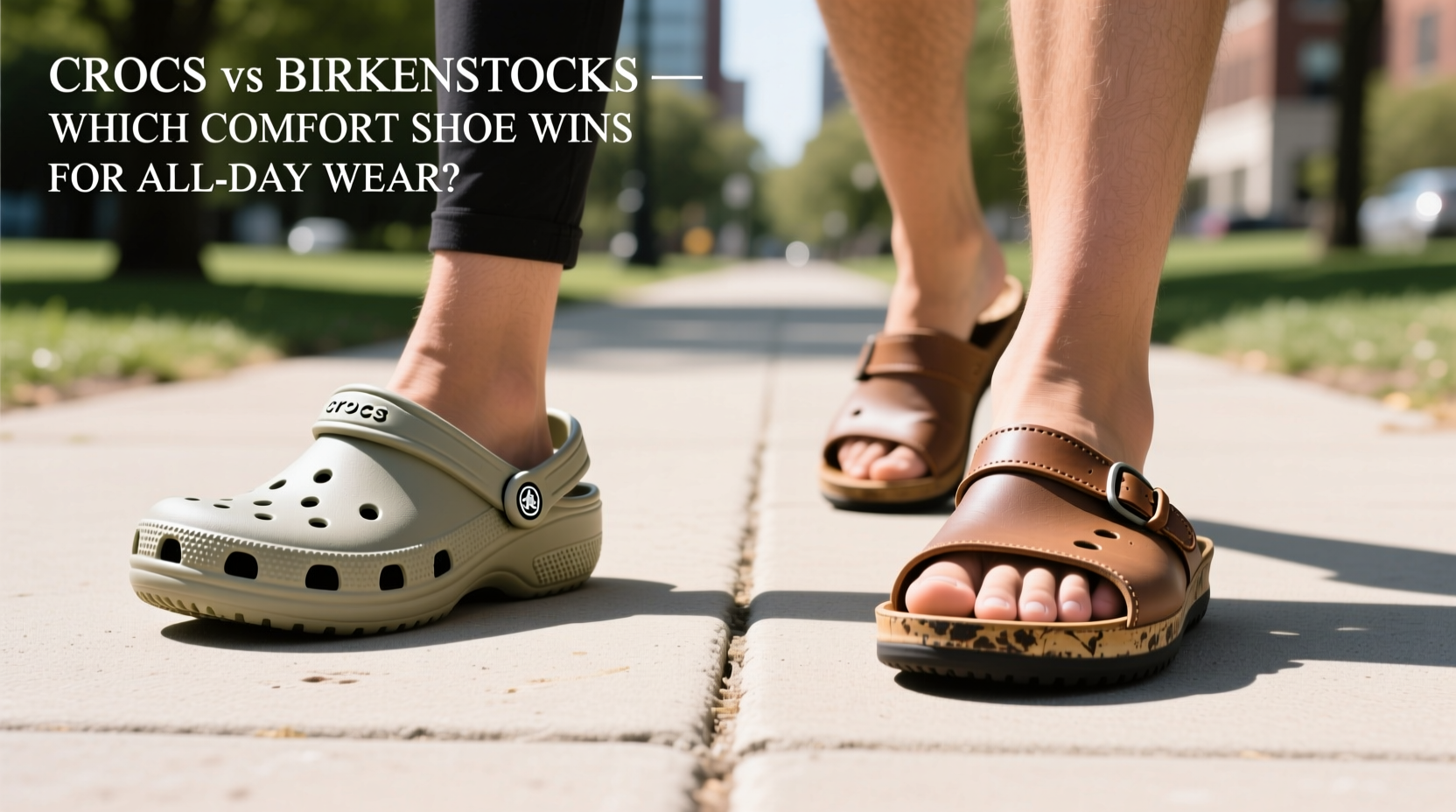
Before diving into brand specifics, it’s essential to understand what defines true all-day comfort. A shoe may feel soft at first, but long-term wear demands more than initial cushioning. Key elements include:
- Arch support: Proper alignment reduces strain on the feet, knees, and lower back.
- Heel cup depth: Stabilizes the heel and prevents slippage during movement.
- Midsole cushioning: Absorbs impact with each step, especially important on hard surfaces.
- Breathability: Prevents overheating and moisture buildup, reducing odor and discomfort.
- Weight: Lighter shoes reduce leg fatigue over time.
- Adjustability: Secure fit without pressure points enhances stability and comfort.
Crocs and Birkenstock approach these principles differently—one favoring lightweight foam innovation, the other relying on anatomically shaped footbeds rooted in orthopedic design.
Tip: If you stand or walk more than four hours a day, prioritize shoes with structured arch support and shock absorption—don’t rely solely on softness.The Crocs Advantage: Lightweight Simplicity and Easy Cleanability
Crocs entered the market in 2002 with their signature clog made from Croslite™, a proprietary closed-cell resin foam. This material gives Crocs their hallmark characteristics: lightness, water resistance, and odor resistance.
Their most popular model, the Classic Clog, weighs under 10 ounces per shoe—making it one of the lightest options available. For people who spend long shifts on concrete floors (like nurses, teachers, or retail workers), that minimal weight adds up to reduced leg fatigue over time.
Another major strength of Crocs is hygiene. They’re fully waterproof and can be hosed down or wiped clean instantly. In high-mess environments—kitchens, gardens, hospitals—this feature is invaluable. Some models even come with ventilation ports to improve airflow, though breathability remains limited compared to open sandals.
However, traditional Crocs lack adjustable straps, meaning they depend on a snug fit around the heel to stay secure. This can lead to toe-gripping—the subconscious tightening of toes to keep the shoe in place—which causes cramping over extended periods. Later models like the Crocs Literide and Baya now include heel straps and enhanced footbeds, addressing earlier criticisms.
“Crocs excel in low-friction, wet, or messy environments where quick drying and easy sanitation are priorities.” — Dr. Lena Patel, Podiatrist and Footwear Consultant
The Birkenstock Edge: Anatomical Support Rooted in Orthopedic Tradition
Birkenstock has been refining its footbed technology since the early 1900s. Their signature cork-latex midsole molds slightly to the wearer’s foot over time, offering personalized support. Unlike flat foam soles, Birkenstock’s contoured design includes a deep heel cup, pronounced arch rise, and toe bar that encourages natural foot movement.
This structure promotes better weight distribution and reduces pronation (inward rolling of the foot). For individuals with plantar fasciitis, flat feet, or general foot instability, this level of biomechanical support often makes Birkenstocks more comfortable over eight+ hour days.
Models like the Arizona, Tokyo, and Mayari feature dual-layer footbeds with suede lining that wicks moisture and provides a broken-in feel from day one. Adjustable straps allow precise customization, ensuring a secure fit without constriction.
While heavier than Crocs (typically 1–1.5 lbs per pair), many users report less overall fatigue due to superior alignment and reduced muscle compensation. However, Birkenstocks require a break-in period—some find them stiff or even uncomfortable during the first few wears.
They’re also less suited for wet conditions. While some newer styles include EVA foam outsoles (like the Gizeh EVA), most retain leather-lined footbeds that degrade if soaked repeatedly. Cleaning requires more care: spot wiping, occasional conditioning, and air drying away from direct heat.
Head-to-Head Comparison: Crocs vs Birkenstocks
| Feature | Crocs | Birkenstocks |
|---|---|---|
| Weight | Very light (8–12 oz) | Moderate to heavy (12–18 oz) |
| Arch Support | Low to moderate (improving in newer models) | High (anatomically contoured) |
| Break-In Period | None – ready to wear | 3–7 days (may cause initial discomfort) |
| Water Resistance | Fully waterproof | Limited (avoid soaking leather-lined models) |
| Cleaning & Maintenance | Easy – rinse or wipe | Requires regular conditioning and careful drying |
| Versatility | Best for casual, indoor, or utility settings | Suitable for urban walks, travel, office (depending on dress code) |
| Durability | 3–5 years with regular use | 5+ years; footbed can be refurbished |
| Price Range | $30–$70 | $90–$150 |
The table reveals a clear trade-off: Crocs win in convenience and weight, while Birkenstocks lead in structural support and longevity.
Real-World Test: A Nurse’s Experience After 12-Hour Shifts
Samantha R., an ER nurse in Chicago, wore both Crocs and Birkenstocks during consecutive 12-hour shifts to evaluate performance. She alternated weekly over a six-week period, logging her comfort levels hourly.
With Crocs (Classic Clog and Rx LiteRide), she appreciated the immediate comfort and ability to sanitize between patients. “After surgery, I could hose them down and they looked brand new,” she said. However, by hour nine, she noticed increasing arch fatigue and toe cramping. “I found myself flexing my toes constantly to keep the back from slipping.”
Switching to Birkenstock Boston clogs (with soft footbed), the first two weeks were challenging. “The heel felt too tight, and the arch was almost painful at first.” But by week three, the shoes had molded to her feet. “By the end of my shift, I actually felt *less* tired than when I started. My lower back didn’t ache like it used to.”
She ultimately chose Birkenstocks for regular rotation, reserving Crocs for ultra-high-mess days or quick errands post-shift. “If I had to pick one for pure all-day comfort, Birks win—but Crocs are unbeatable for cleanup.”
Expert Insight: What Podiatrists Recommend
Dr. Alan Zhou, a podiatric specialist focusing on occupational foot health, evaluates footwear for healthcare professionals. He emphasizes that while both brands offer benefits, they serve different needs.
“Crocs are excellent for short-term use or environments requiring sterility, but they don’t provide enough rearfoot control for prolonged standing. Birkenstocks, with their deep heel cups and medial-lateral stability, more closely mimic orthotic support.” — Dr. Alan Zhou, DPM
He notes that patients with existing foot conditions—such as plantar fasciitis or overpronation—tend to report greater relief with Birkenstock’s structured footbed. However, he acknowledges Crocs’ role in injury recovery: “Post-surgery or during swelling, the non-constrictive design of Crocs allows safe mobility without pressure points.”
Choosing Based on Lifestyle: Who Should Wear What?
Your ideal shoe depends heavily on your daily routine. Here’s a practical checklist to guide your decision:
Choose Crocs if you:
- Work in wet, oily, or messy environments (e.g., kitchens, labs, gardens)
- Need shoes that dry quickly and resist odors
- Prefer zero break-in time and instant comfort
- Are recovering from foot surgery or dealing with swelling
- Want affordable, replaceable footwear
Choose Birkenstocks if you:
- Spend 8+ hours walking or standing on hard floors
- Have flat feet, high arches, or foot pain
- Value long-term investment over upfront cost
- Seek better posture and spinal alignment
- Want a versatile sandal/clog that transitions from errands to casual outings
Frequently Asked Questions
Can I wear Crocs every day?
Yes, but with caveats. Daily wear is fine for light activity or short durations. However, podiatrists caution against relying on standard Crocs for full-day support due to insufficient heel control and arch structure. Consider upgraded models like the Literide or Breeze for better ergonomics.
Do Birkenstocks really mold to your feet?
Yes. The cork-latex footbed compresses slightly in response to pressure points, creating a semi-custom fit over 3–4 weeks of regular use. This molding improves comfort and support but means the shoes should not be shared or resold for optimal benefit.
Are Crocs or Birkenstocks better for walking long distances?
Birkenstocks are generally better for walking due to superior arch support, heel stability, and energy return. Crocs may feel softer initially, but lack the structural integrity needed for multi-mile excursions. Travelers and hikers consistently rate Birkenstocks higher for urban exploration and airport miles.
Final Verdict: Which Comfort Shoe Wins?
There is no universal winner—only the right choice for your needs.
If your priority is **lightweight simplicity, easy maintenance, and mess-ready durability**, Crocs are unmatched. They’ve revolutionized functional footwear for industries where hygiene and practicality come first. Newer models have narrowed the comfort gap, making them viable for moderate daily use.
But when it comes to **true all-day comfort, biomechanical support, and long-term foot health**, Birkenstocks take the crown. Their orthopedic engineering, customizable fit, and proven track record among professionals—from chefs to physical therapists—make them the superior option for sustained wear.
For maximum flexibility, consider owning both: keep a pair of Crocs for quick trips, messy tasks, or recovery days, and invest in a quality pair of Birkenstocks for your core walking and standing needs.
“The best shoe is the one that supports your body’s mechanics without you noticing it. That’s where Birkenstock excels.” — Dr. Lena Patel
Take Action: Find Your Perfect Fit
Don’t settle for foot fatigue or compromise. Whether you lean toward Crocs’ fuss-free practicality or Birkenstock’s engineered comfort, take the next step today. Try on both—walk around the store, test the straps, assess the arch contact. Pay attention not just to how they feel at minute five, but how they hold up at hour eight.
💬 Have your own Crocs vs Birkenstocks story? Share your experience in the comments below—your insight could help someone finally solve their all-day comfort struggle.