
Walk into any well-stocked spirits shop, and you’ll see bottles labeled “brandy” and “cognac” side by side—often at dramatically different price points. Many assume cognac is simply a premium type of brandy, like calling champagne a fancy sparkling wine. That’s partially true—but it’s dangerously incomplete. The distinction isn’t about prestige or marketing; it’s rooted in centuries of French law, terroir-specific viticulture, and tightly enforced production protocols. Confusing the two isn’t just a semantic slip—it risks misrepresenting origin, quality assurance, and cultural heritage. Worse, it obscures why certain expressions command three-figure prices while others sit comfortably under $30. This article cuts through the noise with precision: what legally qualifies as cognac, where the boundaries lie, and why even seasoned drinkers routinely miss the decisive criteria.
The Legal Definition: Appellation d’Origine Contrôlée (AOC) Is Non-Negotiable
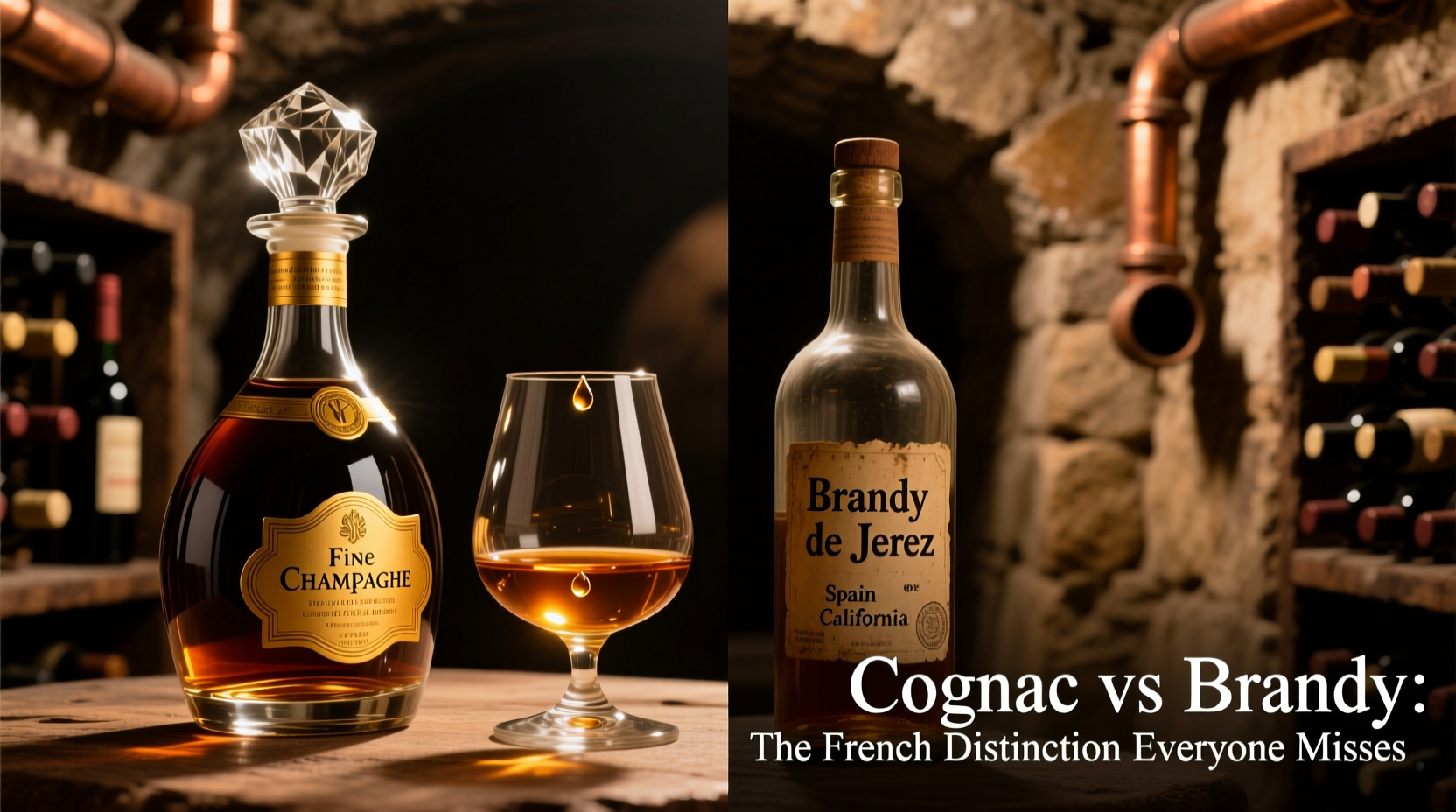
In France, “cognac” is not a style or category—it’s a protected geographical indication governed by the Appellation d’Origine Contrôlée (AOC) system, established in 1936 and reinforced by EU regulation (EU Regulation No. 110/2008). To bear the name “cognac,” a spirit must satisfy four non-negotiable conditions—each verified by the Bureau National Interprofessionnel du Cognac (BNIC), the official regulatory body:
- Geographic origin: Distilled exclusively from grapes grown within the delimited Cognac region in western France—comprising six crus: Grande Champagne, Petite Champagne, Borderies, Fins Bois, Bons Bois, and Bois Ordinaires.
- Grape varieties: Must be made primarily from Ugni Blanc (at least 90% in practice), with Folle Blanche and Colombard permitted as secondary varieties. No other varietals—including Chardonnay or Sauvignon Blanc—are allowed for AOC cognac.
- Distillation method: Must undergo double distillation in traditional copper pot stills (alambics charentais)—a process requiring precise timing, temperature control, and manual separation of the “heart” cut from the heads and tails.
- Aging requirement: Must age for a minimum of two years in French oak barrels (predominantly Limousin or Tronçais oak) before bottling. Age statements (VS, VSOP, XO) reflect the youngest eau-de-vie in the blend—not an average or median.
Brandy, by contrast, carries no such legal constraints. It is a broad category defined only by its method: a distilled spirit made from fermented fruit juice—most commonly grapes, but also apples (calvados), pears (poire william), or plums (slivovitz). Outside France, “brandy” may be aged in stainless steel, filtered, colored with caramel, or blended with neutral grain spirits—all practices strictly forbidden in cognac production.
Tip: If the label doesn’t state “Cognac” and list the producer’s BNIC registration number (e.g., “BNIC N°XXXXX”), it’s not legally cognac—even if distilled in the region or made from Ugni Blanc.Terroir Matters: Why the Cognac Region Isn’t Just a Label
It’s not enough that the grapes grow *near* Cognac—the soil, climate, and micro-terroirs of the six designated crus directly shape the character of the base wine and, ultimately, the eau-de-vie. Unlike many brandy-producing regions where consistency is prioritized through blending across vintages and vineyards, cognac’s AOC mandates strict cru delineation. Each cru imparts distinct sensory signatures:
| Cru | Soil Composition | Typical Profile | Role in Blends |
|---|---|---|---|
| Grande Champagne | Chalk-rich, limestone subsoil with high calcium content | Elegant, floral, long-aging; pronounced finesse and rancio potential | Core of top-tier XO and Hors d’Age expressions |
| Petite Champagne | Slightly less chalky, more clay-limestone mix | Similar elegance to Grande Champagne but slightly rounder and less austere | Often blended with Grande Champagne to form “Fine Champagne” (min. 50% Grande) |
| Borderies | Flinty clay and silica-rich soils | Violet and nutty notes; rapid development of rancio; supple texture | Rarely used alone; prized for aromatic lift in blends |
| Fins Bois | Clay and sand over limestone bedrock | Fruity, approachable, floral; matures faster than crus to the north | Base for VS and younger VSOP; adds volume and vibrancy |
| Bons Bois & Bois Ordinaires | Sandy, acidic, coastal-influenced soils | Lighter, rustic, higher volatility; less complexity and aging potential | Limited use; often declassified to generic brandy or industrial alcohol |
This terroir specificity explains why a 20-year-old cognac from Grande Champagne commands significantly more than a 20-year-old grape brandy from California or South Africa—even if both are aged in oak and distilled twice. The raw material itself is irreplaceable: Ugni Blanc grown on chalk in Grande Champagne yields a low-alcohol, high-acid wine ideal for distillation—thin, sharp, and unpalatable on its own, yet uniquely suited to transforming into complex, layered eau-de-vie during decades of barrel maturation.
The Distillation Divide: Copper Pot Stills vs. Column Stills
Here’s where most consumers misjudge equivalence: they assume “double distilled” means the same thing across categories. In reality, the equipment, process control, and human judgment involved in cognac distillation have no parallel in generic brandy production.
Cognac distillation occurs in small-batch, open-flame copper pot stills—each holding no more than 30 hectoliters (3,000 liters). The process takes place in two stages over 24 hours:
- First distillation (“brouillis”): The low-alcohol wine (9–12% ABV) is heated until vapors rise, condense, and yield a cloudy, fiery liquid called “brouillis” (~28–32% ABV).
- Second distillation (“bonne chauffe”): The brouillis is redistilled. The distiller manually separates three fractions: the volatile, acrid “heads”; the pure, aromatic “heart” (which becomes cognac); and the heavy, oily “tails.” Only the heart—typically just 17–20% of the brouillis volume—is retained. This requires acute sensory skill: judging cut points by smell, taste, and sound of the condensing vapor.
Most international brandy—especially mass-market labels—is produced using continuous column stills. These operate at higher pressures and temperatures, yield spirits at 70–95% ABV, and strip away delicate esters and congeners. While efficient and consistent, column-distilled brandy lacks the textural richness, floral nuance, and oxidative depth inherent to pot-still cognac. As Master Blender Thomas Durand of Rémy Martin observes:
“The copper pot still doesn’t just concentrate alcohol—it refines character. Every cut, every flame adjustment, every pause is a decision that shapes the soul of the eau-de-vie. You cannot replicate that intentionality in a column still, no matter how advanced the engineering.” — Thomas Durand, Rémy Martin Master Blender since 2005
A Mini Case Study: The €29 “Cognac” That Wasn’t
In early 2023, a London-based importer launched a bottle labeled “Château de L’Étang Reserve Cognac” at £29.99. The front label featured a stylized château, the word “Cognac” in bold serif font, and a vintage date (2008). Online reviews praised its “surprisingly smooth finish” and “value-driven complexity.” Within months, sales exceeded 12,000 units.
Then, a sommelier noticed inconsistencies: the ABV was 42.8%—unusual for a single-vintage expression—and the back label listed “grape varieties: Chardonnay, Sauvignon Blanc, and Semillon.” A query to the BNIC confirmed no registration existed for “Château de L’Étang.” Further investigation revealed the liquid was distilled in South Africa from local grapes, shipped to France for brief “finishing” in used oak casks, then bottled and labeled under a dormant French trademark.
The product was legally sold as “brandy”—but the branding, typography, and placement in premium spirits sections deliberately evoked cognac. The UK Trading Standards Authority issued a compliance notice, and the importer rebranded the line as “Artisan Grape Brandy.” The episode underscores how easily consumers are misled—not by fraud, but by omission: absence of the BNIC number, vague “aged in French oak” claims without origin disclosure, and visual cues that override technical literacy. It’s not ignorance that fails here; it’s the deliberate exploitation of widespread confusion between category and appellation.
What Consumers Can Do: A Practical Verification Checklist
You don’t need a BNIC certificate to spot authentic cognac. Use this field-tested checklist before purchase:
- ✅ Look for the BNIC logo or registration number—usually near the bottom of the back label or on the capsule. Verify it online at cognac.fr/en/bnic.
- ✅ Check the grape list: Only Ugni Blanc, Folle Blanche, and Colombard are permitted. Any mention of Chardonnay, Sauvignon, or “other white grapes” invalidates AOC status.
- ✅ Confirm the aging statement: “VS” means ≥2 years; “VSOP” ≥4 years; “XO” ≥10 years (changed from 6 years in 2018). If it says “10 Year Old” but lacks VSOP/XO designation, it may be declassified brandy.
- ✅ Read the origin clause: Phrases like “produced in the Cognac region” or “distilled in France” are insufficient. Legitimate cognac states “Appellation Cognac Contrôlée” or “AOC Cognac.”
- ✅ Examine the producer: Reputable houses (e.g., Hennessy, Martell, Camus, Delamain) list their cellars and crus. Unknown “châteaux” with no verifiable address or history warrant caution.
Frequently Asked Questions
Can cognac be made outside France?
No. Under French and EU law, “cognac” is a protected designation of origin (PDO). Spirits made from the same grapes, using identical methods, but distilled elsewhere—even in Bordeaux or Burgundy—must be labeled “grape brandy” or “eau-de-vie.” Some New World producers make high-quality pot-still brandies, but calling them “cognac” is illegal and actionable.
Why does cognac cost so much more than other brandies?
Three primary drivers: (1) Land scarcity—only 75,000 hectares in the Cognac AOC are authorized for cognac grape cultivation, versus millions globally for generic brandy; (2) Time intensity—minimum two-year aging, but premium expressions require 15–50+ years, tying up capital and losing 2–4% annually to the “angel’s share”; (3) Regulatory overhead—every barrel is tracked, sampled, and certified by the BNIC, adding layers of compliance cost absent in unregulated brandy production.
Is older cognac always better?
Not necessarily. Age indicates time in wood—not quality. Over-oaking can mute fruit and introduce excessive tannin or sawdust notes. The best cognacs balance maturity with vibrancy: a well-crafted 12-year-old Fine Champagne may outperform a disjointed 30-year-old from a lesser cru. Vintage-dated cognacs (rare and expensive) offer transparency—but only if the cru and cooperage are disclosed.
Conclusion: Respect the Name, Not Just the Taste
Calling all brandy “cognac” isn’t a harmless shorthand—it erodes the meaning of one of the world’s oldest and most rigorously protected appellations. The distinction isn’t elitism; it’s accountability. When you choose a certified cognac, you’re not just selecting a spirit—you’re supporting a centuries-old ecosystem: small growers preserving chalk-rich vineyards, coopers hand-toasting Limousin oak, master blenders dedicating lifetimes to harmony, and regulators ensuring every bottle meets exacting standards. That integrity has real-world consequences: resale value for collectible bottles, traceability for ethical sourcing, and preservation of regional biodiversity. Next time you pour a glass, look beyond the amber hue. Check the label. Ask questions. Taste with context—not just curiosity. And when you recognize the difference, you don’t just drink cognac. You honor the land, the law, and the labor behind every drop.
💬 Have you encountered a “cognac” that didn’t meet the AOC standard? Share your experience—including label details—in the comments. Let’s build collective literacy—one verified bottle at a time.








