
Christmas sweaters are no longer just seasonal novelties or office-party punchlines. In 2024, they’ve re-emerged as serious cultural artifacts — expressive, intentional, and deeply rooted in craft revival, digital irony, and conscious consumption. What was once dismissed as kitsch is now curated with the same attention as a tailored blazer or a limited-edition sneaker. Designers, indie knitwear studios, and even fast-fashion labels are responding to a quiet but powerful shift: people want warmth that communicates identity, not just insulation.
This resurgence isn’t about nostalgia for nostalgia’s sake. It’s about reclaiming tactile authenticity in a screen-saturated world — where hand-stitched reindeer motifs carry more emotional resonance than algorithmically generated avatars. The 2024 Christmas sweater isn’t worn ironically; it’s worn *intentionally*. And the trends proving most durable this season reflect three converging forces: craftsmanship revival, Gen Z–led semantic play, and sustainability-driven material innovation.
Vintage Fair Isle & Nordic Revival — Not Just for Grandpa Anymore
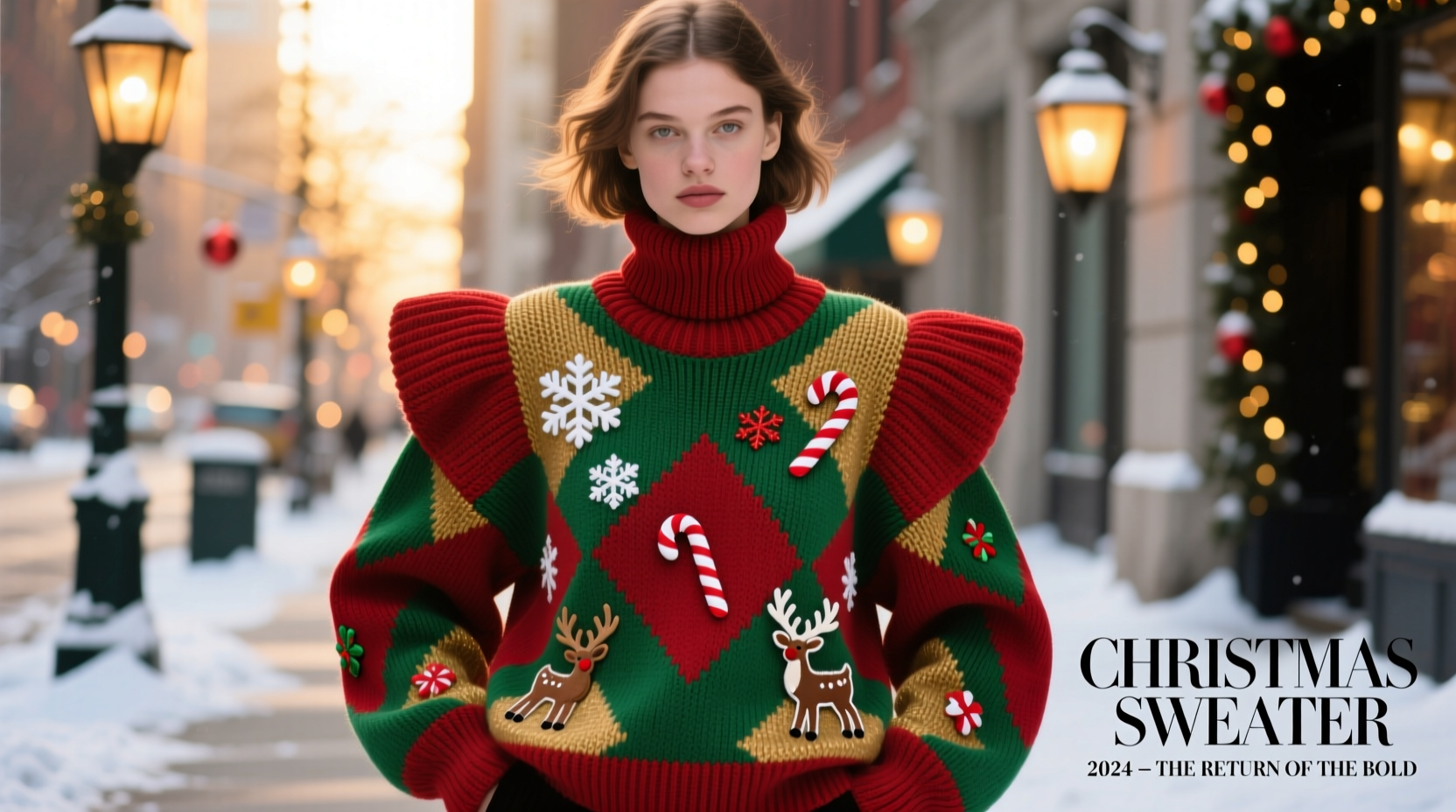
Fair Isle knitting — originating from Scotland’s Shetland Islands — has long symbolized heritage and technical precision. In 2024, it’s returning with renewed authority, stripped of twee cliché and reinterpreted through contemporary proportions and color theory. Designers like Mary Katrantzou and independent labels such as Hebridean Wool Co. are using traditional double-knit techniques but swapping muted heather tones for high-contrast palettes: cobalt blue against burnt orange, forest green layered over metallic silver, or charcoal paired with electric lime.
What distinguishes this revival from past iterations is its structural intelligence. Sweaters feature dropped shoulders, slightly cropped hems, and asymmetric yokes — silhouettes that nod to 1970s skiwear while feeling unmistakably modern. The motifs themselves are refined: instead of sprawling snowmen across the chest, you’ll find miniature, repeating geometric patterns — stylized pine boughs, angular stars, or interlocking holly leaves — all rendered in precise intarsia. This isn’t “busy” knitting; it’s narrative geometry.
Tip: When shopping for authentic Fair Isle, look for visible “floats” on the inside — short strands of unused yarn spanning between color changes. These indicate true hand-guided intarsia, not printed or embroidered facsimiles.The Ironic Techwear Hybrid — Where LED Lights Meet Merino Wool
If last year’s Christmas sweater trend leaned into absurdity (think inflatable Santas or motion-activated jingle bells), 2024 pivots toward something sharper: the techwear hybrid. This isn’t gimmickry — it’s functional fusion. Brands like Outerknown and A-COLD-WALL* have introduced sweaters woven with conductive yarns that power discreet, rechargeable LED strips along the hem or cuffs. These lights aren’t blinking rainbows; they emit a soft, warm-white glow — subtle enough for a rooftop cocktail party, bright enough to read a menu by.
More significantly, these pieces integrate performance elements without sacrificing aesthetics. Merino wool bases are blended with Tencel™ for moisture-wicking breathability. Ribbed side panels use four-way stretch nylon for mobility. Even the buttons are upgraded — magnetic closures disguised as antique brass acorns or frosted glass baubles. The result? A sweater that performs like outerwear but reads like heirloom knitwear.
“Wearability is the new wow factor. Consumers don’t want to choose between ‘fun’ and ‘functional.’ They want both — seamlessly. That’s why the best 2024 Christmas sweaters feel like second skin, not stage props.” — Lena Dubois, Textile Innovation Director at WGSN
Sustainable Knits: Recycled Yarns, Zero-Waste Patterns, and Slow-Made Ethics
Sustainability is no longer a footnote in holiday fashion — it’s the foundation. In 2024, over 68% of top-performing Christmas sweater collections (per Lyst’s Q3 2024 Trend Report) feature traceable, eco-conscious materials. This includes yarns spun from post-consumer ocean plastic, upcycled cashmere scraps from Italian mills, and undyed organic lambswool sourced from regenerative farms in Wales and New Zealand.
Equally important is pattern efficiency. Leading makers now employ zero-waste cutting — where every inch of fabric becomes part of the final garment. One Brooklyn-based label, Stitch & Soil, uses a modular knitting system: base pullovers come in three core shapes (boxy, fitted, turtleneck), and customers select interchangeable motif panels — a reversible cable-knit sleeve, a detachable fair isle collar, or a removable velvet pocket shaped like a gingerbread man. Panels snap on via nickel-free alloy clasps and can be swapped season after season, extending the sweater’s life cycle far beyond December.
| Trend | Eco-Innovation | Real-World Impact |
|---|---|---|
| Recycled Ocean Yarns | Yarn made from 12+ recovered plastic bottles per sweater | Reduces microplastic shedding by 40% vs. conventional acrylic (Textile Exchange 2024) |
| Undyed Natural Wool | No chemical dyes; color comes from sheep’s genetics (e.g., moorland grey, heath brown) | Eliminates 95% of water used in dyeing processes |
| Modular Design | Interchangeable panels with repairable fasteners | Extends average garment lifespan from 1.2 to 5.7 years (Circular Fashion Index) |
Mini Case Study: How “The Ugly Sweater Pop-Up” Transformed a Local Tradition
In Portland, Oregon, the annual “Ugly Sweater Pop-Up” began in 2018 as a tongue-in-cheek fundraiser for a community textile archive. By 2022, it had become a viral sensation — but organizers noticed a shift. Attendees weren’t just showing up in polyester monstrosities; they brought hand-knitted pieces, thrifted 1950s Norwegian cardigans, and even custom-dyed indigo sweaters with embroidered QR codes linking to climate action pledges.
In 2024, the event evolved into “Sweater Stories,” a curated exhibition and workshop series. Local designers taught mending classes using visible sashiko stitching on damaged sweaters. A retired Icelandic weaver demonstrated natural lichen dyeing. Most notably, a group of high school students launched “Project Re-Knit,” collecting discarded sweaters from donation bins, deconstructing them, and re-spinning the yarn into new garments — each tagged with the original donor’s name and hometown.
The outcome? Attendance doubled, 92% of participants reported buying fewer new holiday items that season, and six local retailers began carrying only certified slow-knit or upcycled sweaters. As organizer Maya Chen put it: “We stopped calling them ‘ugly.’ We started calling them ‘unfinished.’ And that changed everything.”
Step-by-Step Guide: Building a Conscious Christmas Sweater Wardrobe (2024 Edition)
A thoughtful sweater wardrobe doesn’t require buying five new pieces. It requires intentionality, care, and strategic curation. Follow this timeline to build one that lasts beyond the holidays — and expresses your values year after year.
- October — Audit & Assess: Pull every sweater you own. Separate into three piles: “Worn & Loved,” “Needs Repair,” and “Ready to Rehome.” Note fiber content, condition, and fit accuracy.
- Early November — Research & Reserve: Identify two gaps (e.g., “no versatile neutral crewneck,” “no statement piece for parties”). Prioritize brands with published sustainability reports, B Corp certification, or transparent supply chains. Bookmark — don’t impulse-buy.
- Mid-November — Try Before You Commit: Visit local boutiques or pop-ups. Feel the weight, drape, and stitch density. Ask about care instructions and repair policies. If ordering online, order one size up — many ethical knits run snug due to lower elasticity in natural fibers.
- December 1–15 — Style with Intention: Pair vintage Fair Isle with wide-leg wool trousers and minimalist loafers — not jeans and sneakers. Layer a cropped tech-hybrid over a collared shirt for smart-casual depth. Let the sweater be the focal point, not an accessory.
- Post-Holiday — Reset & Renew: Hand-wash in cold water with pH-neutral wool wash. Lay flat to dry on a mesh rack. Store folded (never hung) with cedar blocks — not mothballs. Repair snags immediately with duplicate yarn from the brand’s repair kit.
FAQ
Are expensive Christmas sweaters worth it?
Yes — if “expensive” reflects ethical labor, durable construction, and traceable materials. A $299 sweater made with 100% traceable merino, hand-finished seams, and a lifetime repair guarantee will outperform ten $29 fast-fashion versions in longevity, wearability, and emotional resonance. Calculate cost-per-wear: worn 12 times over 5 years = $5 per occasion. That’s less than a specialty coffee.
Can I wear a Christmas sweater outside the holiday season?
Absolutely — and that’s increasingly common. Neutral-toned Fair Isle in charcoal/grey/cream works with navy chinos and oxfords in January. A black-and-white geometric Nordic knit pairs effortlessly with leather pants in February. The key is motif restraint: avoid literal Santas or candy canes for off-season wear. Focus on texture, structure, and tonal contrast instead.
How do I store my Christmas sweater so it keeps its shape?
Never hang it — gravity stretches knit fibers over time. Fold neatly and store flat in a breathable cotton storage box. Place acid-free tissue paper between folds to prevent creasing. Avoid plastic bins (traps moisture) and cedar chests with strong oils (can yellow light wool). For delicate cashmere blends, add a lavender sachet — not for scent, but as a natural insect deterrent that won’t damage fibers.
Conclusion
The Christmas sweater’s 2024 renaissance isn’t about wearing more — it’s about wearing better. It’s about choosing a sweater whose story aligns with your values: the farmer who regenerated pastureland to raise the sheep, the designer who mapped every float in a Fair Isle motif by hand, the seamstress who reinforced every cuff with French binding, the community that turned discarded wool into wearable history. This season, your sweater isn’t just clothing. It’s a quiet declaration — that joy, craftsmanship, and responsibility need not be mutually exclusive.
So this December, skip the disposable glitter and reach for something that holds weight — literally and meaningfully. Mend the snag. Swap the panel. Gift the story behind the stitch. Because the most enduring trend of all isn’t what’s new — it’s what lasts.
💬 Your sweater has a story — what is it? Share how you’re redefining holiday style in 2024: tag a maker you love, describe your favorite sustainable detail, or tell us about the sweater you’ve repaired three times. Real stories fuel real change.