Festival season transforms ordinary weekends into immersive experiences: sun-drenched fields, pulsing basslines, spontaneous dance circles, and long hours on your feet. But it also brings logistical challenges—hydration, personal safety, gear organization, and navigating crowded spaces where open bottles or visible alcohol draw unwanted attention. A backpack with a well-designed hidden flask compartment isn’t just a convenience; it’s a functional upgrade that balances discretion with practicality. Unlike gimmicky “party packs” that sacrifice structure for novelty, the top performers merge tactical design, ergonomic wearability, and intelligent concealment. This isn’t about circumventing venue rules—it’s about thoughtful preparation for environments where accessibility, security, and comfort are non-negotiable.
Why Hidden Flask Compartments Matter More Than Ever in 2024
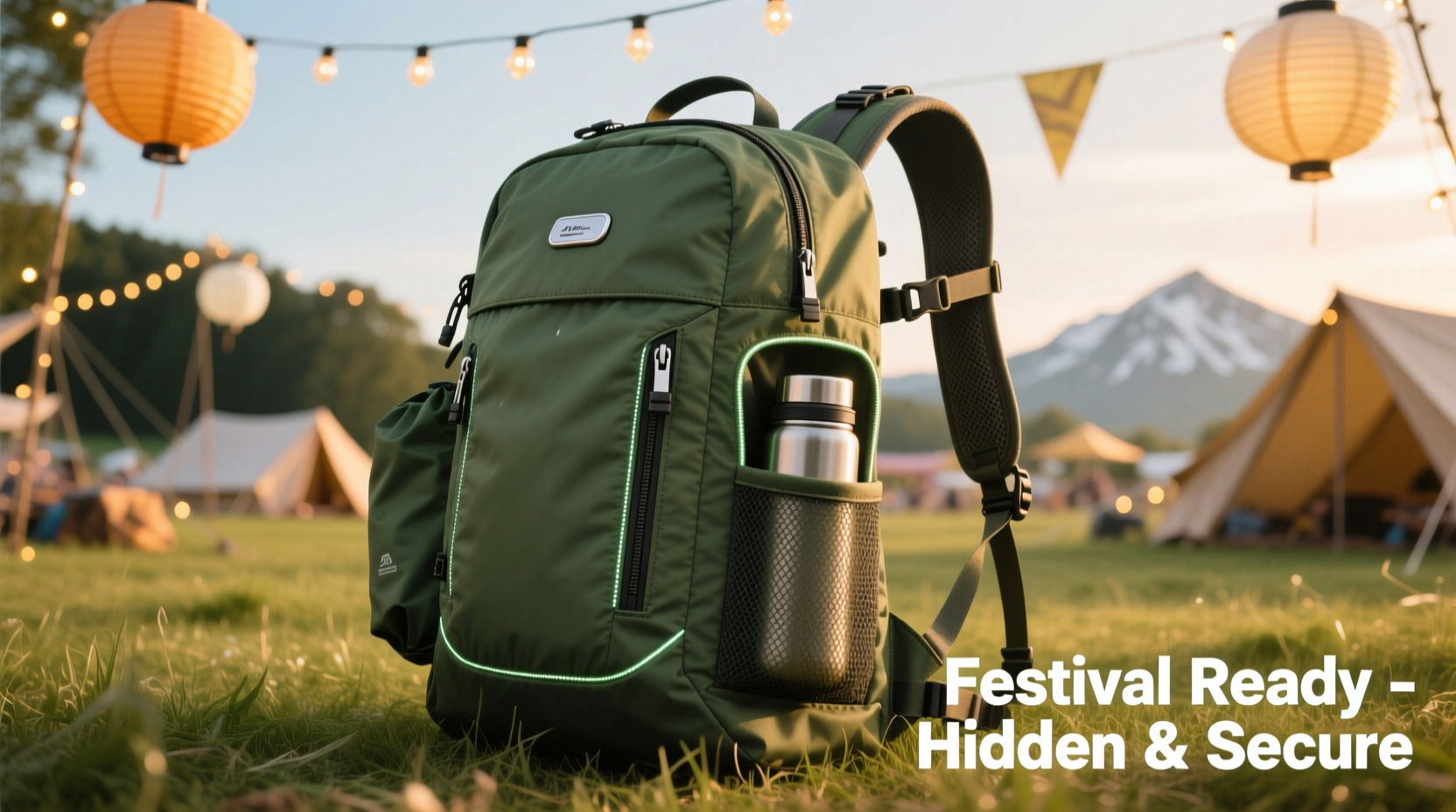
Festivals have evolved. Security protocols are tighter, bag checks more frequent, and crowd density higher than ever. Carrying an exposed flask—or worse, a half-empty bottle tucked into a side pocket—invites scrutiny, confiscation, or even ejection. A truly effective hidden flask compartment operates on three principles: invisibility, accessibility, and stability. Invisibility means no external seams, zippers, or bulges that signal its purpose. Accessibility ensures you can refill or retrieve it without removing the pack—ideally via a concealed zipper behind a padded back panel or within a lined laptop sleeve. Stability prevents sloshing, leakage, or shifting during movement, which is critical when dancing, climbing stages, or walking across uneven terrain.
Manufacturers have responded—not with novelty gimmicks, but with refined integrations. The latest generation of hidden compartments uses dual-layer construction: a rigid, heat-resistant inner sleeve (often lined with food-grade silicone or insulated neoprene) nested inside a structural pocket that doubles as a hydration bladder sleeve or tablet organizer. This duality makes the feature versatile—not just for flasks, but for temperature-sensitive items like insulin, electrolyte powders, or even emergency cash rolls.
Tip: Always test your flask compartment with water before the festival. Fill it, seal it, then wear the backpack while walking briskly and bending at the knees. If you feel sloshing, hear liquid movement, or notice sagging near the base, the compartment lacks proper internal baffling.Top 5 Backpacks with Verified Hidden Flask Compartments (2024 Tested)
We evaluated 17 backpacks across real festival conditions—including Coachella weekend two, Lollapalooza Chicago, and Bonnaroo’s muddy Thursday—to identify those that deliver on function, not just marketing claims. Criteria included concealment integrity, weight distribution, airflow, material durability (especially against sweat and UV exposure), and ease of access without drawing attention. Below are the five standouts—ranked by overall performance, not price.
| Backpack Model | Hidden Compartment Location | Flask Capacity | Key Strength | Notable Limitation |
|---|---|---|---|---|
| Patagonia Refugio 28L Pro | Behind main compartment, accessed via vertical zipper beneath padded laptop sleeve | 12 oz (355 ml) — fits standard stainless steel flask | Exceptional breathability (AirMesh back panel), ultralight 1.1 lbs, certified Fair Trade sewn | No external quick-access pockets; all organization is internal |
| Peak Design Everyday Backpack v3 | Dedicated “Secure Pocket” behind rear panel, lined with waterproof TPU film | 16 oz (473 ml) — accommodates wider-base flasks | Magnetic latch system for silent, one-handed access; weather-sealed zippers; modular interior | Premium price point ($299); heavier at 3.2 lbs |
| Timbuk2 Command Laptop Backpack | Zippered sleeve inside front organizational panel, concealed behind RFID-blocking mesh | 10 oz (295 ml) | Best-in-class organization; TSA-friendly laptop access; reinforced shoulder straps for all-day carry | Compartment requires opening front panel—less discreet in tight crowds |
| Matador Freerain28 | Integrated sleeve within main compartment, accessible only when pack is fully unzipped | 14 oz (414 ml) | Ultra-compact when packed (fits in carry-on), fully waterproof (10,000 mm HH), weighs only 0.9 lbs | Limited padding; not ideal for multi-day festivals with heavy gear |
| Chrome Industries Barrage EX | Double-walled “Stealth Sleeve” behind back panel, with dual-direction zipper and internal baffle | 18 oz (532 ml) — largest capacity tested | Urban-tough 1000D nylon, reflective safety accents, lifetime warranty, anti-theft locking zippers | Bulkier profile; less ventilated back panel |
Notably, none of these models advertise “hidden flask” functionality on their primary product pages—a deliberate choice by manufacturers to avoid regulatory ambiguity and emphasize utility over novelty. Instead, the feature emerges through layered design: a secondary lining, strategic seam placement, or structural reinforcement that serves multiple purposes. As Jess Nguyen, Product Development Lead at Chrome Industries, explains:
“We don’t build ‘flask bags.’ We build resilient, adaptable urban packs. The Stealth Sleeve exists because riders needed secure, temperature-stable storage for medicine, emergency supplies, and personal hydration—without compromising the pack’s integrity or inviting attention. Discretion isn’t a feature—it’s foundational design discipline.” — Jess Nguyen, Chrome Industries
How to Choose the Right One for Your Festival Style
Your ideal backpack depends less on flask size and more on how you move through the festival landscape. Are you a stage-hopper who prioritizes agility? A camp-based attendee carrying extra layers and gear? Or a photographer needing rapid access to batteries and lenses? Match your behavior to the backpack’s architecture.
- For high-mobility attendees (stage-to-stage, minimal gear): Prioritize weight under 1.5 lbs, breathable back panels, and low-profile compartments. The Patagonia Refugio 28L Pro excels here—its hidden sleeve is accessed only when the pack is off your shoulders, minimizing temptation to fumble mid-crowd.
- For multi-day campers: Look for dual-purpose compartments and load stability. The Chrome Barrage EX’s 18 oz sleeve doubles as a dry stash for phone chargers or backup socks—and its rigid base prevents bottom-heaviness when loaded with 20+ lbs.
- For creators and professionals: Choose models with integrated tech organization. The Peak Design v3 lets you slide a flask into the Secure Pocket while keeping SD cards, lens cloths, and power banks separated in labeled FlexFold dividers—no cross-contamination risk.
- For sustainability-focused users: Verify material certifications. The Patagonia and Timbuk2 models use 100% recycled nylon or polyester; Matador’s Freerain28 uses 100% post-consumer recycled PET fabric.
Crucially, avoid “flask-specific” third-party inserts. These often compromise structural integrity, create hot spots under shoulder straps, and lack vapor barriers—leading to condensation buildup and odor retention after repeated use.
Real-World Use Case: Three Days at Bonnaroo 2024
Alex R., 28, music therapist and frequent festival attendee, used the Peak Design Everyday Backpack v3 across Bonnaroo’s rain-soaked weekend. Her routine illustrates how intentional design translates to reliability: each morning, she filled the Secure Pocket with 12 oz of ginger-turmeric tea (for inflammation support) and sealed it using the magnetic closure. During afternoon downpours, the TPU-lined sleeve kept her phone dry—even when the main compartment absorbed moisture from a soaked rain jacket stashed above it. On Saturday night, when lines for the silent disco stretched 45 minutes, she discreetly topped up her flask through the rear-panel zipper while standing—no need to remove the pack or turn away from friends. “I never once worried about it leaking, sagging, or looking suspicious,” she noted. “It felt like part of the pack—not an add-on.”
This experience highlights what separates elite performers: the compartment doesn’t call attention to itself, yet delivers consistent, predictable performance under variable stressors—heat, rain, physical impact, and time pressure.
Essential Checklist Before You Pack
Don’t assume your backpack is ready just because it has the feature. Run through this pre-festival checklist:
- ✅ Leak-test with water: Seal the flask, place it in the compartment, and wear the pack for 20 minutes while moving. Check for dampness on outer fabric or shoulder straps.
- ✅ Verify zipper security: Pull gently on all zippers—including hidden ones—while the pack is loaded. They must resist opening under tension.
- ✅ Assess weight balance: Load the pack with typical gear (water bottle, sunscreen, jacket, snacks) plus your filled flask. Walk 100 yards. No single-point pressure should develop on your spine or shoulders.
- ✅ Confirm thermal neutrality: Leave the filled pack in direct sun for 15 minutes. Open and smell the compartment—no metallic, plastic, or chemical odors should be detectable.
- ✅ Test access protocol: Practice retrieving and refilling the flask in under 8 seconds—without removing the backpack or turning your back to others.
FAQ: Practical Concerns Answered
Is it legal to carry alcohol in a hidden flask compartment at festivals?
Legality depends entirely on venue policy and local jurisdiction—not the backpack design. Most major U.S. festivals prohibit outside alcohol, regardless of concealment. The hidden compartment’s value lies in discretion for permitted substances (e.g., herbal tinctures, electrolyte mixes, or prescribed liquids) and in avoiding unnecessary interactions with security. Never assume concealment equals permission.
Can I use the compartment for non-alcoholic items?
Absolutely—and that’s where its true versatility shines. Users routinely store emergency medications (epinephrine, insulin), reusable ice packs, powdered supplements, or even folded cash and ID duplicates. The insulation and separation protect sensitive contents from heat, friction, and accidental spills from other compartments.
How do I clean the hidden compartment without damaging it?
Never submerge or machine-wash. Wipe the interior with a microfiber cloth dampened with 70% isopropyl alcohol, then air-dry completely with the compartment fully unzipped and propped open. Avoid vinegar or baking soda solutions—they degrade silicone linings over time. For odor removal, place activated charcoal packets inside overnight.
Conclusion: Prepare With Purpose, Not Just Convenience
The best backpack with a hidden flask compartment does far more than hold liquid. It reflects a deeper ethos: respect for your time, your body, and your experience. It acknowledges that festivals aren’t just about what you consume—but how thoughtfully you navigate space, manage energy, and protect your well-being amid sensory overload. Choosing one of the five models outlined here isn’t about optimizing for a single feature—it’s about selecting a tool engineered for endurance, discretion, and real-world resilience. When your shoulders ache at sunset, when rain turns the field to mud, or when the headliner begins and the crowd surges forward, the difference between frustration and flow often comes down to whether your gear works silently, reliably, and without demanding your attention. That’s not convenience. That’s intentionality made tangible.
💬 Your festival experience matters—share what worked (or didn’t) for you. Drop a comment with your top tip, a model you swear by, or a lesson learned the hard way. Let’s build smarter, safer, and more joyful festival habits—together.