Summertime calls for sandals—lightweight, breathable, and easy to slip on. But when it comes to choosing between thick-soled platforms and minimalist flat styles, the decision isn’t just about fashion. Foot specialists, podiatrists, and biomechanics experts agree: the structure of your footwear directly impacts foot health, posture, and even joint alignment over time. While thick-soled sandals have surged in popularity thanks to their perceived comfort and added height, flat sandals remain a staple for their simplicity and natural feel. So which option truly supports your feet best?
The Anatomy of Support: What Your Feet Actually Need
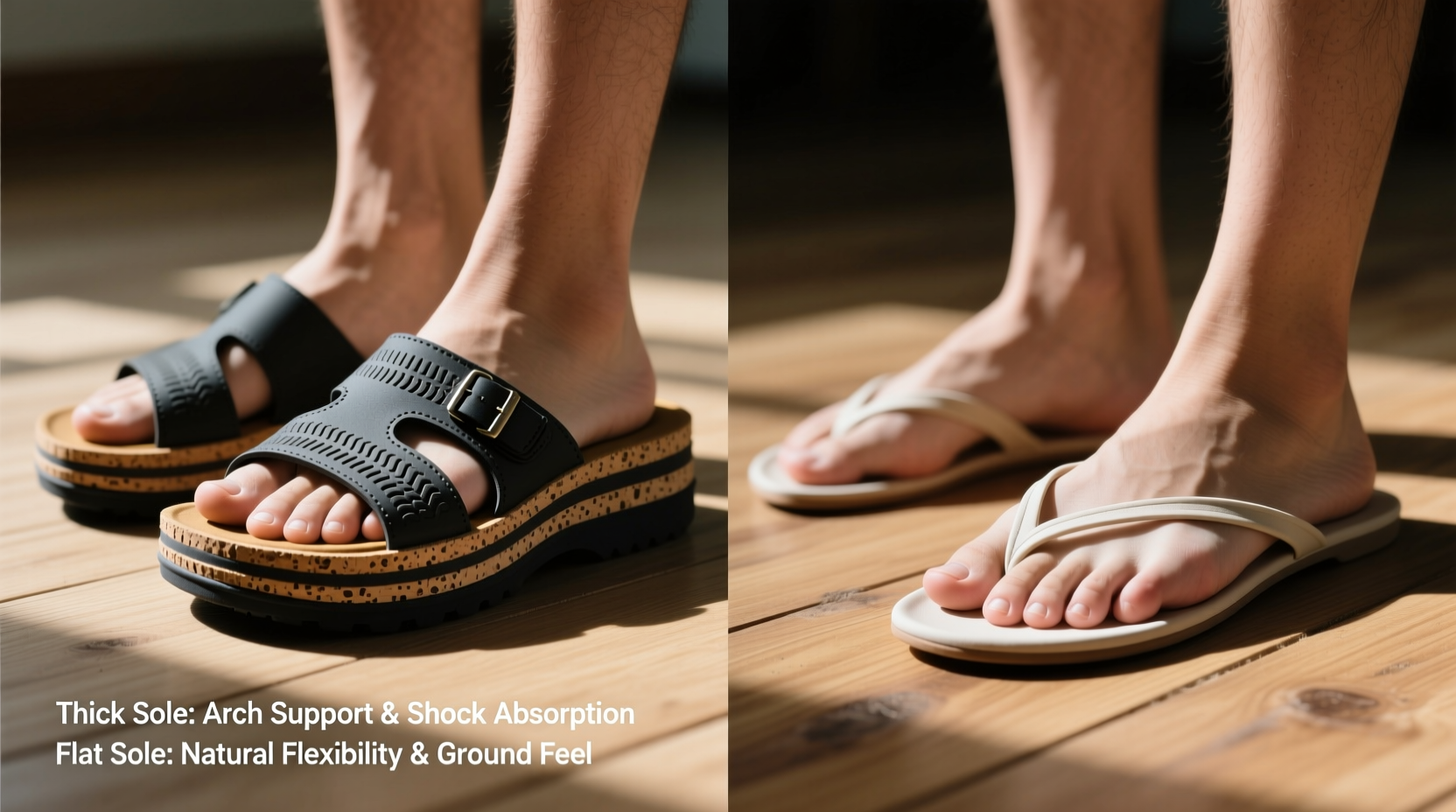
Your feet are complex structures made up of 26 bones, 33 joints, and over 100 muscles, tendons, and ligaments. When walking barefoot on natural terrain, they adapt dynamically to surfaces, absorbing shock and maintaining balance. However, modern lifestyles demand prolonged standing, walking on hard surfaces, and extended wear of footwear that often fails to mimic natural foot function.
The key components of supportive footwear include:
- Arch support – Helps maintain the foot’s natural curve and prevents overpronation.
- Cushioning – Absorbs impact, especially on concrete or asphalt.
- Stable heel counter – Keeps the heel aligned and reduces strain on the Achilles tendon.
- Flexible forefoot – Allows toes to move naturally during push-off.
Flat sandals often lack these features entirely, offering little more than a strap and thin sole. Thick-soled sandals, by contrast, typically incorporate more materials that can be engineered for cushioning and support—but not always effectively.
Tip: Don’t assume thickness equals support. A thick sole made of rigid foam may cushion impact but fail to support the arch or guide foot motion.Thick-Soled Sandals: Comfort or Compromise?
Brands like Birkenstock, Teva, and Ecco have popularized thick-soled designs with contoured footbeds that promote proper weight distribution. These models often feature deep heel cups, metatarsal pads, and arch reinforcement—features grounded in podiatric science.
However, not all thick soles are created equal. Fashion-driven platform sandals from fast-fashion retailers may prioritize aesthetics over ergonomics. They can add unnecessary weight, alter gait mechanics, and increase instability—especially if the sole is thick but inflexible or poorly balanced.
“Just because a sandal has a thick sole doesn’t mean it’s good for your feet. I’ve seen patients develop plantar fasciitis from wearing chunky sandals with zero arch support.” — Dr. Lena Torres, Podiatrist and Gait Specialist
Benefits of well-designed thick-soled sandals include:
- Improved shock absorption on hard surfaces
- Better elevation from hot pavement or rough terrain
- Potential correction of minor biomechanical imbalances
- Greater stability for people with flat feet or overpronation
But drawbacks arise when design overrides function:
- Increased risk of ankle rolling due to high stack height
- Altered stride length and gait pattern
- Excessive rigidity limiting natural foot movement
- Added weight leading to leg fatigue over time
Flat Sandals: Simplicity vs. Structural Deficiency
Minimalist flat sandals—think flip-flops or slide styles—are beloved for their ease of use and breathability. In environments like beaches or pools, they make sense. But wearing them for extended periods on urban streets poses risks.
Most flat sandals offer no arch support, minimal cushioning, and rely heavily on the big toe strap to keep the foot in place. This forces the toes to constantly grip the shoe, leading to muscle fatigue, strain on the plantar fascia, and even conditions like hammertoes over time.
A 2022 study published in the Journal of Foot and Ankle Research found that individuals who wore flat sandals for more than four hours daily were 63% more likely to report heel pain compared to those using supportive footwear.
That said, some flat sandals now integrate ergonomic principles. Brands like Chaco and Vionic offer flat-profile styles with molded arches and contoured footbeds, proving that low height doesn’t have to mean low support.
Comparative Analysis: Thick vs. Flat Sandals
| Feature | Well-Designed Thick-Soled Sandals | Traditional Flat Sandals |
|---|---|---|
| Arch Support | Often present, especially in orthopedic brands | Rarely included; mostly flat surface |
| Shock Absorption | High, due to midsole materials like EVA foam | Low to none; direct transfer of impact |
| Gait Stability | Moderate to high (if well-balanced) | Poor; encourages toe-gripping and instability |
| Durability | Generally higher due to robust construction | Lower; straps and soles wear quickly |
| Suitability for Long Walks | Good to excellent (depending on design) | Poor beyond short distances |
| Fashion Versatility | Can be bulky; limits pairing options | High; easily matches casual outfits |
Real-World Scenario: Sarah’s Summer Foot Pain
Sarah, a 34-year-old graphic designer, spent her vacation in Barcelona walking an average of 8 miles per day in trendy flat leather slides. By the third day, she noticed sharp pain under her heel, especially in the morning. She assumed it was normal travel fatigue—until the discomfort persisted weeks after returning home.
After visiting a podiatrist, she was diagnosed with early-stage plantar fasciitis. The doctor traced it back to inadequate arch support and excessive time on hard cobblestone streets. Switching to supportive thick-soled sandals with custom orthotics significantly reduced her symptoms within four weeks.
Her experience highlights a common misconception: “natural” doesn’t always mean healthy. Even stylish flat sandals can cause harm when worn beyond their functional limits.
How to Choose the Right Sandal: A Practical Checklist
Regardless of sole thickness, focus on function first. Use this checklist before purchasing:
- Press the arch area – It should resist compression slightly, indicating built-in support.
- Bend the sole at the ball of the foot – It should flex easily, allowing natural toe-off.
- Check heel depth – A deep cup keeps your heel stable and aligned.
- Walk in them – Take a few steps; there should be no slipping or pinching.
- Assess strap security – Adjustable straps allow customization for different foot shapes.
- Test on varied surfaces – Try walking on tile, carpet, and pavement to gauge comfort.
Frequently Asked Questions
Can thick-soled sandals cause ankle problems?
Yes—if the sole is excessively tall or lacks lateral stability, it can increase the risk of ankle sprains, particularly on uneven ground. Look for models with wraparound straps or side support to mitigate this.
Are flip-flops always bad for your feet?
Not necessarily, but they’re best reserved for short-term use—like at the beach, pool, or shower. Prolonged wear alters your gait, shortens your stride, and increases stress on the knees and lower back.
Do I need arch support if my feet don’t hurt?
Preventive support matters. Even asymptomatic individuals benefit from proper alignment. Think of it like dental hygiene: waiting for pain often means damage has already occurred.
Final Verdict: Function Over Form
The debate isn’t really about thick versus flat—it’s about support versus neglect. A thoughtfully engineered thick-soled sandal with anatomical shaping, cushioning, and flexibility will almost always outperform a basic flat model in terms of foot health. That said, not all thick soles are superior, and not all flats are harmful. The critical factor is intentionality in design.
If you prioritize all-day comfort, stand for long periods, or walk frequently on hard surfaces, opt for a thick-soled sandal from a reputable brand known for biomechanical integrity. For quick errands or warm evenings close to home, a supportive flat style can suffice—provided it fits well and doesn’t encourage toe-gripping.
Footwear should serve your body, not the other way around. Invest in sandals that respect the complexity of your feet, and you’ll enjoy both comfort and confidence with every step.
💬 What’s your go-to sandal for summer? Have you switched from flat to thick soles—or vice versa—due to comfort or pain? Share your story and help others make smarter choices!