The Apple Watch lineup now spans two distinct philosophies: performance-driven durability in the Ultra 2 and refined everyday elegance in the Series 9. Choosing between them isn’t just about specs—it’s a lifestyle decision. The Ultra 2 promises extreme resilience, advanced tracking, and longer battery life, but at the cost of size and weight. The Series 9 remains sleek, lightweight, and seamlessly integrated into daily routines. For users not scaling mountains or diving coral reefs, the question becomes urgent: does the Ultra 2’s ruggedness justify its heft during ordinary days?
Design and Build: Rugged vs Refined
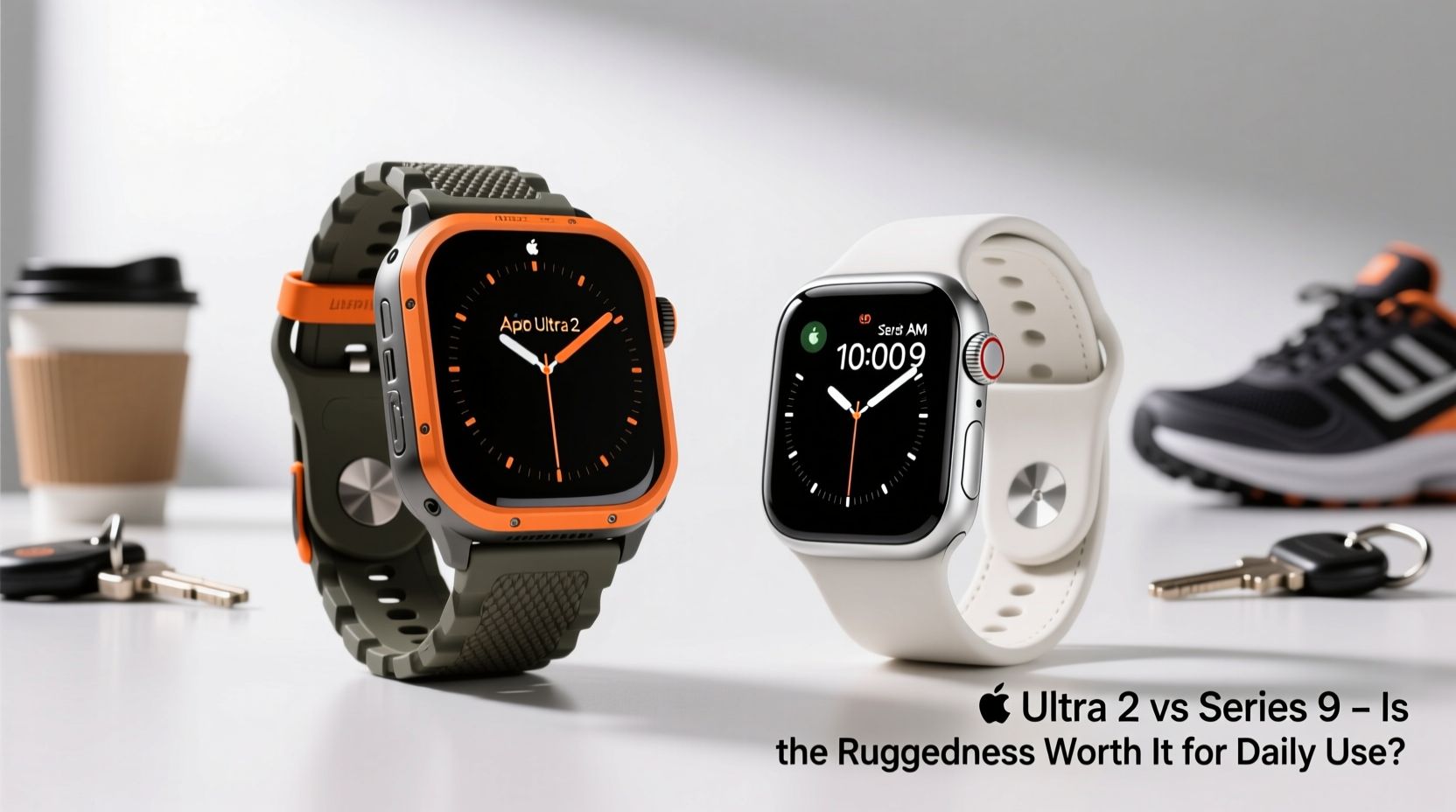
The most immediate difference between the Apple Watch Ultra 2 and Series 9 lies in their physical presence. The Ultra 2 measures 49mm in diameter with a titanium case and a flat sapphire crystal face. It’s built to military-grade standards (MIL-SPEC 810H), resistant to drops, shocks, saltwater, and extreme temperatures. Its Action Button—a programmable physical control—adds functionality for athletes and adventurers who need quick access to timers, workouts, or flashlights.
In contrast, the Series 9 comes in a 41mm or 45mm aluminum case, significantly lighter and more discreet. Its rounded edges and thinner profile make it easier to slip under shirt cuffs and less likely to snag on fabrics. While still water-resistant up to 50 meters and protected by Ion-X glass (or sapphire on higher models), it lacks the overbuilt confidence of the Ultra 2.
The trade-off is clear: the Ultra 2 is engineered for abuse; the Series 9 is designed for integration. For someone commuting via subway, typing at a desk, or attending meetings, the Series 9 feels almost invisible. The Ultra 2, while impressive, can feel like wearing a dive computer on a coffee run.
Tip: If you wear glasses or frequently rest your wrist on a desk, the Ultra 2’s sharp edges may cause discomfort over time. Consider trying both models in-store before committing.Performance and Battery Life: Power vs Practicality
Under the hood, both watches share Apple’s S9 SiP chip, delivering identical processing speed, responsiveness, and Siri accuracy. However, the Ultra 2 leverages its larger frame to house a bigger battery, offering up to 36 hours of typical use and 72 hours in Low Power Mode. That extended runtime matters during multi-day hikes, long flights, or when cellular connectivity is limited.
The Series 9, while improved from previous generations, still averages 18–24 hours per charge. It supports fast charging (up to 80% in 45 minutes), making top-ups manageable during morning routines. But if forgetting to charge overnight is common, the Ultra 2’s endurance provides peace of mind.
For fitness tracking, the Ultra 2 pulls ahead. It includes dual-frequency GPS for precise trail mapping, an altimeter with improved accuracy, and an enhanced compass with waypoint navigation. These tools are invaluable for hikers, climbers, or outdoor athletes. The Series 9 offers basic GPS and elevation tracking but lacks the granularity needed for serious off-road navigation.
“Battery anxiety shouldn’t dictate your day. The Ultra 2 gives outdoor enthusiasts true independence from chargers.” — Jordan Lee, Outdoor Tech Reviewer at TrailGear Weekly
Display and Usability in Daily Scenarios
The Ultra 2’s display is brighter—up to 3,000 nits peak brightness—making it readable even in direct sunlight. This is crucial for runners, cyclists, or skiers who rely on glanceable data outdoors. The flatter crystal also reduces glare compared to the Series 9’s curved edge, which can reflect light at awkward angles.
However, indoors, that brightness advantage fades. The Series 9’s screen is more than sufficient for checking messages, viewing photos, or navigating apps. Its smaller size allows for easier one-handed interaction, especially when using the Digital Crown or swiping through notifications.
Typing responses via scribble or voice dictation works equally well on both models, but the Ultra 2’s larger screen offers slightly more space for handwriting recognition. On the flip side, its size increases the chance of accidental touches during movement.
| Feature | Apple Watch Ultra 2 | Apple Watch Series 9 |
|---|---|---|
| Case Size | 49mm titanium | 41mm / 45mm aluminum |
| Weight | 61.3g | 31.9g (45mm) |
| Battery Life | Up to 36 hrs (72 in LPM) | Up to 18–24 hrs |
| GPS Type | Dual-frequency | Single-frequency |
| Max Brightness | 3,000 nits | 2,000 nits |
| Action Button | Yes | No |
| Water Resistance | 100 meters (WR100) | 50 meters (WR50) |
Real-World Use Case: Office Worker Turned Weekend Adventurer
Consider Mark, a 34-year-old project manager based in Portland. His weekday routine involves back-to-back Zoom calls, note-taking, and managing emails—all while wearing a suit. He values subtlety and comfort. Initially drawn to the Ultra 2 for its hiking capabilities, he found it clashed with his professional attire and caused wrist fatigue after eight hours.
He switched to the Series 9 with a leather loop band and noticed immediate improvement. The watch disappeared into his workflow, didn’t interfere with typing, and looked appropriate in boardroom settings. On weekends, though, he missed the Ultra 2’s GPS precision during mountain runs and felt uneasy about submerging it beyond shallow swimming.
His solution? Dual ownership. He keeps the Series 9 for weekdays and swaps to the Ultra 2 for long trails or ski trips. While costly, this hybrid approach maximizes both devices’ strengths without compromising either context.
Tip: If you lead a mixed lifestyle, consider rotating watches rather than forcing one device to do everything.When the Bulk Makes Sense—and When It Doesn’t
The Ultra 2’s ruggedness is undeniably impressive, but its value depends on usage patterns. Here’s a checklist to determine whether its design aligns with your needs:
- Do you engage in high-intensity outdoor sports (trail running, diving, mountaineering) weekly?
- Do you frequently travel without reliable charging access?
- Do you rely on precise GPS tracking for safety or training analysis?
- Are you willing to sacrifice aesthetics and comfort for durability?
- Do you already own a smartwatch that handles casual use?
If you answered “yes” to three or more, the Ultra 2 is a justified investment. Its titanium build won’t corrode near saltwater, its emergency SOS via satellite could be lifesaving, and its depth gauge supports scuba diving down to 40 meters. These aren’t gimmicks—they’re functional tools for specific lifestyles.
Conversely, if your routine revolves around urban living, office work, gym sessions, and occasional walks, the Series 9 delivers all essential features—heart rate monitoring, ECG, sleep tracking, fall detection, seamless iPhone integration—with far less intrusion. It’s also $600 cheaper starting at $399 versus $799 for the Ultra 2.
Frequently Asked Questions
Can the Apple Watch Series 9 survive outdoor activities?
Yes, within limits. The Series 9 is water-resistant to 50 meters and durable enough for hiking, cycling, or swimming. However, it lacks the reinforced casing, dual-frequency GPS, and depth sensors of the Ultra 2. For casual outdoor use, it’s perfectly capable—but not optimized for extreme conditions.
Is the Action Button on the Ultra 2 useful for non-athletes?
Potentially. While designed for workout shortcuts, the button can be programmed to launch any app, start a timer, or activate flashlight mode. Some users assign it to mindfulness exercises or medication reminders, adding utility beyond fitness. Still, its benefit is situational and doesn’t justify the premium alone.
Does the Ultra 2 feel uncomfortable during sleep tracking?
Many users report discomfort due to its size and weight. While possible to wear overnight, the Ultra 2 is bulkier than most sleep trackers and may disrupt sleep posture. The Series 9, being lighter and slimmer, is generally preferred for continuous wear, including sleep monitoring.
Step-by-Step Guide: Choosing the Right Watch for Your Lifestyle
- Assess your primary use case: List how you spend your time—work, exercise, travel, leisure.
- Evaluate environmental exposure: Do you face mud, water, altitude, or temperature extremes regularly?
- Test wearability: Visit an Apple Store and try both models on your dominant wrist. Wear them for at least 10 minutes.
- Compare battery habits: Are you diligent about nightly charging, or do you often forget?
- Review budget constraints: Factor in band costs, potential replacements, and insurance.
- Decide on specialization vs versatility: One rugged tool for adventure, or one elegant companion for daily life?
This process helps eliminate emotional bias and focuses on practical fit. Most people don’t need a tank when a sedan will do.
Final Verdict: Value Lies in Alignment, Not Specs
The Apple Watch Ultra 2 is not simply a bigger Series 9. It’s a different category of device—one built for resilience, endurance, and precision. Its bulk is not a flaw; it’s a consequence of engineering choices meant to protect internal components and enhance performance in hostile environments.
Yet for the average user, that ruggedness brings diminishing returns. The Series 9 handles health monitoring, communication, and moderate fitness tracking with finesse. It integrates smoothly into professional and social settings where conspicuous tech might seem out of place. It charges quickly, weighs less, and costs significantly less.
The real question isn’t whether the Ultra 2 is better—it clearly outperforms in raw capability. The question is whether those capabilities matter to you. If your life includes regular expeditions, open-water swimming, or remote exploration, the Ultra 2 earns its place on your wrist. But if your adventures end at the local park or weekend getaway, the Series 9 offers smarter balance.
💬 Have you made the switch between models? Share your experience below. Whether you love the Ultra 2’s toughness or prefer the Series 9’s simplicity, your insights can help others choose wisely.