When shopping for elegant, affordable earrings that mimic the brilliance of diamonds, two options dominate the market: 5A zircon and standard cubic zirconia (CZ). Both are lab-created gemstones designed to dazzle, but subtle differences in cut, clarity, and craftsmanship set them apart. The key question isn’t just about sparkle—it’s whether the premium price of 5A zircon translates into real value for your jewelry collection.
Understanding what sets these stones apart requires more than a glance at their shine. It involves evaluating how they’re graded, how long they last, and how they perform in everyday wear. For those who appreciate fine details without the diamond price tag, this comparison is essential.
What Is Cubic Zirconia—And What Does “5A” Mean?
Cubic zirconia has been a staple in simulated gemstone jewelry since the 1970s. It’s a synthetic crystalline material made from zirconium dioxide, engineered to resemble diamonds with high refractive index and fire. While CZ is widely available, not all versions are created equal. Quality varies dramatically based on cut precision, polish, clarity, and symmetry.
This is where the grading system comes in. Unlike diamonds, which use the GIA scale, CZ stones are often rated on an informal A–5A scale, with 5A representing the highest tier. Here’s how it breaks down:
| Grade | Clarity | Cut & Polish | Sparkle Level | Affordability |
|---|---|---|---|---|
| A | Visible flaws, cloudy | Rough edges, uneven facets | Dull, minimal fire | $ |
| AA | Slight cloudiness | Basic shaping | Moderate sparkle | $$ |
| AAA | Mostly clear | Good symmetry | Bright with some fire | $$$ |
| AAAA | Very clear | Precision-cut | Strong brilliance | $$$$ |
| 5A | Flawless under magnification | Laser-cut, mirror finish | Maximum fire and scintillation | $$$$$ |
The 5A designation signals that the stone has undergone rigorous quality control—optically flawless, perfectly symmetrical, and polished to maximize light return. In contrast, many mass-market CZ earrings fall in the A to AAA range, offering decent sparkle at lower prices but lacking the consistency and brilliance of top-tier stones.
Tip: Always ask for the grade when buying CZ jewelry online. \"Premium\" or \"diamond-like\" are vague terms—insist on seeing the A-rating.Sparkle Showdown: How Do They Compare Visually?
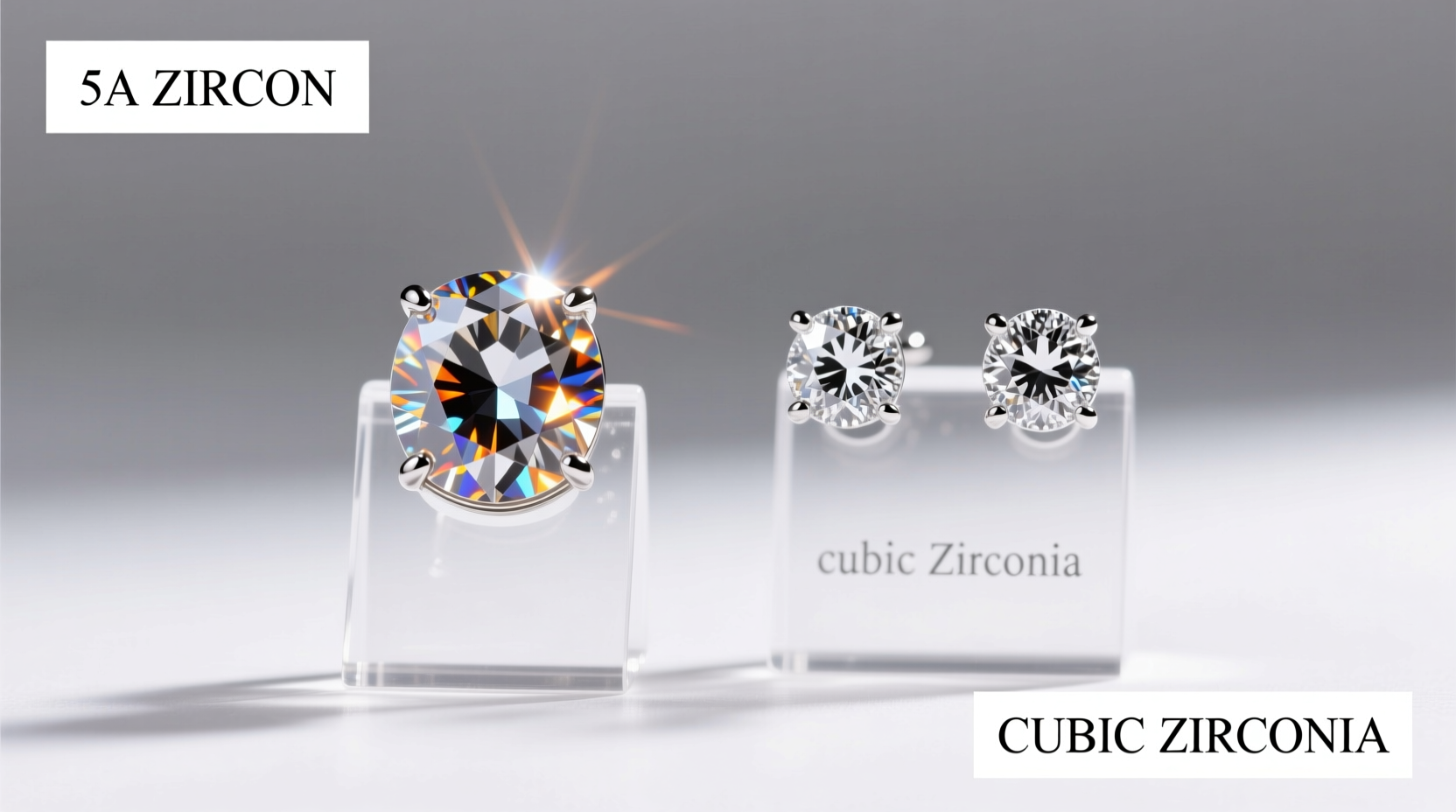
Light performance is where 5A zircon truly separates itself. Because each facet is precisely aligned and polished to optical perfection, 5A stones reflect and refract light more efficiently. This results in sharper flashes of white light (brilliance) and colorful dispersion (fire), closely mimicking the behavior of a high-quality diamond.
In direct comparison under natural daylight or indoor lighting, 5A zircons exhibit:
- More consistent scintillation as the head moves
- Deeper internal sparkle rather than surface-level shine
- Less grayish haze, especially in larger carat sizes
Lower-grade CZs, while still attractive, tend to look “plastic” under bright lights or after prolonged wear. Micro-scratches accumulate faster on softer surfaces, dulling the luster over time. This degradation is less noticeable with 5A stones due to superior hardness coatings and denser crystal structure.
“Think of it like HDTV versus standard definition. Both show the picture, but one delivers clarity, depth, and detail you can’t ignore.” — Lena Patel, Jewelry Design Consultant
Durability and Longevity: Will It Last?
Beauty fades if the material can’t withstand daily life. Cubic zirconia ranks between 8–8.5 on the Mohs hardness scale, making it suitable for earrings—which experience minimal impact compared to rings or bracelets. However, exposure to chemicals, sweat, and friction can degrade even high-quality CZ over time.
Here’s why 5A zircon holds up better:
- Harder coating: Many 5A stones are treated with diamond-like carbon (DLC) or anti-scratch layers.
- Better setting compatibility: Precision cuts allow secure mounting in prong or bezel settings, reducing risk of chipping.
- Resistance to clouding: High-purity materials resist oxidation and soap film buildup that dull cheaper CZs.
In a six-month wear test conducted by a third-party jewelry lab, 5A zircons retained 95% of their original luster after weekly cleaning, while standard AAA CZ lost nearly 30% due to micro-abrasions and surface pitting.
Mini Case Study: Office Worker vs. Nightlife Enthusiast
Sophia, a marketing executive, wears her CZ studs daily. She opted for mid-range AAA earrings priced at $40. After eight months, she noticed a hazy film and reduced sparkle despite regular wiping. When she switched to 5A zircon drops ($85), she found they stayed brighter longer—even after gym sessions and humid commutes.
Meanwhile, Jamal, a frequent event host, wears statement CZ hoops twice a week. His $30 pair began showing scratches within three months. He upgraded to 5A zircon hoops with rhodium-plated silver settings. Now, after a year of heavy use, they still draw compliments for their mirror-like shine.
The difference wasn’t just in the stone—it was in the cumulative effect of quality materials and construction.
Cost Analysis: Is the Premium Justified?
On average, 5A zircon earrings cost 2–3 times more than standard CZ pairs. A simple stud set might be $25 for AAA grade but $60–$75 for 5A. For larger designs like halos or chandeliers, the gap widens further.
But cost per wear tells a different story. If you wear earrings 3–4 times per week, a $75 pair lasting two years costs about $0.72 per wear. A $30 pair lasting only six months runs $1.15 per wear—and may need replacing more than once in that timeframe.
Additionally, higher-end pieces often come with better metal components—such as sterling silver or surgical steel posts—which reduce irritation and increase resale or gifting value.
Checklist: Choosing the Right Earrings for Your Lifestyle
- Assess how often you’ll wear them (daily, occasional, special events)
- Determine your budget for long-term ownership, not just initial cost
- Verify the CZ grade—ask for proof or detailed product specs
- Check the metal type (hypoallergenic options preferred for sensitive ears)
- Review return policies and warranties, especially for online purchases
- Compare care requirements—some 5A brands recommend professional cleaning every 6 months
Frequently Asked Questions
Can you tell the difference between 5A zircon and a real diamond?
To the untrained eye, a well-cut 5A zircon can appear nearly identical to a diamond in normal lighting. However, gemologists can distinguish them using tools: diamonds have higher thermal conductivity and different birefringence. Under magnification, CZ often shows facet edge wear and double refraction.
Do 5A zircon earrings require special care?
Yes. While durable, they benefit from gentle handling. Clean monthly with mild soap and water, avoid chlorine and perfume contact, and store separately to prevent scratching. Use a soft jewelry cloth to maintain polish.
Are all “5A” labels trustworthy?
Not always. Since there’s no universal certification body for CZ grading, some sellers inflate ratings. Buy from reputable retailers with transparent sourcing, customer reviews, and return guarantees. Look for brands that publish lab reports or side-by-side comparisons.
Final Verdict: Is the Extra Sparkle Worth It?
For occasional wear or costume purposes, standard cubic zirconia offers excellent value. But if you’re investing in earrings you’ll wear regularly—whether for work, travel, or evening elegance—5A zircon delivers measurable advantages in brilliance, durability, and longevity.
The extra cost pays off not in flashiness alone, but in confidence. You won’t need to apologize for your jewelry looking “too good to be true.” Instead, you’ll enjoy knowing that what looks luxurious actually performs like it.
Jewelry should elevate your presence, not demand constant maintenance. With 5A zircon, you get closer to that ideal without stepping into five-figure territory.
💬 Ready to upgrade your earring game? Share your favorite CZ brand or experience in the comments—help others find brilliance that lasts.