As the holiday season approaches, homeowners face a familiar decision: how to make their property shine. For years, elaborate string lights, inflatable figures, and hand-strung garlands have defined festive curb appeal. But in recent years, wireless Christmas projectors have emerged as a compelling alternative—offering dazzling visuals with minimal setup. The question isn’t just about convenience; it’s about impact. Which method truly impresses neighbors, visitors, and passersby more: traditional physical light displays or modern laser projectors?
The answer depends on several factors—scale, audience expectations, budget, maintenance, and even neighborhood character. While some prize the craftsmanship of a hand-decorated roofline, others are captivated by the dynamic motion of animated projections dancing across a wall. This article breaks down both options with real-world insights, practical comparisons, and expert observations to help you decide where to invest your holiday effort.
Visual Impact and Aesthetic Appeal
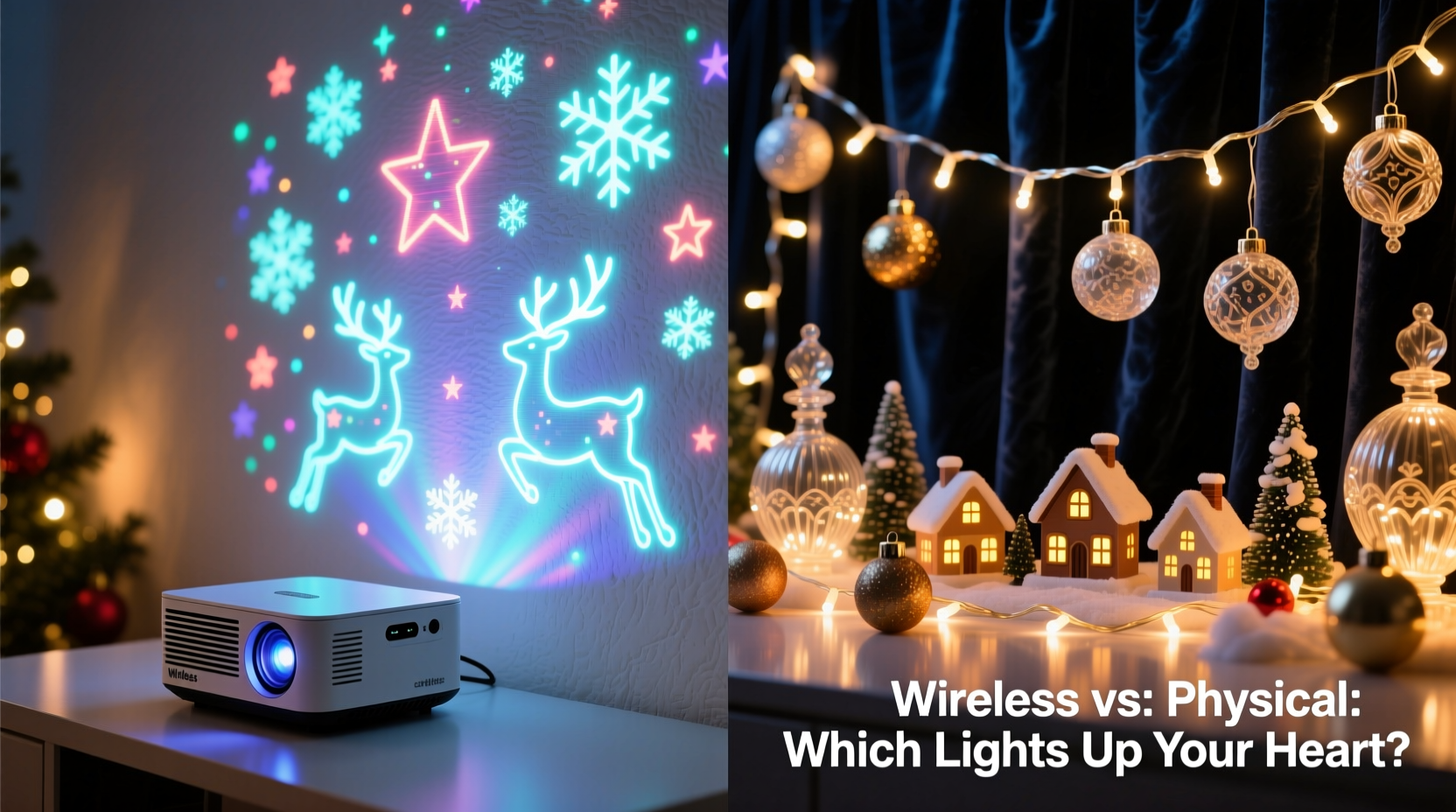
First impressions matter most during the holidays, and visual impact is often the deciding factor in what draws attention. Physical light displays offer tangible depth, dimension, and texture. When thousands of LED bulbs outline eaves, wrap trees, and frame windows, they create a three-dimensional glow that feels immersive and warm. The craftsmanship involved—measuring, securing, and testing each strand—often signals dedication and personal investment.
In contrast, wireless Christmas projectors use high-lumen lasers or LEDs to cast animated patterns onto walls, fences, or driveways. These can include snowflakes, falling stars, Santa sleighs, or twinkling trees—all moving in sequence. The effect is cinematic and eye-catching, especially in low-light environments. Because the images are projected, they appear to float in space, creating an illusion of magic rather than manual labor.
“Projection technology has evolved to the point where it can rival traditional displays in emotional resonance. People don’t always distinguish between ‘real’ and ‘projected’ when the experience feels joyful.” — Derek Langston, Lighting Designer & Holiday Display Consultant
However, aesthetic preference plays a major role. In suburban neighborhoods with long-standing decoration traditions, a full physical display may be expected and celebrated. In urban apartments or homes with limited exterior access, a projector might be the only viable way to participate visibly in the season. Ultimately, “impressiveness” hinges on context: a 30-second animation of reindeer flying across a garage door might delight children more than a static string of white lights, even if the latter required ten hours to install.
Installation, Setup, and Maintenance Comparison
One of the most significant differences lies in setup complexity. Physical light displays demand time, tools, and often multiple people. Hanging lights safely requires ladders, extension cords, clips, timers, and weatherproofing measures. Even a modest roofline installation can take several evenings. After the season, every strand must be carefully removed, coiled, and stored—risking tangles and bulb damage.
Wireless projectors, by comparison, are plug-and-play. Most models come with a tripod mount or stake, require only a power source (some even run on rechargeable batteries), and can be operational in under five minutes. You aim the unit, adjust focus, select a pattern, and activate the timer. No climbing, no drilling, no tangled wires.
Tip: Place your projector on stable ground and angle it slightly upward to maximize coverage and minimize shadow distortion.Maintenance is equally divergent. Physical displays need periodic checks during the season—replacing burned-out bulbs, reattaching fallen strands, and ensuring electrical safety after storms. Projectors, while generally low-maintenance, can suffer from lens fogging, misalignment due to shifting ground, or overheating in enclosed spaces. Still, troubleshooting a projector usually involves wiping the lens or resetting the unit—not rewiring half your roof.
Cost and Long-Term Value Analysis
Initial investment varies widely. A basic wireless Christmas projector ranges from $30 to $80, with premium models reaching $150 for higher brightness, multiple animations, and app control. These units are typically reusable for years, making the per-season cost minimal. Some even offer seasonal pattern updates via firmware or removable SD cards.
Physical displays scale quickly in cost. A single 50-light strand averages $10–$20. A comprehensive home setup might require 20–50 strands, plus extension cords, timers, clips, and storage bins—totaling $300 to $800 or more. Inflatable decorations add another $50–$200 each. While many components last several seasons, bulbs burn out, wires fray, and storage issues lead to replacement costs year after year.
| Factor | Wireless Projector | Physical Light Display |
|---|---|---|
| Upfront Cost | $30–$150 | $300–$1,000+ |
| Setup Time | 5–15 minutes | 3–10+ hours |
| Labor Required | Minimal (1 person) | Moderate to high (often 2+ people) |
| Storage Space | Compact (shoebox size) | Bulky (multiple bins) |
| Lifespan | 3–7 years (with care) | 2–5 years (strand-dependent) |
| Energy Use | 5–20 watts | 100–500+ watts |
From a value perspective, projectors win on efficiency. They consume significantly less electricity, reduce replacement frequency, and eliminate storage headaches. However, for those aiming to build a legacy display—something passed down or expanded over decades—physical lights offer customization and sentimental value that projectors can’t replicate.
Real-World Example: Two Neighbors, Two Approaches
Consider Maple Street, a quiet cul-de-sac known for its holiday spirit. Two neighbors, Maria and James, took different approaches in 2023.
Maria invested $65 in a dual-laser projector with snowfall and nativity scenes. She set it up on her front lawn Friday night, plugged it into an outdoor outlet, and scheduled it to run from 5 PM to 11 PM. By Saturday evening, children from three blocks away were stopping by to watch the animated carolers dance across her house. Local news even featured her display in a “Tech-Savvy Holidays” segment.
James, meanwhile, spent two weekends installing over 1,200 LED lights, a 7-foot illuminated tree, and a motorized sleigh display. His total expenditure exceeded $700, and he enlisted his brother and son to help. While his yard became a local landmark—drawing cars nightly and earning praise from the homeowners’ association—it also came with stress: a blown fuse during a storm, a cracked inflatable, and over $25 in added electricity costs for the month.
Both impressed. But Maria’s display sparked curiosity and conversation about innovation, while James’ evoked nostalgia and admiration for craftsmanship. Neither was objectively “better”—but Maria reached more people with less effort, while James deepened community ties through visible dedication.
When to Choose a Projector (And When to Stick with Lights)
Choosing between these options isn’t about superiority—it’s about alignment with your goals, constraints, and environment. Consider the following checklist to guide your decision:
✅ Choose a Wireless Christmas Projector If:
- You live in an apartment, condo, or rental with limited exterior access.
- You want a quick, temporary setup without permanent modifications.
- Power outlets are scarce or far from display areas.
- You prioritize energy efficiency and low storage demands.
- Your audience includes young children who love motion and animation.
- You’re new to holiday decorating and want a low-risk entry point.
✅ Choose Physical Light Displays If:
- You own your home and plan to decorate long-term.
- Your neighborhood values tradition and elaborate setups.
- You enjoy hands-on projects and DIY satisfaction.
- You want layered lighting effects—depth, color gradients, 3D shapes.
- You host gatherings and want ambient lighting beyond a single wall.
- You’re building a signature display that grows over years.
Step-by-Step: Planning Your Holiday Lighting Strategy
Regardless of your choice, a thoughtful approach ensures maximum impact. Follow this timeline to prepare effectively:
- Early October: Assess your space, power sources, and budget. Walk around your property at night to identify focal points.
- Mid-October: Research options. Compare projector lumens (aim for 3,000+ for outdoor clarity) or light strand lengths and color temperatures.
- Early November: Purchase equipment. Test projectors indoors; inspect light strands for damage.
- Late November: Install your display. For physical lights, work in daylight. For projectors, test at dusk to judge visibility.
- December 1: Activate your display. Share photos on community groups or social media to invite viewers.
- Throughout December: Check weekly for malfunctions, misalignment, or weather damage.
- January 2–7: Carefully dismantle and store. Label cords, use reels for lights, and keep projector lenses covered.
Frequently Asked Questions
Can I use a wireless projector in rainy or snowy conditions?
Most outdoor-rated projectors are water-resistant but not fully waterproof. Place them under an overhang or use a weatherproof cover. Avoid submerging or leaving them exposed to direct downpours.
Do projectors work on brick or uneven surfaces?
Yes, but image clarity may vary. Smooth, light-colored walls yield the best results. Brick or stucco can scatter light, reducing sharpness. Adjust distance and angle to compensate.
Are physical lights brighter than projectors?
Not necessarily. High-lumen projectors (5,000+ lumens) can appear brighter than standard LED strings, especially at night. However, physical lights emit illumination from multiple points, creating a fuller ambient glow.
Final Verdict: What Truly Impresses?
Impressiveness isn’t solely about brightness or scale—it’s about emotional resonance. A wireless Christmas projector can dazzle with motion and surprise, especially in settings where such tech is rare. It lowers barriers to participation, allowing more people to share in the joy of holiday lighting. Its ease and affordability make it accessible, and its novelty keeps audiences engaged.
Yet, nothing quite matches the warmth of a meticulously crafted physical display—the sense that someone cared enough to spend hours stringing lights just right. There’s pride in ownership, beauty in repetition, and community in tradition.
In high-traffic areas or competitive decorating neighborhoods, a hybrid approach may be optimal: use a projector for dynamic focal points and supplement with targeted string lights for depth and authenticity. This combines the best of both worlds—efficiency and artistry.
The most impressive displays, ultimately, are those that reflect personality, thoughtfulness, and connection. Whether achieved through a single beam of light or a thousand bulbs, the goal remains the same: to spark wonder, spread cheer, and remind us all of the season’s magic.
💬 What’s your holiday lighting style? Are you team projector or team physical lights? Share your experience, tips, or favorite display memories in the comments—let’s inspire the next generation of festive decorators!