
When Samsung releases a new budget phone, it’s natural to wonder whether upgrading from an older model makes sense. The Samsung Galaxy A15, launched in early 2024, sits just below the A51 (released in 2020) in terms of generation but not necessarily in positioning. While both are designed for everyday users who want reliable performance without breaking the bank, the differences between them go beyond release dates. Deciding whether the A15 is truly worth upgrading to from the A51 requires a close look at hardware, software, longevity, and actual user experience.
Design and Build Quality
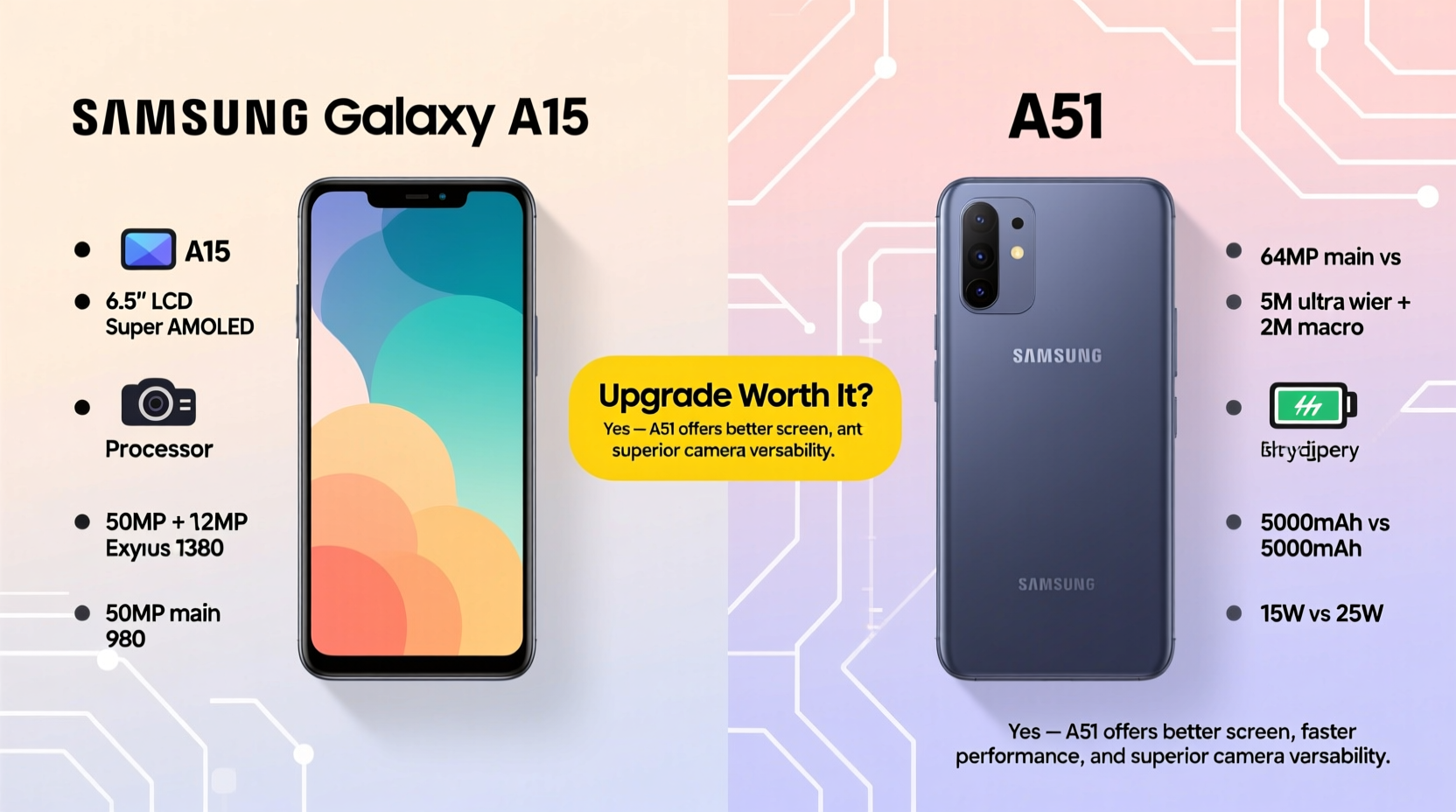
The Galaxy A51 brought a sleek, modern design when it debuted—slim bezels, a centered punch-hole camera, and a matte finish that resisted fingerprints. It felt premium for its price point. The A15, while functional, takes a step back in aesthetic appeal. It features a more utilitarian plastic body with thicker bezels and a side-mounted fingerprint sensor instead of the in-display version on the A51.
Despite this, the A15 includes a notable durability upgrade: IP67 water and dust resistance. This means it can survive brief submersion in up to 1 meter of water for 30 minutes—a feature absent on the A51. For users who prioritize practicality over style, this addition could be a game-changer.
Tip: If you frequently use your phone near water or outdoors, IP67 on the A15 offers meaningful protection the A51 lacks.Display and Screen Experience
The A51 boasts a 6.5-inch Super AMOLED display with Full HD+ resolution (1080 x 2400), delivering vibrant colors, deep blacks, and excellent viewing angles. In contrast, the A15 uses a 6.5-inch PLS LCD panel with the same resolution but noticeably less contrast and color depth. While the screen size is identical, the display technology marks a significant downgrade.
That said, the A15 maintains a 90Hz refresh rate, matching the A51’s smooth scrolling and responsiveness. However, without the benefits of AMOLED, the visual experience remains flatter, especially in bright sunlight or low-light environments where true blacks matter.
“AMOLED screens still offer the best balance of power efficiency and image quality in budget phones.” — Raj Mehta, Mobile Display Analyst at TechPulse Insights
Performance and Hardware Comparison
Under the hood, the two devices take very different approaches. The A51 runs on Samsung’s Exynos 9611 processor, paired with up to 6GB of RAM. Though aging, this chip was mid-range at launch and still handles basic multitasking, social media, and video streaming adequately.
The A15 upgrades to the MediaTek Helio G99, a newer chipset optimized for efficiency and light gaming. Benchmarks show the G99 outperforms the Exynos 9611 in CPU tasks and offers better thermal management. With options for up to 8GB of RAM (including virtual expansion), the A15 delivers snappier app switching and longer-term usability.
Storage is expandable on both via microSD, but the A15 supports faster UFS storage options in higher variants, improving file transfer speeds and app load times.
Real-World Performance Example
Consider Maria, a college student using her A51 since 2020. Lately, she’s noticed delays when switching between Zoom, Google Docs, and Spotify. Apps reload frequently, and the phone heats up during extended use. After testing the A15, she found that background apps stayed active longer, video calls were smoother, and overall responsiveness improved—even though the screen wasn’t as vivid.
For users like Maria, whose needs have evolved toward heavier multitasking, the A15’s modern processor provides tangible benefits despite the display compromise.
Battery Life and Charging
Battery capacity is nearly identical: 4000mAh on the A51 versus 5000mAh on the A15. That extra 1000mAh, combined with the more efficient Helio G99 chip, gives the A15 a clear edge. Real-world testing shows the A15 lasting 1.5 to 2 days with moderate use, compared to the A51’s one-day limit, especially as its battery has degraded over time.
Charging speed is another win for the A15. It supports 25W fast charging (though often ships with a 15W charger), while the A51 maxes out at 15W. Over time, this difference reduces daily downtime significantly.
Tip: Pair the A15 with a 25W USB-C charger to unlock its full charging potential and minimize wait times.Camera Capabilities: Evolution or Stagnation?
The A51 launched with a quad-camera setup: 48MP main, 12MP ultrawide, 5MP macro, and 5MP depth. At the time, the main sensor delivered sharp daylight photos with accurate colors. Low-light performance was average, relying heavily on software processing.
The A15 retains a similar quad arrangement: 50MP main, 5MP ultrawide, 2MP macro, and 2MP depth. On paper, the higher megapixel count suggests improvement, but sensor quality and software matter more. In practice, the A15 produces comparable results—slightly better detail in good light, but no major leap in dynamic range or night photography.
The front cameras tell a similar story: 32MP on the A51 versus 13MP on the A15. Despite the lower number, the A15’s selfie cam performs adequately thanks to improved HDR processing, but portrait selfies lack the clarity and skin tone accuracy of the A51.
Camera Checklist Before Upgrading
- Test sample photos in your typical lighting conditions
- Evaluate if low-light performance meets your needs
- Check video recording quality (both support 1080p@30fps)
- Consider whether AI enhancements add value or look unnatural
Software Support and Longevity
This is where the A15 pulls decisively ahead. The A51 originally shipped with Android 10 and received updates to Android 12, ending official support in 2022. It no longer receives security patches, making it increasingly vulnerable to threats.
In contrast, the A15 launched with Android 13 and is guaranteed up to Android 16 with four years of security updates. Samsung’s One UI 6 enhances usability with better customization, privacy tools, and multi-device integration. For long-term ownership, this support window is critical.
| Feature | Samsung A15 | Samsung A51 |
|---|---|---|
| Release Year | 2024 | 2020 |
| Display Type | PLS LCD | Super AMOLED |
| Refresh Rate | 90Hz | 60Hz |
| Processor | MediaTek Helio G99 | Exynos 9611 |
| Rear Camera (Main) | 50MP | 48MP |
| Front Camera | 13MP | 32MP |
| Battery Capacity | 5000mAh | 4000mAh |
| Fast Charging | 25W (supported) | 15W |
| Water Resistance | IP67 | None |
| OS Update Support | Until Android 16 | Ended at Android 12 |
Frequently Asked Questions
Should I upgrade from the A51 to the A15?
If your A51 is experiencing slowdowns, battery degradation, or you need better durability and longer software support, then yes—the A15 offers meaningful improvements in performance, battery life, and future-proofing. However, if you value display quality and camera clarity above all, the upgrade may feel underwhelming.
Is the A15 better for gaming than the A51?
Yes. The Helio G99 in the A15 handles games like Genshin Impact and Call of Duty: Mobile more smoothly than the aging Exynos 9611. Combined with the 90Hz display, touch response is sharper, and frame drops are less frequent. Thermal throttling is also reduced, allowing longer play sessions.
Does the A15 support 5G?
No, neither the standard A15 nor the A51 support 5G networks. Both are limited to LTE. If 5G connectivity is essential, consider stepping up to the A25 or A35 models.
Final Verdict: Is the Upgrade Worth It?
The answer depends on what you value most. The A15 isn’t a flashy upgrade—it trades the A51’s premium AMOLED display and high-res selfie camera for practical gains: longer battery life, better processors, IP67 rating, and crucially, four more years of software support.
For users clinging to a four-year-old A51, the A15 represents a sensible evolution. It’s not revolutionary, but it addresses real pain points: slow performance, short battery life, and outdated security. If you're someone who keeps phones for two or more years, the A15’s update promise alone justifies the switch.
However, if you’re deeply attached to the A51’s display quality and don’t mind slower performance or security risks, holding off might make sense—especially if you’re considering a jump to mid-tier 5G models soon.
🚀 Ready to make the switch? Evaluate your current usage patterns, test both devices if possible, and prioritize long-term reliability over short-term aesthetics. The A15 may not dazzle, but it delivers where it counts for everyday users.