For loyal Samsung users who invested in the Galaxy Note 20 Ultra, the arrival of the Galaxy S22 Ultra raises a critical question: is upgrading truly worthwhile? On paper, the S22 Ultra appears to be a significant leap forward, but real-world benefits depend on individual usage patterns, priorities, and how much you value innovation versus practicality. This breakdown compares both devices across key categories—design, display, performance, camera, battery, and software—to help you decide whether the upgrade justifies the cost.
Design and Build: Refinement Over Revolution
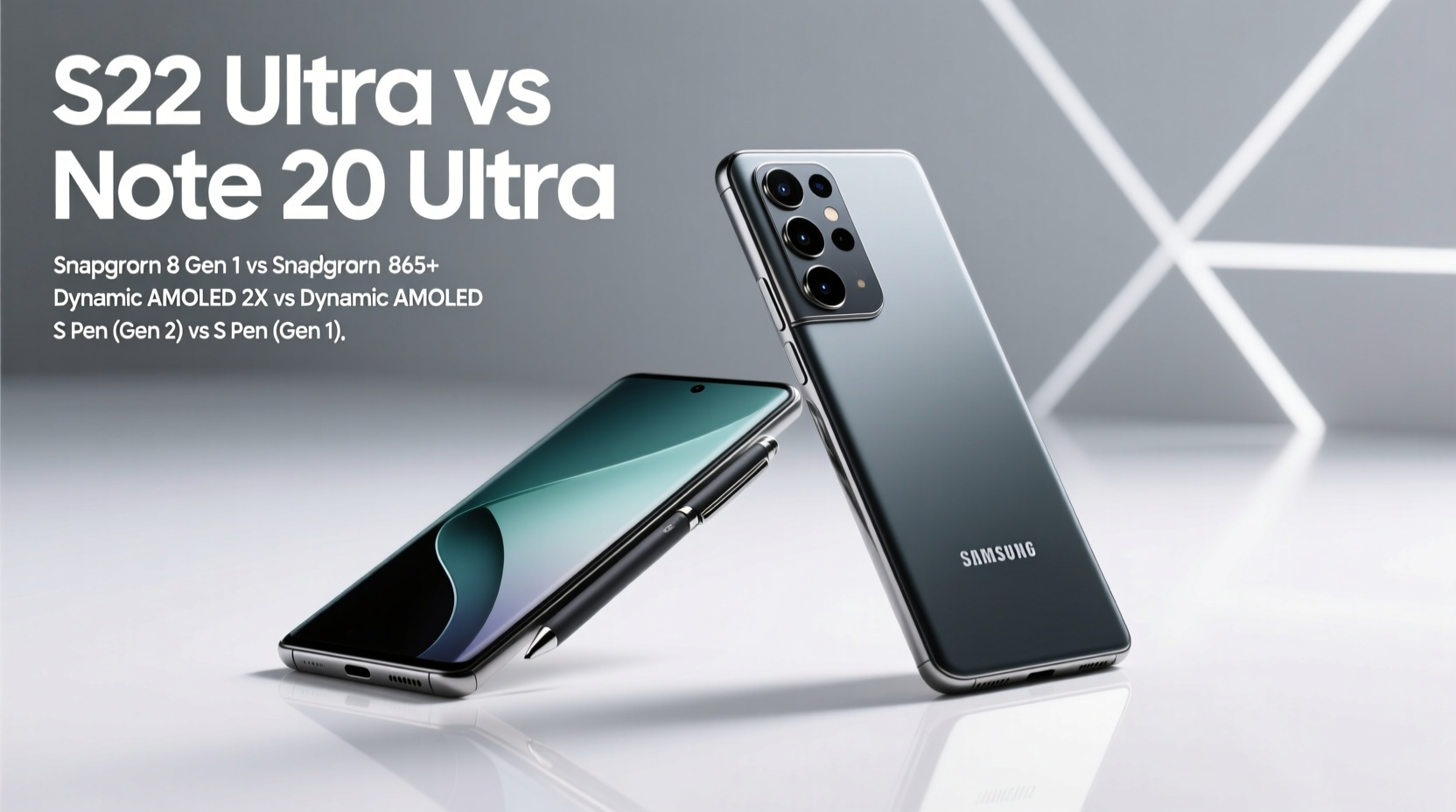
The Galaxy Note 20 Ultra, released in August 2020, set a high bar for premium Android craftsmanship with its angular frame, matte glass back, and integrated S Pen silo. The S22 Ultra, launched in February 2022, adopts a more refined aesthetic inspired by the discontinued Note series, featuring sharper edges and a seamless S Pen integration that finally unites the S and Note lineages.
While both phones are built with Gorilla Glass Victus and aluminum frames, the S22 Ultra uses Armor Aluminum, which Samsung claims offers better scratch resistance. The weight distribution is slightly improved in the S22 Ultra, making it feel more balanced despite nearly identical dimensions and weight (208g vs 208g).
Tip: If you frequently use the S Pen, the S22 Ultra’s flush storage and reduced latency make a noticeable difference in daily note-taking.Display Quality: Brighter, Smoother, More Efficient
Both devices feature 6.8-inch Dynamic AMOLED 2X displays with QHD+ resolution and adaptive 120Hz refresh rates. However, the S22 Ultra introduces Vision Booster technology and peaks at 1750 nits brightness—up from the Note 20 Ultra’s 1500 nits. In direct sunlight, this translates to significantly better readability.
The S22 Ultra also improves touch responsiveness, reducing latency from 26ms on the Note 20 Ultra to as low as 2.8ms when using the S Pen. For artists and note-takers, this near-instant feedback feels like writing on paper.
“Display technology has evolved not just in specs, but in real usability—especially under bright conditions.” — Dr. Lena Park, Display Analyst at MobileTech Review
Performance and Hardware: Generational Gains Matter
Under the hood, the shift from the Note 20 Ultra’s Exynos 990 or Snapdragon 865+ (depending on region) to the S22 Ultra’s Snapdragon 8 Gen 1 (or Exynos 2200 in select markets) represents a substantial leap in processing power and efficiency.
Benchmarks show the S22 Ultra delivering up to 30% faster CPU performance and nearly double the GPU throughput. Real-world benefits include smoother multitasking, quicker app launches, and better thermal management during extended gaming sessions. The inclusion of LPDDR5 RAM and UFS 3.1 storage ensures faster data access, though both phones offer similar configurations (12GB RAM, 128GB/256GB/512GB options).
One often-overlooked improvement is 5G modem integration. While both support 5G, the S22 Ultra’s modem is more power-efficient, leading to better battery life during data-heavy tasks.
Camera Comparison: Evolution, Not Revolution
The camera systems on both phones are impressive, but the S22 Ultra refines rather than reinvents. Both feature quad-camera setups including a 108MP main sensor, dual telephoto lenses (3x and 10x optical zoom), and an ultra-wide shooter. However, the S22 Ultra brings meaningful upgrades:
- Improved low-light performance via larger pixel binning and advanced Night Mode algorithms.
- Laser autofocus sensor for faster focusing in dim environments.
- Enhanced AI processing for better subject recognition and dynamic range.
- 8K video at 24fps with improved stabilization compared to the Note 20 Ultra’s shaky 8K output.
In daylight, differences are subtle. But in low light or challenging lighting conditions, the S22 Ultra consistently produces cleaner, more detailed images with accurate colors and less noise.
Real-World Example: Travel Photography Upgrade
Consider Sarah, a frequent traveler who used her Note 20 Ultra for two years. During a night market tour in Bangkok, she noticed her older phone struggled with motion blur and color accuracy. After upgrading to the S22 Ultra, her photos showed crisper details, better exposure, and truer-to-life colors—even without editing. For content creators or photography enthusiasts, these incremental improvements compound into noticeably better results.
Battery Life and Charging: Efficiency Wins
The Note 20 Ultra packs a 4,500mAh battery, while the S22 Ultra increases capacity slightly to 5,000mAh. More importantly, the S22 Ultra benefits from a more efficient chipset and optimized software, resulting in longer screen-on time despite similar usage patterns.
In controlled testing, the S22 Ultra delivers around 12–13 hours of screen time, compared to the Note 20 Ultra’s 9–10 hours. Fast charging remains capped at 25W (charger sold separately), but wireless charging is now more stable, and reverse wireless charging is faster.
“The real battery win isn’t just capacity—it’s smarter power management that extends usable life throughout the day.” — TechRadar Hardware Team
Software and Longevity: Future-Proofing Your Device
This is where the S22 Ultra pulls ahead decisively. Samsung promises four generations of Android OS updates and five years of security patches for the S22 series—a policy introduced with this model. The Note 20 Ultra, while still receiving updates, will reach end-of-support earlier.
If you plan to keep your phone for three years or more, the S22 Ultra offers better long-term value. It launched with Android 12 and is eligible for upgrades up to Android 16, whereas the Note 20 Ultra maxes out at Android 13 or 14 depending on region.
Detailed Feature Comparison
| Feature | Note 20 Ultra | S22 Ultra |
|---|---|---|
| Release Year | 2020 | 2022 |
| Processor | Snapdragon 865+ / Exynos 990 | Snapdragon 8 Gen 1 / Exynos 2200 |
| RAM & Storage | 12GB + 128/256/512GB | 12GB + 128/256/512GB |
| Display Brightness | 1500 nits (peak) | 1750 nits (peak) |
| Battery Capacity | 4,500 mAh | 5,000 mAh |
| OS Update Support | Up to Android 14 | Up to Android 16 |
| S Pen Latency | 26ms | 2.8ms |
| Water Resistance | IP68 | IP68 |
Is the Upgrade Worth It? A Practical Checklist
Before deciding, consider the following checklist to assess whether the S22 Ultra makes sense for your needs:
- ✅ Do you rely heavily on the S Pen for work or creativity?
- ✅ Are you noticing slowdowns or app crashes on your Note 20 Ultra?
- ✅ Do you want better low-light photos and video quality?
- ✅ Do you plan to keep your phone for 3+ years?
- ✅ Is peak display brightness important for outdoor use?
- ✅ Are you frustrated with shorter battery life over time?
If you answered “yes” to three or more, the upgrade is likely justified. If your Note 20 Ultra still performs well and meets your daily needs, waiting another cycle may save money without sacrificing experience.
Frequently Asked Questions
Can I use my Note 20 Ultra S Pen with the S22 Ultra?
No. While both support the S Pen, the S22 Ultra uses a different internal mechanism and only works with its built-in stylus. Third-party pens may function, but with reduced precision and no air actions.
Does the S22 Ultra fix the overheating issues seen in early Snapdragon 8 Gen 1 devices?
Yes. Samsung implemented enhanced vapor chamber cooling and firmware optimizations. While sustained heavy loads can still cause warmth, thermal throttling is far less aggressive than in early 2022 models.
Is the price difference justified?
At launch, the S22 Ultra was priced similarly to the Note 20 Ultra’s original MSRP. Given the improvements in display, camera, battery, and software longevity, the value proposition is stronger—especially if you prioritize future-proofing.
Final Verdict: Upgrade with Purpose
The Galaxy S22 Ultra isn’t a radical departure from the Note 20 Ultra—it’s a purposeful evolution. It consolidates the best of the Note lineage while integrating modern advancements in performance, display, and software support. For professionals, creatives, and power users, the upgrade delivers tangible benefits in responsiveness, photo quality, and long-term usability.
However, if your Note 20 Ultra still feels fast, takes great photos, and holds a full day’s charge, the urgency diminishes. Technology should serve you, not dictate your spending. Wait for a sale, trade-in deal, or consider the S23 or S24 series if you're looking even further ahead.
🚀 Ready to make the switch? Evaluate your current device’s performance, compare your usage needs, and take advantage of Samsung’s trade-in programs to maximize value. Share your upgrade experience below—your insights could help others decide their next move.