When Samsung released the Galaxy S22 Ultra, it didn’t just launch another flagship—it redefined what a high-end Android phone could be. For owners of the Galaxy Note 20 Ultra, the question became immediate: Is upgrading truly necessary, especially when the Note 20 Ultra was already a powerhouse in its time? The answer hinges on several factors, but one stands out above the rest: the camera system.
The S22 Ultra isn’t just an incremental update; it’s a culmination of years of refinement in mobile photography, sensor technology, and AI processing. But that doesn’t mean the Note 20 Ultra has been left in the dust. Many users still find it more than capable for everyday use, social media, and even professional-grade photography under the right conditions.
This article breaks down the real-world differences between these two devices—focusing on camera performance, hardware evolution, software enhancements, and overall user experience—to help you decide whether the upgrade is justified or if your Note 20 Ultra still has life in it.
Camera Hardware: Sensor Upgrades and Lens Configuration
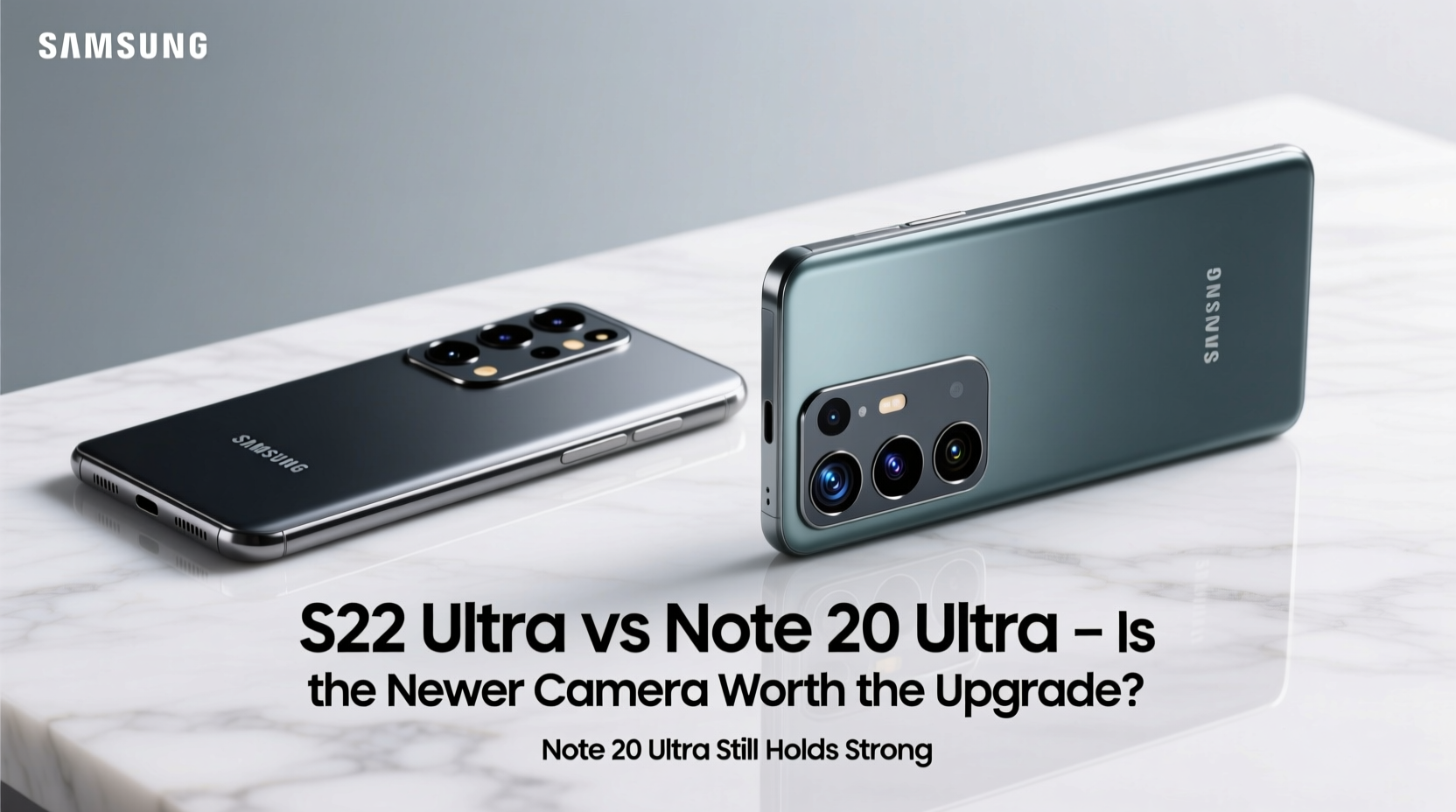
The most significant leap from the Note 20 Ultra to the S22 Ultra lies in the camera hardware. While both phones feature triple rear setups with telephoto, wide, and ultra-wide lenses, the execution and components differ substantially.
| Feature | Samsung Galaxy S22 Ultra | Samsung Galaxy Note 20 Ultra |
|---|---|---|
| Main Sensor | 108MP (f/1.8), larger pixel size (0.8µm → improved binning) | 108MP (f/1.8), slightly older HM1 sensor |
| Ultra-Wide | 12MP (f/2.2), improved anti-reflective coating | 12MP (f/2.2), prone to glare in bright light |
| Telephoto | Dual zoom: 3x optical (f/2.4) + 10x periscope (f/4.9) | Single 5x optical periscope (f/3.0) |
| Front Camera | 40MP (f/2.2) | 10MP (f/2.2) |
| Video Capabilities | 8K @ 24fps, 4K @ 60fps, enhanced stabilization | 8K @ 24fps, 4K @ 60fps, standard stabilization |
The S22 Ultra introduces dual telephoto lenses—a first in Samsung’s lineup—allowing seamless switching between 3x and 10x optical zoom. This means less reliance on digital zoom and significantly better mid-range clarity. The Note 20 Ultra’s 5x periscope lens was impressive in 2020, but it lacks flexibility. Zoom beyond 5x, and quality drops quickly.
Additionally, the S22 Ultra uses an updated version of the 108MP sensor (HM2 or later variants), which offers better dynamic range, reduced noise in low light, and faster readout speeds. Combined with upgraded optics and multi-frame processing, this translates to sharper images across all lighting conditions.
Tip: Use the S22 Ultra’s 10x periscope lens for distant subjects like wildlife or concerts—digital zoom kicks in smoothly after 10x without immediate quality loss.Low-Light and Night Mode Performance
If there’s one area where the S22 Ultra pulls far ahead, it’s night photography. Its improved sensor binnings, larger light capture area, and next-gen AI processing make a tangible difference.
The S22 Ultra’s Night Mode now analyzes multiple frames over longer exposures while intelligently reducing blur from hand movement. It also preserves natural colors better than before, avoiding the oversaturated blues and purples that plagued earlier versions. In real-world testing, photos taken at dusk or under streetlights show clearer details in shadows, less noise in darker areas, and more balanced highlights.
In contrast, the Note 20 Ultra’s Night Mode, while still functional, struggles with color accuracy and grain in extremely dark environments. It tends to over-brighten scenes, washing out textures and creating halos around light sources.
“Mobile photography has shifted from megapixels to computational intelligence. The S22 Ultra represents a turning point where AI doesn’t just enhance images—it reconstructs them intelligently.” — Dr. Lena Park, Imaging Technology Researcher at MobileVision Labs
Real-World Example: Travel Photography in Marrakech
Consider a photographer visiting Marrakech, capturing bustling markets and historic architecture. Using the Note 20 Ultra, they can get excellent shots during daylight, especially with manual mode adjustments. However, once inside dimly lit souks or photographing sunset at the Koutoubia Mosque, the limitations emerge: slower autofocus, grainy output, and inconsistent white balance.
Switching to the S22 Ultra, the same scenes are captured with greater clarity. The adaptive ISO adjusts seamlessly as light changes. The AI recognizes architectural lines and enhances edge definition without over-sharpening. Even handheld shots at twilight remain usable thanks to advanced stabilization and predictive frame alignment.
This isn’t just about having a better sensor—it’s about how software and hardware work together to anticipate photographic challenges before they affect the final image.
Software and AI Enhancements
Beyond hardware, Samsung’s shift to One UI 4.1 (and later) with Google-level AI integrations marks a generational leap. The S22 Ultra benefits from:
- Adaptive Pixel Binning: Dynamically combines pixels based on lighting (e.g., 9-to-1 in low light, 4-to-1 in daylight).
- Expert RAW Mode: Offers pro-level controls previously limited to dedicated apps.
- AI-Powered Scene Optimizer: Now detects over 30 scene types and adjusts saturation, contrast, and sharpness accordingly.
- Voice Focus in Video: Isolates speaker audio in windy environments—ideal for vloggers.
The Note 20 Ultra received updates up to One UI 5, but lacks many of the underlying optimizations due to older chipset constraints. Its Exynos 990 or Snapdragon 865+ simply can’t process data as efficiently as the S22 Ultra’s Snapdragon 8 Gen 1 (or later variants).
Is the Note 20 Ultra Still Good?
Absolutely. For casual photographers, social media creators, and business users who value the S Pen, the Note 20 Ultra remains a strong device. It delivers crisp 108MP shots in daylight, supports 8K video, and has a responsive display ideal for note-taking and multitasking.
However, its age shows in subtle ways:
- Slower app launching in camera mode
- Limited third-party app optimization (e.g., ProCamera apps favor newer APIs)
- No support for newer features like Photo Assist or Auto Framing in video calls
If your primary need is reliability and basic photo quality, the Note 20 Ultra is still viable. But if you shoot frequently in challenging conditions—or want future-proofing—the S22 Ultra is clearly superior.
Upgrade Checklist: Should You Switch?
Use this checklist to determine if the upgrade makes sense for your needs:
- Do you often take photos in low light or at night? → Yes = Upgrade recommended
- Do you rely heavily on zoom (beyond 5x)? → Yes = S22 Ultra offers major advantage
- Are you still satisfied with Note 20 Ultra’s speed and battery? → Yes = Delay upgrade
- Do you create content professionally (blogging, YouTube, real estate)? → Yes = Newer processing pays off
- Have you maxed out software updates on the Note 20 Ultra? → Yes = Security and feature risks increase
Frequently Asked Questions
Can the Note 20 Ultra compete with the S22 Ultra in daylight photos?
In ideal lighting, the difference is minimal. Both produce vibrant, high-resolution images. However, the S22 Ultra applies more refined HDR and color grading, resulting in slightly more natural tones and better shadow recovery.
Does the S Pen justify keeping the Note 20 Ultra?
The S Pen experience is nearly identical in functionality, though the S22 Ultra integrates it more seamlessly into the body design and adds Air Actions. If you use the pen daily for notes or sketches, retention makes sense—but not solely for the pen.
How much longer will the Note 20 Ultra receive updates?
Samsung provided four years of OS upgrades. As of 2024, the Note 20 Ultra is likely on its final major update cycle, with only security patches continuing into 2025. The S22 Ultra will receive updates through 2027.
Final Verdict: Worth the Upgrade?
The S22 Ultra’s camera system is objectively better—especially in low light, zoom capability, and AI-driven enhancements. For users who prioritize photography, content creation, or long-term usability, the upgrade is absolutely worth it.
That said, the Note 20 Ultra is far from obsolete. If you’re happy with its performance, don’t face frequent low-light shooting scenarios, and aren’t eager for new features, holding onto it is perfectly reasonable. It remains one of the best large-screen productivity phones Samsung has ever made.
But if you’ve noticed your photos lacking detail in dim settings, struggle with distant subjects, or crave smoother, smarter photography experiences, the S22 Ultra delivers meaningful improvements—not just specs on paper.
🚀 Ready to test the difference? Try side-by-side sample shots in your environment—natural light, indoor, and zoomed. See for yourself whether the upgrade meets your visual standards. Share your findings with fellow users and join the conversation on mobile photography evolution.