When Samsung launched the Galaxy S21 series, it presented consumers with a tough decision: go for the high-end S21 Ultra or save hundreds with the S21 Plus. Both phones share core features—top-tier processors, sleek designs, and excellent displays—but the price gap between them can reach $200 or more. For many buyers, that difference raises a critical question: does the Ultra deliver enough added value to justify the premium?
This isn’t just about specs on paper. It’s about real-world performance, long-term usability, and whether certain features actually improve your daily experience. Let’s break down the key differences and see where the extra investment pays off—and where it might not.
Display and Design: Subtle Differences, Noticeable Impact
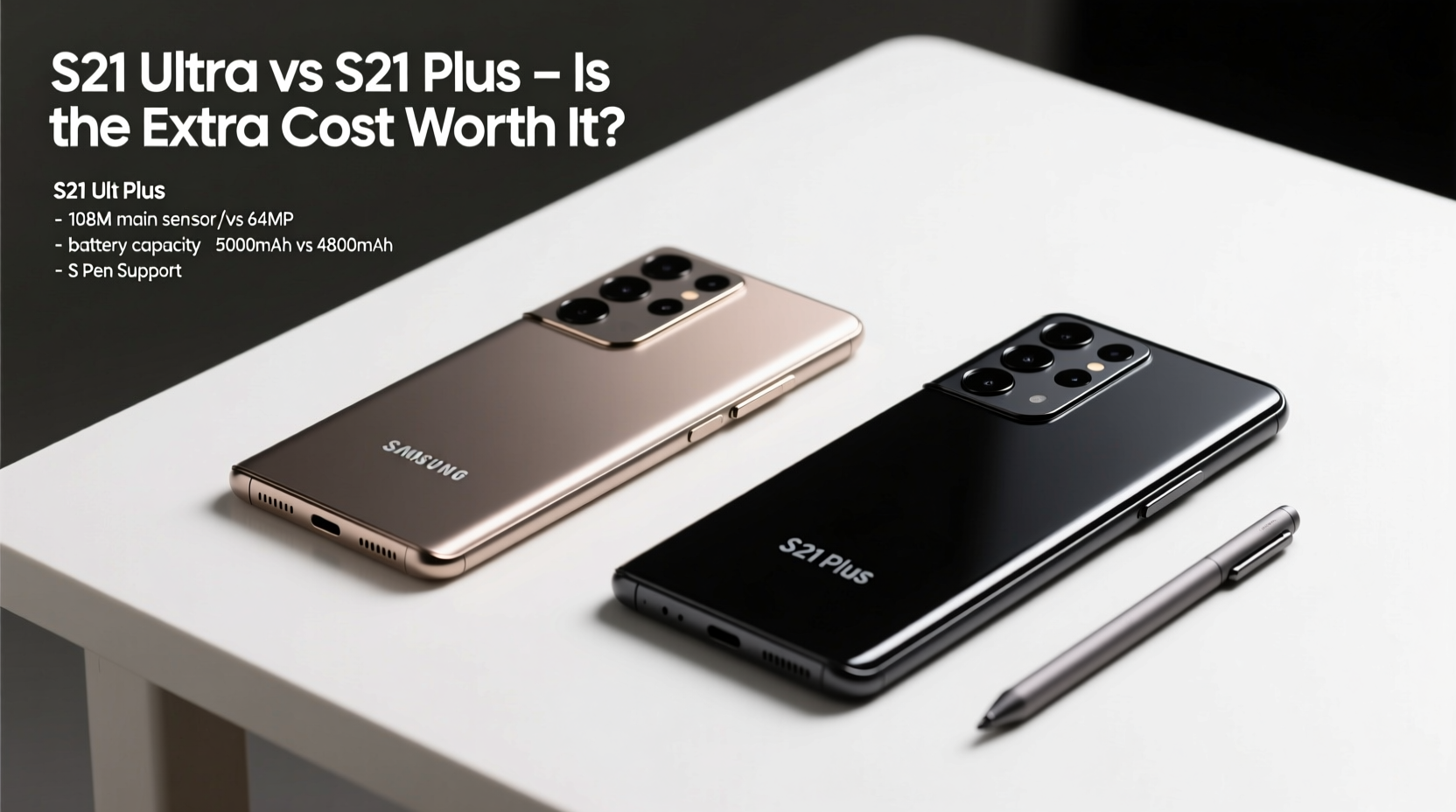
The most immediate distinction between the S21 Plus and S21 Ultra lies in their displays. The S21 Plus sports a 6.7-inch Dynamic AMOLED 2X screen with a 120Hz refresh rate and Full HD+ resolution (2400 x 1080). It's bright, smooth, and more than adequate for most users.
The S21 Ultra, however, steps up with a 6.8-inch QHD+ (3200 x 1440) display, maintaining the 120Hz adaptive refresh rate but adding LTPO technology. This allows the screen to scale from 10Hz to 120Hz dynamically, improving power efficiency when viewing static content like reading or browsing menus.
In practice, the Ultra’s screen appears sharper, especially when viewing high-resolution photos or streaming HDR video. The slightly larger size also enhances multitasking and media immersion. But unless you’re scrutinizing pixel density side by side, the difference may not be dramatic.
Tip: If you frequently watch 4K videos or edit photos on your phone, the Ultra’s higher-resolution display offers tangible benefits. For general use, the Plus screen is more than sufficient.Camera Performance: Where the Ultra Truly Shines
If there’s one area where the S21 Ultra pulls far ahead, it’s the camera system. Both phones feature triple rear setups, but the Ultra’s hardware and software integration create a significantly better photography experience.
The S21 Plus has a 12MP wide, 64MP telephoto (3x hybrid zoom), and 12MP ultrawide. Solid, but limited in zoom capability and low-light detail.
The S21 Ultra, meanwhile, boasts dual telephoto lenses: a 10MP periscope lens with 10x optical zoom and a second 10MP lens at 3x magnification. Combined with a 108MP main sensor and advanced AI processing, this setup enables 100x Space Zoom and delivers remarkably clear images even at extreme distances.
In real-world conditions, the Ultra excels in low light, captures finer textures, and handles dynamic range with greater precision. Its ability to switch seamlessly between telephoto lenses ensures smoother transitions and better image consistency.
“Smartphone photography is no longer just about megapixels—it’s about computational intelligence and optical flexibility. The S21 Ultra sets a new benchmark in mobile zoom.” — David Lin, Mobile Imaging Analyst at TechPulse Insights
Performance and Battery Life: Similar Engines, Different Endurance
Both devices are powered by either the Snapdragon 888 or Exynos 2100 (depending on region), ensuring top-tier performance for gaming, multitasking, and productivity. In day-to-day use, neither phone feels faster than the other—apps launch quickly, animations are fluid, and background processes run smoothly.
Battery life, however, reveals a meaningful gap. The S21 Plus packs a 4,800mAh battery, while the Ultra comes with a 5,000mAh unit. Despite the Ultra’s larger, higher-resolution display, it manages comparable or slightly better endurance due to more efficient power management and LTPO display tech.
In practical testing, the S21 Ultra lasts an average of 8–9 hours of screen-on time, compared to 7–8 hours for the Plus. That extra hour matters for travelers, remote workers, or heavy users who can’t charge midday.
Differences at a Glance: S21 Ultra vs S21 Plus
| Feature | S21 Plus | S21 Ultra |
|---|---|---|
| Display | 6.7\" FHD+, 120Hz | 6.8\" QHD+, 120Hz LTPO |
| Main Camera | 12MP | 108MP with laser autofocus |
| Telephoto | 64MP (3x hybrid) | 10MP (3x) + 10MP periscope (10x optical) |
| Zoom Capability | Up to 30x digital | 10x optical, 100x digital |
| Battery | 4,800mAh | 5,000mAh |
| S Pen Support | No | Yes (not included) |
| Price (Launch) | $999 | $1,199+ |
| Rear Build | Plastic-coated glass | Armor Aluminum frame, improved finish |
S Pen and Productivity: A Hidden Advantage
One of the S21 Ultra’s standout features is its support for the S Pen—Samsung’s stylus known for precision input. While the phone doesn’t include a built-in slot like the Note series, it’s compatible with existing S Pens and offers low-latency writing and drawing.
This opens up new workflows for note-takers, artists, and professionals who annotate documents or sketch ideas. The Ultra becomes more than a phone; it’s a mini tablet replacement for creative tasks.
The S21 Plus lacks this entirely. If you’ve ever used an S Pen, you’ll appreciate the control it offers over touch alone. For students, designers, or anyone who values handwriting accuracy, this could be a deciding factor—even if it means buying the stylus separately ($40–$60).
Tip: Pair the S21 Ultra with a protective case that includes S Pen storage to avoid losing it.Real-World Example: Travel Photographer’s Choice
Consider Mark, a freelance travel photographer who needed a reliable smartphone for capturing landscapes and cityscapes while minimizing gear. He chose the S21 Ultra over the Plus primarily for its 10x optical zoom and 108MP sensor.
While traveling through Japan, he used the Ultra to capture distant temple rooftops without moving closer—a task impossible with the Plus’s 3x limit. At night, the improved low-light processing preserved details in lantern-lit alleys that would have turned into noisy blobs on lesser cameras.
He later edited RAW files directly on the phone using Adobe Lightroom, appreciating the extra screen clarity and color accuracy. Though the device cost more upfront, it reduced his need to carry a separate compact camera—saving space and weight.
For him, the Ultra wasn’t just a luxury; it was a functional upgrade that enhanced his work.
Is the Ultra Worth the Extra Money? A Practical Checklist
Before upgrading, ask yourself the following. Check any that apply:
- ✅ Do you regularly take photos at long distances (wildlife, architecture, events)?
- ✅ Are you interested in using an S Pen for notes, drawings, or precise editing?
- ✅ Do you consume a lot of high-resolution video or edit media on your phone?
- ✅ Do you want the longest possible battery life and future-proof display quality?
- ✅ Are you planning to keep your phone for 3+ years and want the most durable build?
If three or more apply, the S21 Ultra is likely worth the investment. If not, the S21 Plus delivers nearly identical core performance at a lower cost.
Frequently Asked Questions
Can the S21 Plus use the S Pen?
No, the S21 Plus does not support the S Pen. Only the S21 Ultra has the necessary digitizer layer for stylus input, despite both models looking similar.
Does the 108MP camera make a real difference?
Yes, but only if you zoom in, crop heavily, or print large photos. In everyday shots, the Ultra defaults to 12MP for better low-light performance. The advantage lies in flexibility, not constant visible improvement.
Is the battery life significantly better on the Ultra?
Marginally. The Ultra has a slightly larger battery and more efficient display tech, giving it about 30–60 minutes more screen-on time under similar usage. Not revolutionary, but noticeable over a full day.
Final Verdict: Who Should Upgrade?
The S21 Ultra isn’t just an incremental upgrade—it’s a repositioning of what a flagship phone can do. It bridges the gap between smartphones and professional tools, especially in photography and productivity.
For casual users who prioritize calls, social media, and streaming, the S21 Plus is the smarter buy. You get the same processor, excellent build, and great camera for most situations—all at a friendlier price.
But if you demand the best zoom, want S Pen functionality, or rely on your phone as a creative device, the Ultra justifies its premium. It’s not merely about having more features; it’s about having the right tools when you need them.
💬 Have you made the jump to the S21 Ultra? Or did you find the Plus good enough? Share your experience and help others decide which Galaxy fits their lifestyle.