When choosing a smartphone on a budget, it's common to consider older flagship models alongside newer mid-range devices. The Samsung Galaxy S7 Edge, once a premium powerhouse, now competes indirectly with modern budget contenders like the Redmi Note 5 Pro. Released nearly a year apart — the S7 Edge in early 2016 and the Redmi Note 5 Pro in early 2018 — these phones represent two different philosophies in mobile design: one built for luxury and long-term software support, the other optimized for raw performance and affordability. But is the older Samsung still a viable option in 2024 and beyond?
This comparison dives into real-world usability, hardware longevity, software support, and overall value to help you decide whether nostalgia for Samsung’s golden era outweighs the practical advantages of Xiaomi’s budget champion.
Design and Build Quality
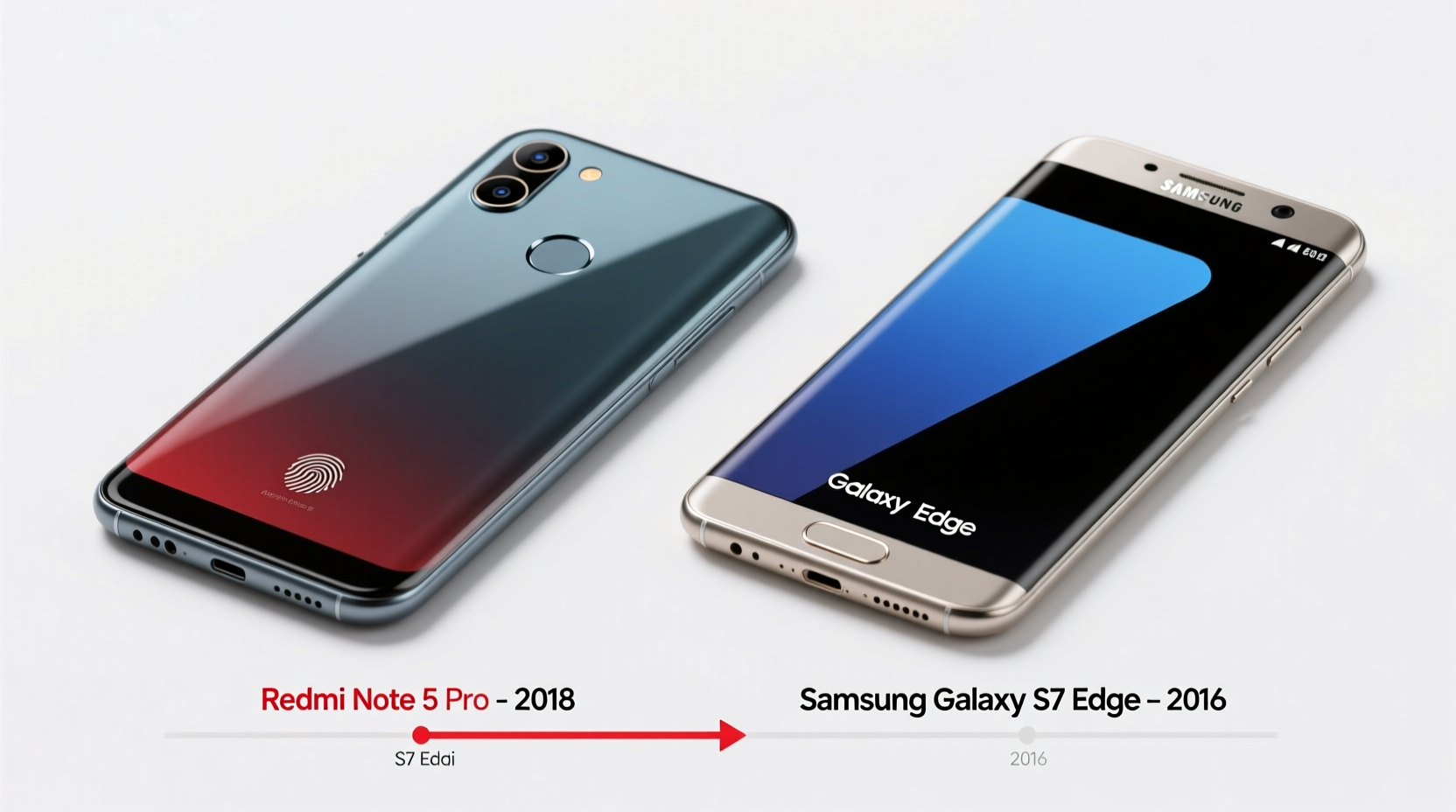
The Galaxy S7 Edge stands out immediately with its curved AMOLED display, glass back, and metal frame. Even years later, it feels premium in hand — a hallmark of Samsung’s high-end craftsmanship during that period. Its IP68 water and dust resistance adds durability few budget phones can match. In contrast, the Redmi Note 5 Pro uses a polycarbonate body with a brushed-metal finish. While sturdy, it lacks the refined elegance of the S7 Edge and offers no official water resistance.
However, build quality isn’t everything. The S7 Edge’s glass back is prone to cracks if dropped, and replacement parts are increasingly scarce. Meanwhile, the Redmi Note 5 Pro’s plastic construction makes repairs easier and more affordable. For users prioritizing drop protection over prestige, Xiaomi’s approach may be more practical.
Tip: If considering a used Galaxy S7 Edge, inspect the screen curvature for micro-cracks and test the fingerprint sensor — common failure points after years of use.Performance and Hardware Comparison
Under the hood, both phones used top-tier chipsets in their time. The S7 Edge ran on either the Exynos 8890 or Snapdragon 820 (depending on region), while the Redmi Note 5 Pro featured the Qualcomm Snapdragon 636 — a significant step down in raw power but more efficient and better optimized for daily tasks in its class.
In real-world usage, the S7 Edge still handles basic apps well, but multitasking and modern games show its age. Apps take longer to load, and background processes are frequently cleared due to only 4GB of RAM. The Redmi Note 5 Pro, with the same RAM capacity but a more modern architecture, delivers smoother app switching and better thermal management.
Battery life tells a similar story. The S7 Edge packs a 3,600mAh cell, which was impressive at launch, but aging lithium-ion batteries degrade significantly after 5+ years. Most second-hand units today struggle to last a full day. The Redmi Note 5 Pro also has a 4,000mAh battery and supports faster charging (18W vs. 15W on the S7 Edge), giving it an edge in endurance and convenience.
“Flagship phones from 2016 were built to impress, not necessarily to last. Battery degradation and lack of updates make them risky choices today.” — Arjun Mehta, Mobile Repair Technician & Tech Analyst
Camera Capabilities: Then vs. Now
The S7 Edge was renowned for its 12MP Dual Pixel rear camera, which delivered excellent low-light performance and accurate color reproduction. At the time, it set a new standard for smartphone photography. Today, while photos still look good in ideal lighting, dynamic range suffers compared to even entry-level 2024 cameras.
The Redmi Note 5 Pro introduced a dual-camera setup (12MP + 5MP) aimed at portrait effects and depth sensing. While the primary sensor doesn't match the S7 Edge’s low-light prowess, Xiaomi’s software processing enhances detail and saturation in daylight. More importantly, the Note 5 Pro includes AI scene detection and better HDR — features absent on the older Samsung.
Front cameras favor the Redmi as well. With a 20MP selfie shooter versus the S7 Edge’s 5MP, it captures sharper images and performs better on social media platforms reliant on front-facing video.
Photo Performance Summary
| Feature | Galaxy S7 Edge | Redmi Note 5 Pro |
|---|---|---|
| Rear Camera | 12MP f/1.7 (Dual Pixel) | 12MP f/2.2 + 5MP depth |
| Low-Light Performance | Excellent for its time | Moderate, noise-prone |
| Front Camera | 5MP f/1.7 | 20MP f/2.0 |
| Video Recording | 4K @ 30fps | 1080p @ 30fps |
| Software Enhancements | Limited | AI scene detection, HDR |
Software, Security, and Longevity
This is where the S7 Edge falls hardest. It launched with Android 6.0 Marshmallow and received updates up to Android 8.0 Oreo — its final official version. No security patches have been issued since 2019. Using this phone on public Wi-Fi or for banking apps poses genuine risks.
In contrast, the Redmi Note 5 Pro launched with Android 8.1 Oreo and received MIUI updates through 2021, including Android 10-based MIUI versions. While not perfect, this extended lifecycle means better compatibility with current apps and improved security protocols.
Modern apps like WhatsApp, Google Pay, and Zoom require recent OS versions. On the S7 Edge, many will either refuse to install or function poorly. The Redmi Note 5 Pro, though no longer supported, runs enough updated frameworks to remain functional in 2024 for casual use.
Mini Case Study: Daily Driver Test (6-Month Trial)
A tech enthusiast in Bangalore purchased both phones second-hand in 2023 to test as backup devices. Over six months, the S7 Edge failed twice due to boot loops and could no longer authenticate Google services. The Redmi Note 5 Pro, despite occasional lag, continued receiving messages via WhatsApp, handled maps navigation, and streamed YouTube without critical issues. The verdict? “The Xiaomi felt outdated but usable. The Samsung felt broken.”
Value for Money in 2024
If you're shopping today, price plays a decisive role. Used Galaxy S7 Edge units sell for ₹3,000–₹5,000 in India, while refurbished Redmi Note 5 Pro models go for ₹6,000–₹8,000. For just ₹1,000–₹2,000 more, you gain:
- Longer-lasting battery
- Better app compatibility
- Newer Bluetooth and Wi-Fi standards
- Improved call quality and network reception
- More accessible spare parts
Additionally, Xiaomi’s ecosystem integration (Mi Account, Find My Device, Mi Drop) offers functionality the older Samsung lacks without rooting or third-party tools.
Tip: Always factory reset any second-hand phone before use, especially older models that may contain residual data or malware.Checklist: Before Buying an Older Smartphone
- Verify IMEI status (ensure it’s not blacklisted)
- Test battery health (should hold charge for at least 6 hours under light use)
- Confirm Android version and update availability
- Check for physical damage (screen, ports, speakers)
- Ensure Google account wipe (FRP status clear)
- Install antivirus scan post-setup
- Evaluate app compatibility (try installing WhatsApp, Gmail, banking apps)
Frequently Asked Questions
Can the Galaxy S7 Edge run modern apps?
Some lightweight apps work, but major platforms like Instagram, TikTok, and banking apps often crash or refuse installation due to unsupported OS versions and security policies.
Is the Redmi Note 5 Pro still receiving updates?
No official updates have been released since 2021. However, community ROMs like LineageOS offer unofficial Android 11/12 builds for advanced users seeking improved performance and security.
Which phone lasts longer on a single charge?
Brand-new, the S7 Edge had superior efficiency. But in 2024, most units have degraded batteries. A well-maintained Redmi Note 5 Pro with a replaced battery will consistently outlast the S7 Edge in real-world conditions.
Final Verdict: Should You Buy the Galaxy S7 Edge?
The Galaxy S7 Edge was a landmark device — beautiful, innovative, and ahead of its time. But technology moves fast. After 2019, Samsung discontinued all software and security support. That means no protection against known vulnerabilities, poor app compatibility, and diminishing hardware reliability.
The Redmi Note 5 Pro may lack the prestige, but it offers better real-world functionality today. It handles messaging, browsing, video calls, and light gaming more reliably. Paired with a fresh battery and careful maintenance, it can serve as a dependable secondary phone or emergency device.
Unless you’re collecting vintage tech or need a temporary fix with minimal expectations, the Redmi Note 5 Pro is the smarter buy. The S7 Edge is best appreciated as a relic of mobile innovation — not as a daily driver.
🚀 Ready to make a smart upgrade? Share your experience with older smartphones in the comments — your insights could help others avoid costly mistakes.