For years, Apple has catered to a wide range of users—from those who crave cutting-edge technology to those who value simplicity and compact design. The iPhone SE and iPhone 14 represent two very different philosophies in smartphone design. One prioritizes affordability and pocketability; the other delivers flagship performance and modern features. But for users considering an upgrade or first-time purchase, the real question remains: is the smaller size of the iPhone SE worth the compromises it brings?
This isn’t just about screen dimensions. It’s about how each phone fits into your daily life—how it feels in your hand, performs under pressure, captures memories, and lasts from morning to night. Let’s break down the key differences and trade-offs to help you decide which device aligns with your priorities.
Design and Ergonomics: Small Doesn’t Always Mean Simple
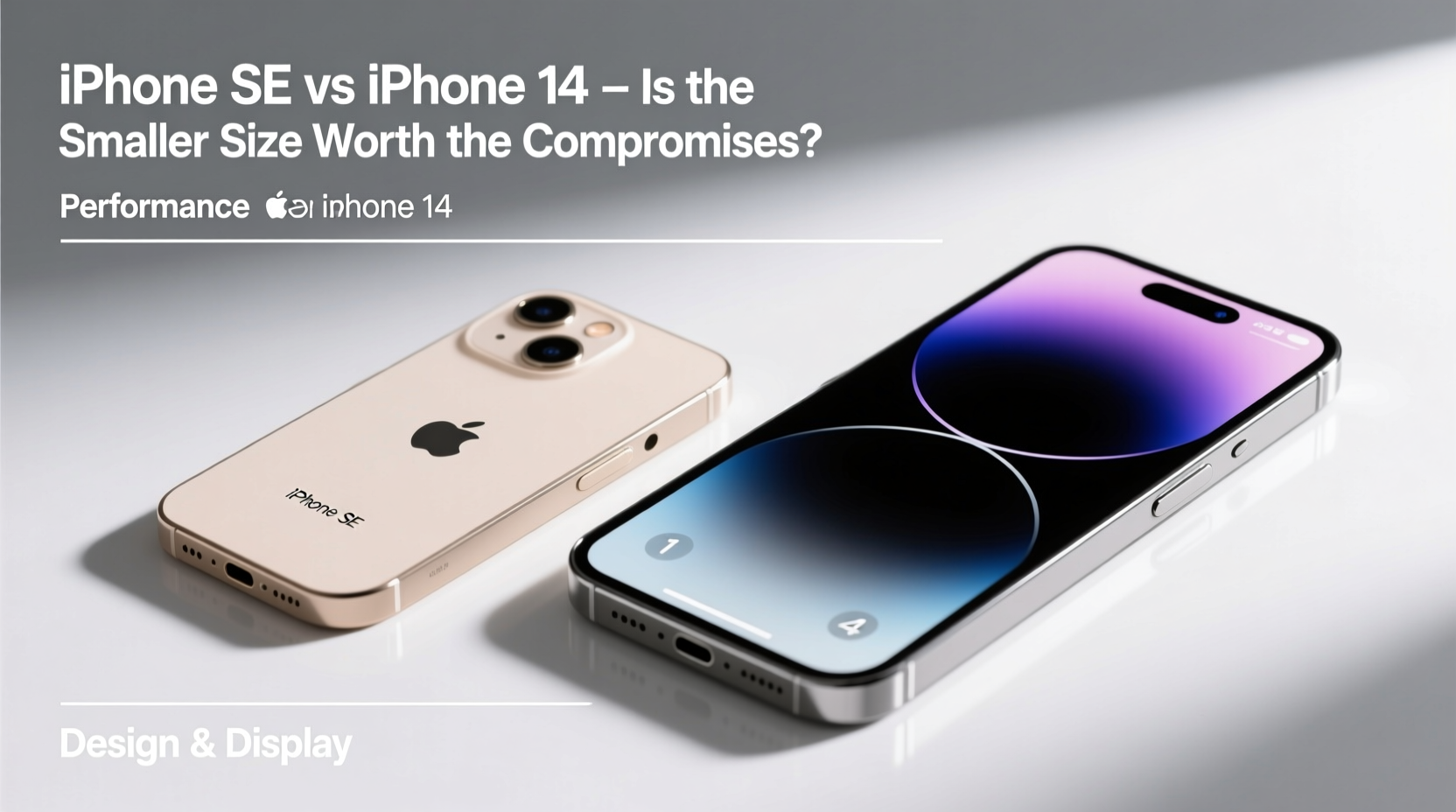
The most immediate difference between the iPhone SE (3rd gen) and the iPhone 14 is size. The SE measures 5.45 x 2.65 x 0.3 inches and weighs 4.87 oz, making it one of the few truly compact smartphones still available. In contrast, the iPhone 14 is significantly larger at 5.78 x 2.82 x 0.31 inches and 6.03 oz. For users with smaller hands or those who prioritize one-handed use, the SE offers unmatched comfort.
However, this compactness comes at a cost. The SE retains the older Touch ID home button design with thick bezels, while the iPhone 14 embraces Face ID and an edge-to-edge Super Retina XDR display. The larger screen on the iPhone 14 provides more real estate for multitasking, video consumption, and gaming—features that matter if you rely on your phone for productivity or entertainment.
Tip: If pocket space is critical and you mostly use your phone for calls, messages, and light apps, the iPhone SE’s size is a genuine advantage.Performance: Nearly Identical Chip, Very Different Experience
Surprisingly, both phones are powered by the same A15 Bionic chip—Apple’s powerhouse processor from 2021. On paper, they should perform identically. And in many tasks—app launches, web browsing, photo editing—they do. However, real-world usage reveals subtle but meaningful differences.
The iPhone SE uses a four-core GPU version of the A15, while the iPhone 14 uses a five-core variant. This means slightly better graphics performance on the 14, particularly noticeable in high-end games and AR applications. Additionally, the iPhone 14 benefits from improved thermal management due to its larger chassis, allowing it to sustain peak performance longer during extended use.
Storage options also differ. The SE starts at 64GB (with 128GB and 256GB options), while the iPhone 14 begins at 128GB. For users who store large photo libraries, videos, or apps, starting at double the base storage is a significant advantage.
“Even with the same chip, system-level optimizations and hardware integration give the iPhone 14 a smoother, more responsive feel over time.” — David Lin, Mobile Hardware Analyst at TechPulse Insights
Camera Capabilities: One Lens vs. Two, But It’s More Than That
The iPhone SE features a single 12MP wide camera. It’s capable in good lighting but lacks Night mode on the front camera, ultra-wide shots, and advanced computational photography features like Photographic Styles and Smart HDR 4 found on the iPhone 14. The front-facing camera is also limited to 7MP without Center Stage support.
In contrast, the iPhone 14 includes a dual-camera system: a 12MP main sensor and a 12MP ultra-wide lens. This opens up creative possibilities—capturing sweeping landscapes, fitting more people in group shots, or shooting close-up macro photos. The iPhone 14 also supports Photonic Engine, improving low-light detail across all cameras.
Video recording sees even starker differences. The iPhone 14 supports Action mode—a stabilization feature ideal for moving shots—and can record in Dolby Vision HDR at 4K up to 60fps. The SE maxes out at 4K/30fps with no stabilization beyond standard digital.
Real-World Example: Capturing Family Moments
Consider Sarah, a parent who uses her phone to document her child’s milestones. With the iPhone SE, she struggles to fit everyone in frame during birthday parties and often misses crisp nighttime shots. After switching to the iPhone 14, she gains ultra-wide framing for crowded scenes, better low-light performance, and smoother video when filming active playtime. The extra camera features directly improve her ability to preserve memories.
Battery Life and Charging: Efficiency vs. Endurance
Despite its smaller battery, the iPhone SE benefits from efficient hardware and iOS optimization. Apple rates it for up to 15 hours of video playback. The iPhone 14, with a larger battery and more power-hungry display, offers up to 20 hours—making it more reliable for heavy users or travel days.
Neither phone includes a charger in the box, but both support fast charging (up to 50% in 30 minutes with a 20W+ adapter) and MagSafe accessories. However, only the iPhone 14 supports Emergency SOS via satellite and Crash Detection—safety features that could be lifesaving in remote areas or after accidents.
Tip: If you frequently travel, hike, or drive long distances, the iPhone 14’s emergency features add meaningful peace of mind.Detailed Comparison Table
| Feature | iPhone SE (2022) | iPhone 14 (2022) |
|---|---|---|
| Display | 4.7” Retina HD (LCD) | 6.1” Super Retina XDR (OLED) |
| Biometrics | Touch ID (home button) | Face ID |
| Rear Cameras | 12MP Wide | 12MP Wide + 12MP Ultra-Wide |
| Front Camera | 7MP | 12MP with Center Stage |
| Video Recording | 4K@30fps, no Action mode | 4K@60fps, Action mode, Dolby Vision |
| Battery Life (Video) | Up to 15 hours | Up to 20 hours |
| Special Features | IP67, Touch ID | Emergency SOS via satellite, Crash Detection |
| Starting Price | $429 | $799 |
Who Should Choose Which Phone?
The decision ultimately hinges on lifestyle and priorities. Here’s a quick checklist to guide your choice:
- Choose the iPhone SE if:
- You prefer a phone that fits comfortably in one hand.
- You want Touch ID for easier access with masks or gloves.
- Your budget is under $500.
- You primarily use basic apps (calls, texts, email, social media).
- You don’t take many photos or videos.
- Choose the iPhone 14 if:
- You value modern design and edge-to-edge displays.
- You take a lot of photos or videos, especially in low light.
- You need longer battery life for full-day use.
- Safety features like Crash Detection are important.
- You plan to keep the phone for 4+ years and want future-proof performance.
Frequently Asked Questions
Can the iPhone SE run the latest apps smoothly?
Yes. Thanks to the A15 chip, the iPhone SE handles current iOS apps and games well. However, as software becomes more demanding over time, the lack of RAM (4GB vs. 6GB in the 14) may lead to earlier slowdowns.
Is the iPhone 14 worth nearly double the price?
It depends on your needs. If you value camera quality, screen size, battery life, and long-term usability, yes. But if you prioritize compactness and cost, the SE delivers exceptional value for its price.
Does the iPhone SE support 5G?
Yes, both models support 5G, though real-world speeds depend on carrier coverage and network congestion.
Final Verdict: Compromises Have Context
The iPhone SE proves that small phones aren’t obsolete. It’s a powerful, affordable option for users who don’t need bells and whistles. But the compromises—outdated design, limited camera, smaller screen—are real and grow more apparent over time.
The iPhone 14, while larger and more expensive, offers a complete modern smartphone experience. Its superior display, camera system, battery life, and safety features justify the premium for most users.
So, is the smaller size worth it? Only if compactness is non-negotiable and you’re willing to sacrifice photographic capability, screen immersion, and long-term versatility. For everyone else, the iPhone 14 represents a more balanced, future-ready investment.
💬 Still unsure which iPhone fits your lifestyle? Share your usage habits in the comments—we’ll help you decide whether size or substance should win.