Choosing between the iPhone SE (3rd generation) and the iPhone 13 Mini isn’t just about price or screen size—it’s a decision shaped by how you use your phone, what features matter most, and whether compactness comes at a premium worth paying. Both devices offer flagship-level processors and support for 5G, but they diverge sharply in design, display, camera capabilities, and overall user experience. For users prioritizing pocketability and iOS longevity, the comparison is especially nuanced.
The iPhone SE 3 starts at $429, while the iPhone 13 Mini begins at $599—a $170 difference that buys more than just a slightly larger body. This analysis breaks down where that extra investment goes and whether the 13 Mini’s refined compact form truly justifies its higher price tag.
Design and Usability: Size Isn't Everything
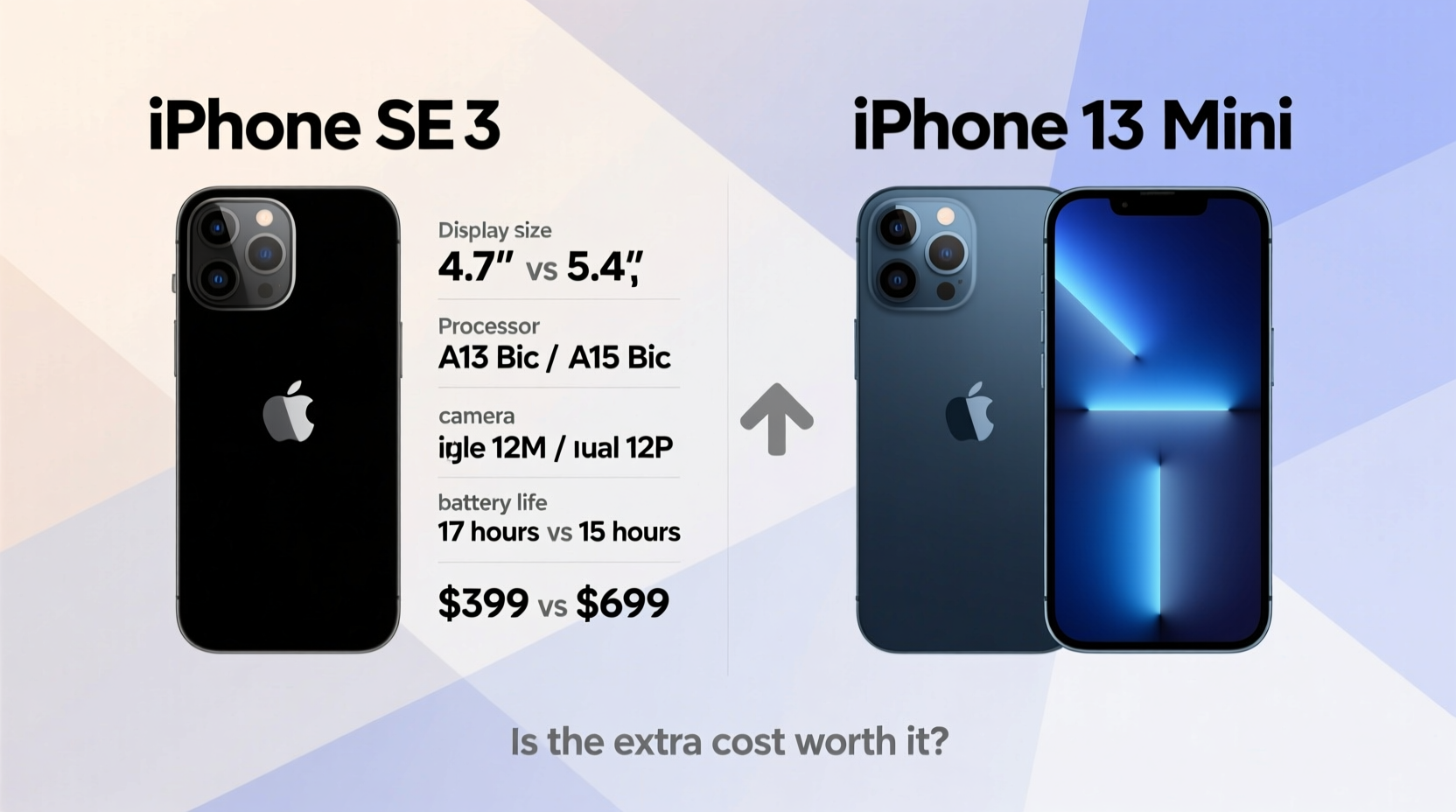
The iPhone SE 3 revives the classic iPhone 8 design: a 4.7-inch LCD display with thick bezels and a Touch ID home button. It's one of the last iPhones to feature this layout, appealing to users who prefer single-handed operation and physical fingerprint sensing. At 5.45 x 2.65 inches, it slips easily into tight pockets and small purses.
In contrast, the iPhone 13 Mini measures 5.18 x 2.53 inches with a 5.4-inch OLED Super Retina XDR display. Though marginally shorter, it feels denser due to edge-to-edge glass and no home button. Its modern design includes Face ID, a flatter aluminum band, and improved water resistance (IP68 vs IP67). The smaller notch and curved edges make interaction smoother despite similar footprint dimensions.
Tip: If you wear gloves frequently or dislike looking up to unlock your phone, the SE 3’s Touch ID may be more practical than Face ID.Despite being marketed as “mini,” the 13 Mini isn’t dramatically smaller than the SE 3—but it does feel more contemporary. The lack of bezels means more screen real estate without increasing device length. For readers valuing aesthetics and gesture navigation, the 13 Mini offers a noticeably more modern interface.
Performance: Nearly Identical Under the Hood
Both phones are powered by Apple’s A15 Bionic chip—the same processor found in the iPhone 13 Pro. This gives the SE 3 exceptional performance for its price point, handling intensive apps, multitasking, and gaming with ease. In synthetic benchmarks, there’s negligible difference between the two models.
However, real-world usage reveals subtle distinctions. The 13 Mini benefits from an additional GPU core within the A15 (the SE uses a reduced version), which improves graphics rendering during extended gameplay or video editing. Additionally, the 13 Mini ships with 4GB RAM compared to the SE’s 3GB, enhancing background app retention and system fluidity over time.
“Even budget iPhones now have pro-level chips, but thermal management and sustained performance favor the pricier models.” — David Kim, Mobile Hardware Analyst at TechPulse
For everyday tasks—browsing, messaging, social media, streaming—the SE performs indistinguishably from the 13 Mini. But power users engaging in photo editing, AR applications, or long recording sessions will notice smoother operation on the 13 Mini.
Camera Capabilities: One Wins Clearly
This is where the gap widens significantly. The iPhone SE 3 has a single 12MP wide rear camera with computational photography enhancements like Smart HDR 4 and Deep Fusion. It delivers decent daylight photos but struggles in low light and lacks Night mode on ultra-wide scenes (since there is no ultra-wide lens).
The iPhone 13 Mini features dual cameras: a 12MP wide and a 12MP ultra-wide. This enables versatile framing, macro photography, and spatial depth information used in Portrait mode and Cinematic Mode videos. More importantly, its sensor-shift optical image stabilization captures sharper low-light shots, and Night mode activates across both lenses.
| Feature | iPhone SE 3 | iPhone 13 Mini |
|---|---|---|
| Rear Cameras | 1 (12MP wide) | 2 (12MP wide + 12MP ultra-wide) |
| Front Camera | 7MP | 12MP (with Night mode & Portrait mode) |
| Night Mode | Yes (rear only) | Yes (all cameras) |
| Cinematic Mode | No | Yes (1080p @ 30fps) |
| Video Recording | 4K @ 60fps | 4K @ 60fps + Dolby Vision HDR |
If photography matters even moderately—whether for social sharing, family memories, or creative projects—the 13 Mini provides substantially greater flexibility and quality. The ability to zoom out optically, capture dramatic portraits, and record cinematic video makes it a compelling upgrade.
Battery Life and Charging: Trade-offs in Miniaturization
Apple rates the 13 Mini for up to 17 hours of video playback, while the SE 3 manages around 15 hours. Real-world usage shows a clearer advantage: the 13 Mini typically lasts a full day with moderate-to-heavy use, whereas the SE often requires midday charging under similar conditions.
Interestingly, the SE 3 supports faster wired charging (up to 20W with compatible adapter, sold separately), while the 13 Mini also supports 20W but charges more efficiently due to optimized power management. Both lack MagSafe compatibility (magnets aren’t included), limiting wireless charging convenience.
Tip: Pair either phone with a 20W USB-C charger for fastest results—older 5W adapters take over 3 hours to fully charge these devices.Despite its smaller size, the 13 Mini packs better endurance thanks to efficiency gains from the full-spec A15 and iOS optimizations tailored for newer hardware. Users relying on their phone throughout the workday or commuting should consider this a meaningful differentiator.
Value Proposition: When the Extra Cost Pays Off
The $170 price difference translates into tangible upgrades: superior display, better cameras, longer battery life, modern biometrics, and future-proof software support. While the SE 3 remains one of the best-value smartphones on the market, it targets a specific audience: iOS loyalists needing affordable entry, existing iPhone users upgrading from older models, or those who prioritize durability and simplicity.
A real-world example illustrates this trade-off: Sarah, a teacher, replaced her iPhone 8 with the SE 3. She appreciated the familiar home button and lower cost but quickly missed portrait lighting effects and struggled to capture clear images during school events. After six months, she traded up to a used 13 Mini for $480—spending only $50 more than her original purchase—for vastly improved photography and all-day battery.
For such users, the 13 Mini isn’t merely a status symbol—it solves actual usability gaps. Conversely, someone like Mark, a retiree using his phone primarily for calls, texts, and occasional web browsing, finds the SE 3 perfectly adequate. He values the physical home button and doesn’t need advanced camera modes.
Checklist: Which iPhone Should You Choose?
- ✅ Need Touch ID? → iPhone SE 3
- ✅ Want Face ID and gesture navigation? → iPhone 13 Mini
- ✅ Take lots of photos or videos? → iPhone 13 Mini
- ✅ On a tight budget under $450? → iPhone SE 3
- ✅ Prefer OLED display and deeper blacks? → iPhone 13 Mini
- ✅ Use phone heavily all day? → iPhone 13 Mini
- ✅ Upgrade every 3+ years? → iPhone 13 Mini (longer support expected)
Frequently Asked Questions
Does the iPhone SE 3 support 5G?
Yes, the iPhone SE 3 includes 5G connectivity (mmWave in U.S. models, sub-6GHz elsewhere), enabling faster download speeds on supported networks.
Will the iPhone 13 Mini get longer software updates?
Yes. As part of the iPhone 13 series, the 13 Mini is expected to receive iOS updates until at least 2027, possibly longer. The SE 3 will likely be supported through 2026, but may drop support earlier due to limited hardware features.
Is the screen on the iPhone SE 3 hard to see outdoors?
The LCD panel reaches lower peak brightness (625 nits) than the 13 Mini’s OLED (1,200 nits HDR), making it less visible in direct sunlight. Users spending time outside may find the 13 Mini easier to read.
Final Verdict: Worth It Depends on Your Priorities
The smaller size of the iPhone 13 Mini isn’t just about ergonomics—it represents a complete generational leap in design, imaging, and ecosystem integration. Paying extra isn’t solely for a sleeker look; it’s investing in better displays, smarter cameras, longer battery life, and extended software relevance.
For users already embedded in the Apple ecosystem—using AirPods, Apple Watch, or iCloud—the seamless experience of the 13 Mini enhances daily productivity and enjoyment. However, if your needs are basic and budget is paramount, the SE 3 delivers remarkable performance at an unmatched price.
💬 Have you switched from the SE to a Mini—or vice versa? Share your experience and help others decide whether compact convenience is worth the upgrade cost.