In the high-stakes arena of flagship smartphones, two titans consistently dominate headlines: Apple’s iPhone 14 Pro Max and Samsung’s Galaxy S23 Ultra. These devices represent the pinnacle of mobile engineering in 2023, each pushing boundaries in design, performance, and user experience. But as Samsung continues to refine its hardware and software integration, a growing number of users are asking: is it finally time to switch? Or does Apple’s tightly controlled ecosystem still make it the undisputed king?
The answer isn’t simple. It depends on priorities—camera versatility, long-term software support, multitasking capability, or seamless integration with other devices. This deep dive compares both phones across critical categories, backed by real-world usage insights and expert analysis.
Design and Build: Premium Materials, Different Philosophies
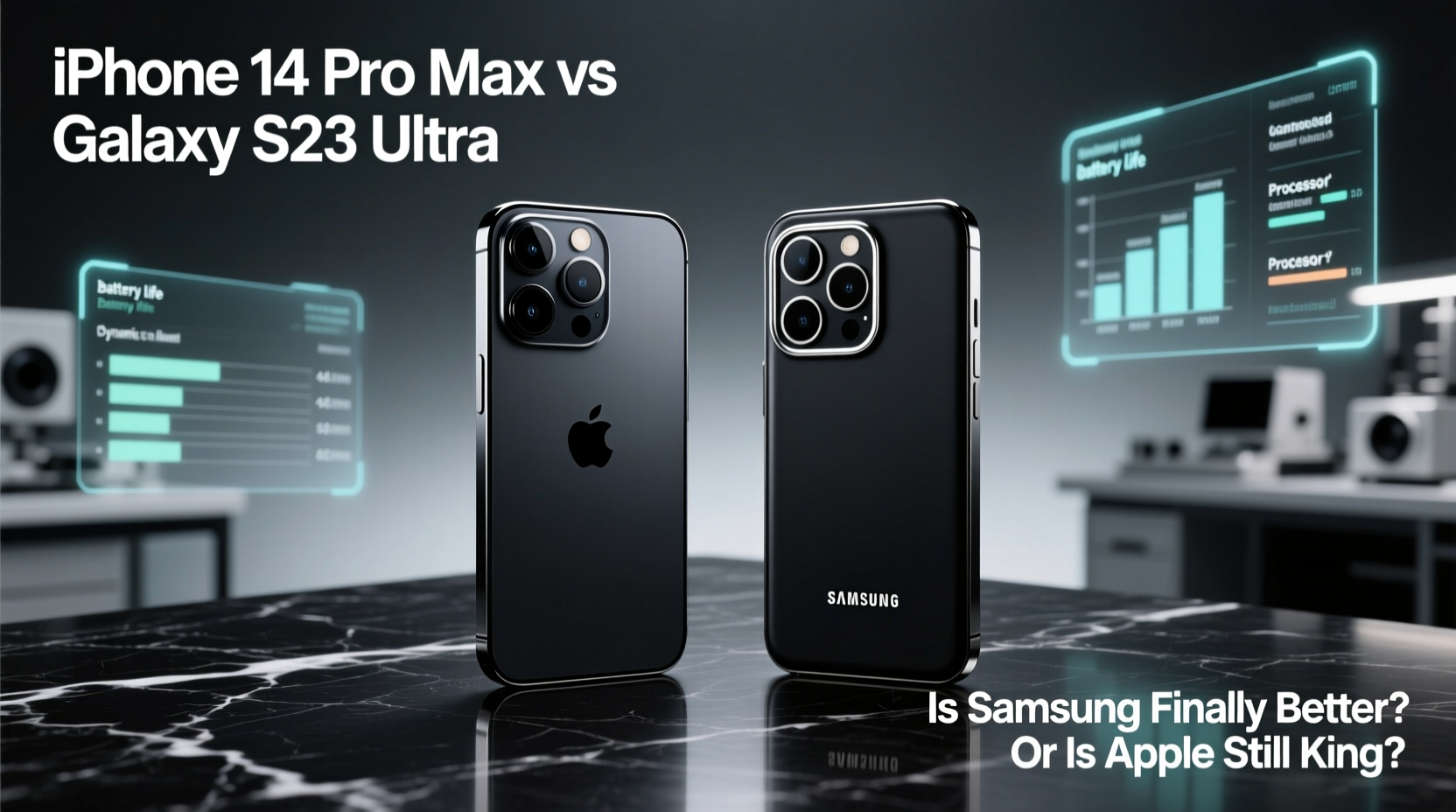
Both phones exude luxury. The iPhone 14 Pro Max features a surgical-grade stainless steel frame with a textured matte glass back, offering a dense, premium feel. Its flat edges provide a classic grip but can dig into the palm during prolonged use. At 240g, it’s heavy—among the heaviest iPhones ever made.
The Galaxy S23 Ultra, weighing 234g, uses Armor Aluminum 2.0 and Gorilla Glass Victus 2, making it slightly lighter while maintaining durability. Its squared-off silhouette echoes the old Note series, appealing to fans of a more utilitarian aesthetic. Unlike the iPhone, it integrates an S Pen—a standout feature for note-takers and creatives.
Tip: If you frequently use your phone one-handed, the iPhone’s slightly narrower body (despite its weight) may offer better reachability than the S23 Ultra’s broader footprint.Display Quality: Brightness, Smoothness, and Usability
The iPhone 14 Pro Max introduced the groundbreaking ProMotion 120Hz display with Always-On functionality—a first for Apple. Its Super Retina XDR OLED panel peaks at 2000 nits outdoors, delivering exceptional clarity under sunlight. Colors are calibrated for accuracy, favored by photographers and videographers.
Samsung counters with a 6.8-inch Dynamic AMOLED 2X display, also 120Hz with adaptive refresh rates. It hits an astonishing 1750 nits peak brightness and supports HDR10+, offering richer contrast in supported content. Samsung’s display has historically led in color vibrancy and viewing angles, though Apple excels in white balance consistency.
For media consumption, the S23 Ultra’s larger screen gives a cinematic edge. For color-critical work, the iPhone’s factory calibration holds an advantage.
Performance: Raw Power vs. Long-Term Efficiency
Beneath the surface, these phones take different paths to speed. The iPhone 14 Pro Max runs on Apple’s A16 Bionic chip—built on a 4nm process, optimized for machine learning and graphics efficiency. In real-world tasks, it delivers near-instant app launches, buttery-smooth scrolling, and unmatched thermal management.
The Galaxy S23 Ultra uses the custom Snapdragon 8 Gen 2 for Galaxy, also 4nm but tailored for Samsung with enhanced GPU performance and AI capabilities. While Geekbench scores show the A16 edging out in single-core tasks, the S23 Ultra handles sustained loads—like gaming or 8K video editing—more effectively thanks to superior cooling architecture.
“Apple’s silicon leads in per-watt efficiency, but Samsung’s thermal design allows longer peak performance bursts.” — David Liu, Mobile Hardware Analyst at TechPulse
Both phones will last three to five years without slowdowns. However, Apple’s iOS updates typically extend over five years, compared to Samsung’s four-year promise—making the iPhone a stronger long-term investment.
Camera Comparison: Versatility vs. Consistency
This is where preferences diverge sharply. The iPhone 14 Pro Max uses a 48MP main sensor (a first for iPhone), paired with 12MP ultrawide and telephoto lenses offering 3x optical zoom. Its computational photography engine excels in natural color reproduction, low-light stabilization, and video recording—particularly Dolby Vision HDR at 4K/60fps.
The S23 Ultra goes all-in on zoom: a 200MP main sensor, 10x periscope zoom, and dual telephoto lenses (3x and 10x). This enables unmatched flexibility—from macro shots to distant wildlife. Google-style “computational zoom” blends digital and optical data for surprisingly usable 30x and even 100x results.
| Feature | iPhone 14 Pro Max | Galaxy S23 Ultra |
|---|---|---|
| Main Sensor | 48MP (f/1.78) | 200MP (f/1.7) |
| Zoom Range | 3x optical, 15x digital | 10x optical, 30x space zoom |
| Video Recording | 4K/60fps Dolby Vision HDR | 8K/30fps, Super Steady mode |
| Low-Light Performance | Natural tone, minimal noise | Brighter output, slight oversharpening |
| Pro Mode | Limited manual controls | Full RAW, shutter speed, ISO adjustment |
If you value point-and-shoot reliability, the iPhone wins. If you want creative control and extreme zoom, the S23 Ultra is unmatched.
Battery Life and Charging: Endurance Meets Ecosystem Limits
The S23 Ultra packs a 5000mAh battery, consistently lasting 1.5 days with moderate use. Fast charging reaches 50% in 30 minutes (with a 45W adapter, sold separately). It also supports wireless and reverse wireless charging.
The iPhone 14 Pro Max, despite a smaller 4323mAh cell, achieves similar endurance due to A16 efficiency and iOS optimization. However, charging remains slow—20W wired means roughly 1.5 hours to full. MagSafe adds convenience but sacrifices speed and generates heat.
Tip: For frequent travelers, carry a USB-C PD charger with the iPhone; Samsung users should invest in a 45W GaN brick for maximum speed.Real-World Example: Photographer on a Safari Trip
Consider Maya, a travel photographer visiting Kenya. She needs to capture distant animals without disturbing them. With the S23 Ultra, she uses 10x optical zoom to photograph lions from her safari vehicle, then edits RAW files directly on-device using Adobe Lightroom. The large screen helps with framing, and the S Pen lets her annotate shots for her blog.
Had she used the iPhone, she’d need external lenses for similar reach. While her videos would benefit from smoother stabilization and better audio recording, the lack of pro-level zoom limits her storytelling options.
Software and Ecosystem: The Deciding Factor
Here lies the crux of the decision. iOS offers simplicity, security, and unmatched app optimization. iMessage, FaceTime, AirDrop, and Handoff create a frictionless experience across Mac, iPad, and Apple Watch. Updates arrive instantly and uniformly.
Samsung’s One UI 5.1 (based on Android 13) provides deep customization, split-screen multitasking, DeX desktop mode, and native support for file folders, widgets, and third-party launchers. For power users, this flexibility is liberating. However, carrier delays can postpone updates by weeks.
Moreover, Google integration—Assistant, Photos, Maps—is deeply embedded. Samsung’s ecosystem, while improving with Galaxy Buds and Watches, still trails Apple’s seamless continuity features.
Checklist: Choosing the Right Flagship for You
- Choose iPhone 14 Pro Max if:
- You’re invested in Apple’s ecosystem (Mac, iPad, Watch).
- You prioritize video quality and consistent photo results.
- You value long-term software support (5+ years).
- You prefer intuitive, clutter-free software.
- Choose Galaxy S23 Ultra if:
- You need advanced zoom or manual camera controls.
- You use stylus input for notes or drawing.
- You want faster charging and greater hardware flexibility.
- You rely on Google services and multitasking features.
Frequently Asked Questions
Can the S23 Ultra replace a tablet or laptop?
With Samsung DeX, connecting to a monitor transforms the S23 Ultra into a desktop-like environment. Paired with a keyboard and mouse, it handles light productivity tasks effectively—though not a full replacement for professional workflows.
Is the iPhone camera really worse than Samsung’s?
Not worse—different. The iPhone prioritizes natural colors and reliable performance in all conditions. Samsung pushes dynamic range and zoom capability, sometimes at the cost of realism. Preference depends on your editing style and shooting habits.
Which phone holds resale value better?
Historically, iPhones retain value longer. After 18 months, the iPhone 14 Pro Max typically keeps 60–70% of its value, compared to 50–60% for the S23 Ultra, according to market data from Gazelle and Decluttr.
Final Verdict: King or Challenger?
Apple remains king for users who value cohesion, longevity, and effortless integration. The iPhone 14 Pro Max delivers a polished, predictable experience that just works—especially within the Apple universe.
But Samsung’s Galaxy S23 Ultra is no longer merely competitive. It surpasses the iPhone in specific areas: zoom photography, multitasking, charging speed, and creative tools like the S Pen. For professionals, Android enthusiasts, or those seeking maximum hardware flexibility, it’s arguably the more capable device in 2023.
So, is Samsung finally better? In raw specs and versatility—yes. But Apple still rules the ecosystem game. The winner depends not on benchmarks, but on how you use your phone.
💬 Ready to choose your next flagship? Share your preference—iPhone or Galaxy—and tell us what matters most to you: camera, battery, ecosystem, or innovation.