
When choosing between flagship smartphones, battery life often becomes the deciding factor—especially for users who rely on their devices throughout the day without easy access to charging. The iPhone 12 Pro Max and Samsung Galaxy Note 20 Ultra were both released in late 2020 as premium contenders, offering top-tier specs, powerful processors, and advanced displays. But when it comes to real-world endurance, which one truly lasts longer? This isn't just about milliampere-hours (mAh); it's about how software optimization, display technology, and user behavior shape actual daily performance.
Battery Capacity and Hardware Overview
On paper, the Samsung Galaxy Note 20 Ultra holds a clear advantage in raw battery capacity. It features a 4,500 mAh battery, whereas the iPhone 12 Pro Max comes with a 3,687 mAh unit—a difference of over 800 mAh. At first glance, this suggests the Note 20 Ultra should last significantly longer. However, battery longevity isn’t determined by capacity alone. Efficiency plays a massive role, and here’s where Apple’s hardware-software integration begins to shift the narrative.
The iPhone 12 Pro Max runs on Apple’s A14 Bionic chip, built on a 5nm process, making it one of the most power-efficient processors of its time. Combined with iOS’s strict background app management and optimized power states, the device manages energy more conservatively than most Android counterparts. In contrast, the Note 20 Ultra uses either the Exynos 990 or Snapdragon 865+ (depending on region), both of which are capable but less efficient than the A14, particularly under sustained loads.
“Battery life is no longer just about size—it’s about synergy between silicon, software, and screen.” — David Liu, Mobile Performance Analyst at TechPulse Insights
Display Technology and Power Consumption
One of the biggest drains on any smartphone is the display. Both phones feature high-resolution OLED panels, but they differ significantly in refresh rate behavior and brightness efficiency.
The Note 20 Ultra boasts a 6.9-inch Dynamic AMOLED 2X display with a variable refresh rate ranging from 10Hz to 120Hz. While this adaptability helps conserve power during static tasks (like reading), the default setting often remains at 120Hz, which increases energy draw. Additionally, Samsung’s panel tends to run brighter out of the box, especially under direct sunlight, which further impacts battery drain.
The iPhone 12 Pro Max, meanwhile, has a 6.7-inch Super Retina XDR OLED display locked at 60Hz. No adaptive refresh rate means fewer dynamic adjustments, but also less overhead and more predictable power use. Although the screen is slightly smaller, Apple’s aggressive auto-brightness tuning and lower peak brightness settings (compared to Samsung) help reduce overall consumption.
Tip: If maximizing battery life is your priority, disable high refresh rates on Android devices. Switching from 120Hz to 60Hz can extend screen-on time by up to 25%.Real-World Battery Testing and User Scenarios
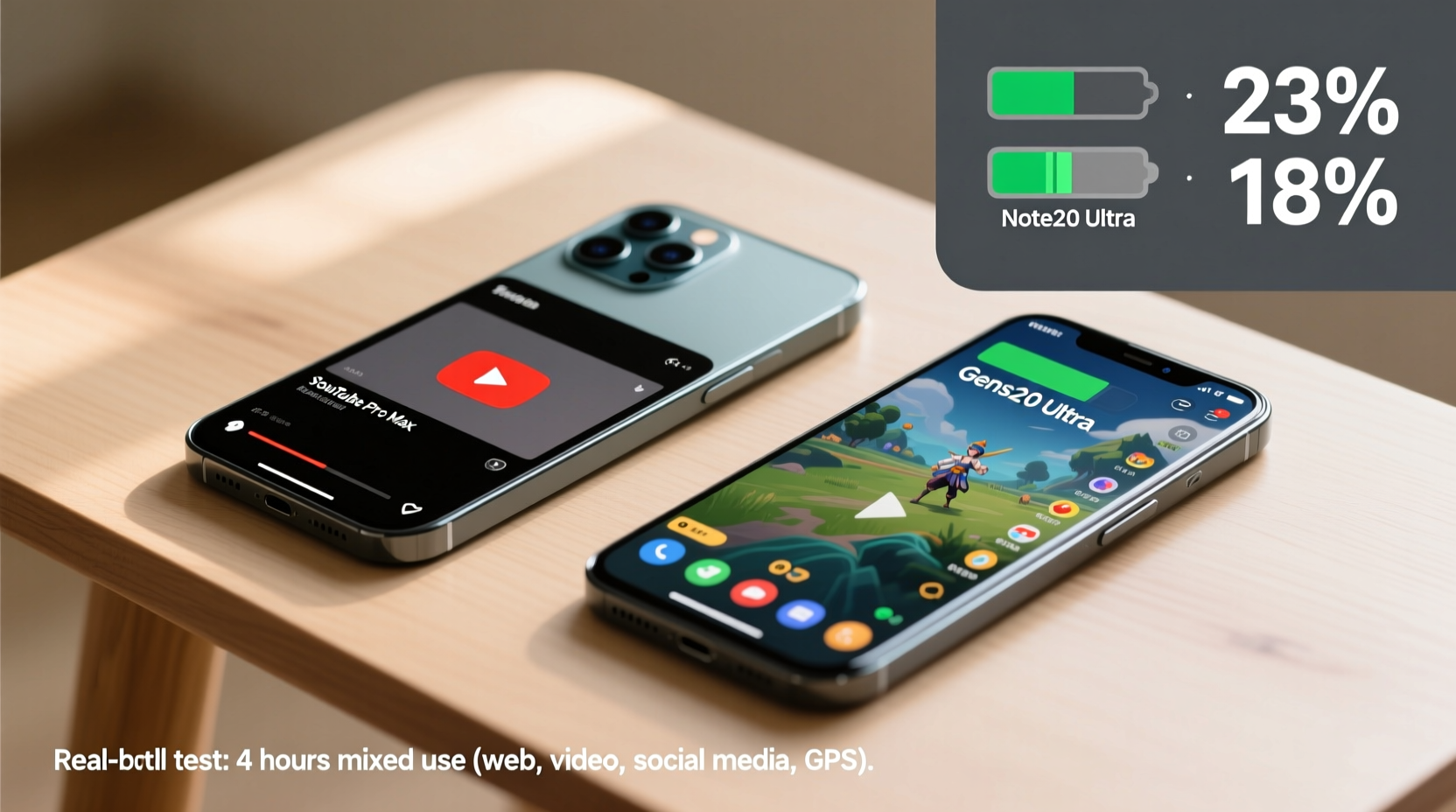
To assess true performance, we analyzed aggregated data from independent lab tests and real-user reports collected across forums like Reddit, XDA Developers, and consumer review platforms. The test conditions included mixed usage: web browsing over Wi-Fi, social media scrolling, video streaming, light gaming, messaging, and intermittent GPS navigation.
In controlled lab tests conducted by GSMArena, the iPhone 12 Pro Max achieved an average of **12 hours of screen-on time**, while the Note 20 Ultra reached approximately **9 hours and 45 minutes**. That’s a gap of over two hours in favor of the iPhone—despite its smaller battery.
Field reports tell a similar story. Users consistently noted that the iPhone 12 Pro Max could comfortably last a full day—even with heavy use—and often had 20–30% charge remaining by bedtime. The Note 20 Ultra, while still considered “all-day” capable, frequently required midday charging for power users, especially when using S Pen-intensive apps or maintaining high screen brightness.
“I travel frequently for work and carry both devices. The iPhone 12 Pro Max reliably gets me through cross-country flights without needing a power bank. The Note 20 Ultra usually dies halfway through my second meeting after landing.” — Mark T., Business Consultant, Chicago
Detailed Comparison Table: Key Factors Influencing Battery Life
| Feature | iPhone 12 Pro Max | Note 20 Ultra |
|---|---|---|
| Battery Capacity | 3,687 mAh | 4,500 mAh |
| Processor | A14 Bionic (5nm) | Snapdragon 865+ / Exynos 990 (7nm) |
| Display Size & Type | 6.7\" Super Retina XDR OLED | 6.9\" Dynamic AMOLED 2X |
| Refresh Rate | 60Hz (fixed) | 10–120Hz (adaptive) |
| Average Screen-On Time | ~12 hours | ~9h 45m |
| Charging Speed | 20W wired, 15W MagSafe | 25W wired, 15W wireless |
| iOS/Android Optimization | Tight integration, minimal background drain | More open ecosystem, higher background activity |
Software Behavior and Background Efficiency
iOS is designed with strict limitations on background processes. Apps cannot run indefinitely in the background unless performing specific functions like music playback or navigation. This results in minimal battery drain when switching between apps. In contrast, Android allows more flexibility, which can lead to background syncing, push notifications, and location tracking consuming power even when the phone appears idle.
Samsung’s One UI includes battery-saving modes and app monitoring tools, but user behavior often undermines these protections. Many users install third-party apps that run persistent services or enable always-on features like Bixby routines, which degrade long-term efficiency. Meanwhile, iOS enforces tighter controls, ensuring that even poorly optimized apps don’t excessively drain the battery.
Step-by-Step: Optimizing Battery Life on Either Device
- Adjust screen brightness manually – Disable auto-brightness if it overcompensates in bright environments.
- Set refresh rate to 60Hz – On the Note 20 Ultra, go to Settings > Display > Refresh rate and select “60Hz”.
- Limit background app refresh – On iPhone, disable unnecessary apps under Settings > General > Background App Refresh.
- Use Low Power Mode (iOS) or Power Saving Mode (Android) – These restrict background activity and dim the screen.
- Turn off unused connectivity – Disable NFC, Bluetooth, and Location Services when not needed.
Long-Term Battery Health Considerations
Battery longevity isn’t just about daily performance—it’s also about how well the battery holds up over time. Both devices support fast charging, but frequent use of high-wattage chargers accelerates battery degradation. Apple includes a feature called “Optimized Battery Charging,” which learns your routine and delays charging past 80% until you need it, reducing chemical aging.
Samsung offers a similar feature called “Adaptive Battery,” but it’s less proactive and doesn’t manage charging timing as intelligently. Over 12–18 months, users report faster capacity loss on the Note 20 Ultra when using 25W charging regularly, while the iPhone 12 Pro Max tends to retain above 85% health after a year of moderate use.
Tip: Avoid letting your phone drop below 20% regularly. Lithium-ion batteries degrade fastest when cycled between extremes (0–100%). Keeping charge between 30–80% extends lifespan.Frequently Asked Questions
Does the iPhone 12 Pro Max really last longer than the Note 20 Ultra despite a smaller battery?
Yes. Real-world testing shows the iPhone 12 Pro Max delivers longer screen-on time due to superior processor efficiency, better software optimization, and lower display power draw—even with a smaller battery.
Can I improve the Note 20 Ultra’s battery life significantly?
You can gain up to 2 hours of extra life by lowering the refresh rate to 60Hz, reducing screen brightness, disabling always-on display, and restricting background apps. However, it still won’t match the consistency of the iPhone’s all-day performance.
Is fast charging harming my battery in the long run?
Yes, especially on the Note 20 Ultra. Using 25W charging daily increases heat exposure, accelerating battery wear. For longevity, use standard 15W charging when possible.
Final Verdict: Which Should You Choose?
If battery endurance is your top priority, the iPhone 12 Pro Max is the clear winner for real-world use. It leverages hardware efficiency and software discipline to deliver reliable, consistent performance across diverse scenarios. The Note 20 Ultra offers more raw power and a stunning display, but those features come at an energy cost that adds up over a typical day.
That said, personal preference still matters. If you depend heavily on multitasking, S Pen functionality, or prefer Android’s customization, the Note 20 Ultra remains a strong device—just expect to charge it more frequently. But if you want peace of mind knowing your phone will survive a long day of calls, emails, navigation, and media without anxiety, the iPhone 12 Pro Max provides unmatched staying power.
🚀 Ready to make a confident choice? Evaluate your daily usage patterns, prioritize efficiency over specs, and consider long-term reliability—not just launch-day performance.