In the ever-evolving world of smartphones, even the most capable budget devices eventually face obsolescence. Yet some models manage to endure beyond their expected lifespan due to solid build quality, reliable performance, or long-term usability. The Huawei P9 Lite (released in 2016) and the Moto E4 Plus (launched in 2017) were both standout budget phones in their time—offering value, decent specs, and appealing features for cost-conscious buyers. But nearly a decade later, which one still holds up as a functional daily driver? This article dives deep into hardware, software, battery life, user experience, and real-world practicality to determine which device remains relevant today.
Design and Build Quality
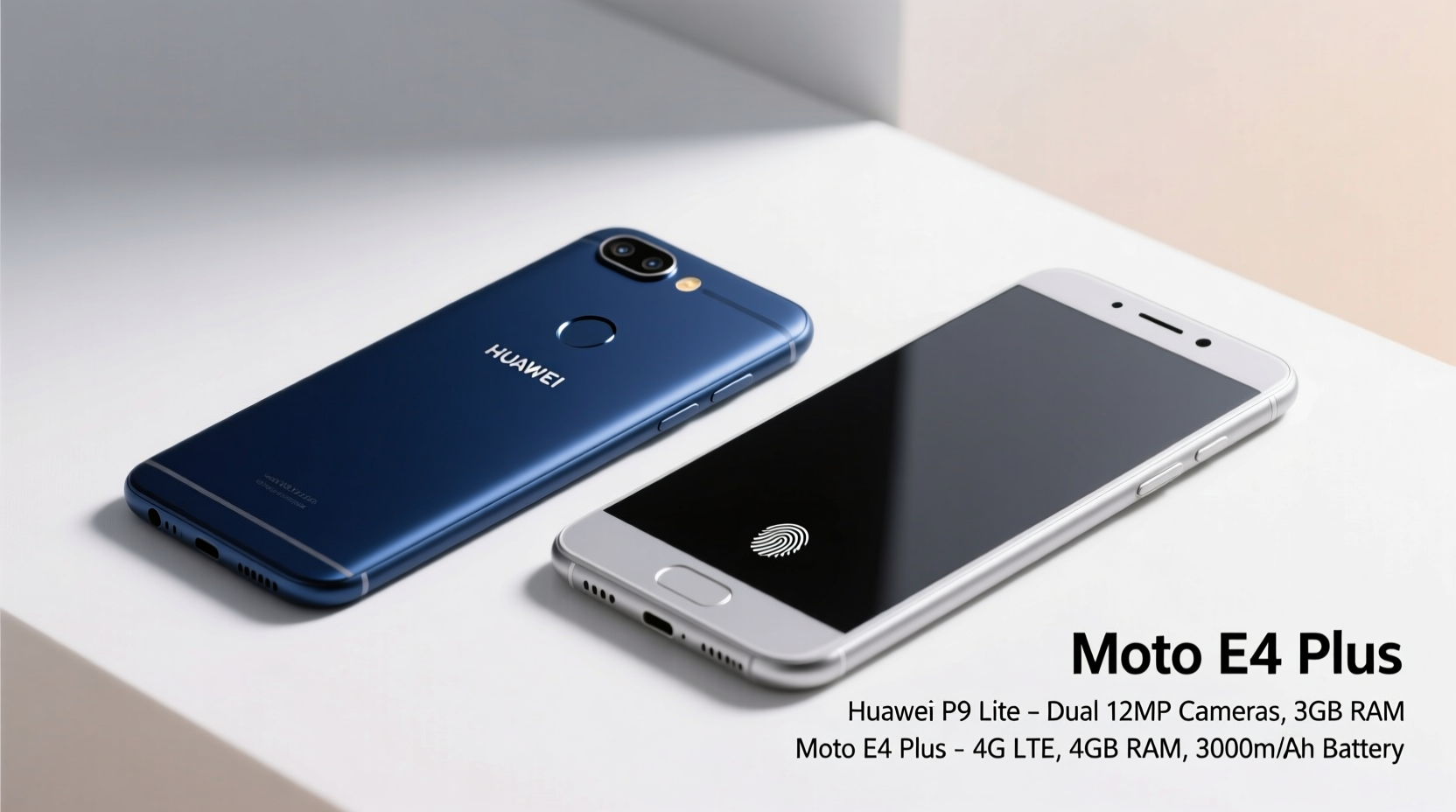
The Huawei P9 Lite and Moto E4 Plus take different approaches to design. The P9 Lite features a sleek, minimalist aluminum unibody with chamfered edges and a fingerprint sensor on the front—a premium look that belied its mid-range price point. It was lightweight at 143g and measured just 7.6mm thick, making it comfortable to hold and pocket-friendly.
In contrast, the Moto E4 Plus opts for a more utilitarian design with a plastic body and curved back that fits snugly in hand. While less refined than the P9 Lite, its build prioritizes durability and comfort during extended use. At 198g and 9.55mm thick, it’s noticeably heavier and bulkier, but this is largely due to its massive 5000mAh battery.
Tip: If portability matters, the P9 Lite wins. For all-day grip and sturdiness, the E4 Plus may be more suitable.Performance and Hardware Comparison
Under the hood, both phones reflect the typical limitations of their era’s budget segment. The Huawei P9 Lite is powered by a HiSilicon Kirin 650 octa-core processor, paired with 3GB of RAM and 16GB/32GB storage options. This chip, built on a 16nm process, offered respectable efficiency and multitasking capability for its time—especially when running EMUI over Android 6.0 Marshmallow.
The Moto E4 Plus uses a MediaTek MT6737 quad-core processor clocked at 1.3GHz, with either 2GB or 3GB RAM variants and 16GB internal storage. While adequate for basic tasks, the MT6737 struggles with heavier apps and modern web browsing compared to the Kirin 650. Motorola's near-stock Android interface helps mitigate some performance issues through efficient resource management.
“Hardware longevity isn’t just about raw power—it’s about how well the system manages resources under aging conditions.” — Rajiv Mehta, Mobile Systems Analyst
Key Specifications Side-by-Side
| Feature | Huawei P9 Lite | Moto E4 Plus |
|---|---|---|
| Release Year | 2016 | 2017 |
| OS at Launch | Android 6.0 (EMUI 4.1) | Android 7.1 Nougat |
| CPU | Kirin 650 (Octa-core) | MT6737 (Quad-core) |
| RAM | 3GB | 2GB / 3GB |
| Battery | 3000 mAh | 5000 mAh |
| Display | 5.2” IPS LCD, 1080p | 5.5” IPS LCD, 720p |
| Rear Camera | 13MP f/2.0 | 13MP f/2.0 |
| Fingerprint Sensor | Yes (front-mounted) | No |
Battery Life and Charging Realities
This is where the Moto E4 Plus shines brightest. Its 5000mAh battery can last two to three days with light usage—even by today’s standards. In standby mode, it leaks minimal charge, and under moderate screen-on use (messaging, music, occasional browsing), you’ll likely get 1.5 full days without plugging in.
The P9 Lite, while equipped with a smaller 3000mAh cell, benefits from a more power-efficient SoC and higher-resolution display optimization. Still, it rarely exceeds a single day of average use today, especially with background processes from outdated apps consuming resources.
Charging is another consideration. The E4 Plus supports standard 5V/1A charging only—meaning a full recharge takes upwards of four hours. The P9 Lite doesn’t offer fast charging either, but its smaller battery fills faster, typically reaching full in 2.5–3 hours.
Mini Case Study: Daily Use After Five Years
Consider Maria, a freelance writer who kept her Moto E4 Plus as a backup device until 2023. She used it primarily for note-taking, audiobooks, and offline maps during travel. Despite degraded battery capacity (~70%), she reported consistent uptime of 18–20 hours per charge. Meanwhile, her old P9 Lite, though snappier in app launches, required daily charging and began exhibiting Wi-Fi connectivity drops after Android security updates ceased in 2019.
Software Support and Security
Here, the Huawei P9 Lite has a complicated legacy. Originally receiving updates up to Android 8.0 Oreo, it benefited from EMUI enhancements like split-screen multitasking and improved camera processing. However, post-2019 U.S. trade restrictions halted Google service integration on newer Huawei devices—and while the P9 Lite predates this issue, it no longer receives security patches or Play Services optimizations.
The Moto E4 Plus shipped with near-stock Android and received one major OS upgrade (to Android 8.0). Motorola provided monthly security updates for approximately 18 months, ending around mid-2019. Both phones are now disconnected from official support channels, leaving them vulnerable to unpatched exploits.
For users considering continued use, installing a custom ROM like LineageOS could extend functionality. The Moto E4 Plus enjoys better community developer support due to Motorola’s openness, whereas Huawei’s bootloader unlocking policy complicates third-party firmware installation on the P9 Lite.
Tip: Never use either device for banking or sensitive logins without updated antivirus protection and restricted permissions.Checklist: Is Your Legacy Phone Still Safe to Use?
- ✅ Avoid logging into financial accounts
- ✅ Disable unnecessary app permissions
- ✅ Install a reputable ad/tracker blocker (e.g., Blokada)
- ✅ Use only trusted APK sources if sideloading
- ✅ Enable firewall settings via third-party tools
- ✅ Keep Bluetooth and location off when not needed
Camera and Multimedia Experience
The P9 Lite’s 13MP rear camera was praised at launch for accurate color reproduction and decent low-light performance thanks to its f/2.0 aperture and Huawei’s image processing algorithms. Front-facing photos also held up well, making it a favorite for social media users pre-2018.
The E4 Plus matches the same megapixel count but delivers softer images with noticeable noise in dim lighting. Video recording tops out at 1080p on both, but the P9 Lite stabilizes footage slightly better due to software tuning.
For audio, the E4 Plus includes a 3.5mm headphone jack and surprisingly loud mono speaker tuned by MaxxAudio. The P9 Lite’s audio output is quieter and less balanced, though both lack stereo separation.
Frequently Asked Questions
Can either phone run WhatsApp reliably in 2024?
As of early 2024, WhatsApp requires Android 5.0 or higher, so technically both phones meet minimum requirements. However, WhatsApp has begun dropping support for older processors and 32-bit architectures. Users report intermittent crashes and failed message sends on both devices, particularly when clearing cache or reinstalling the app. Long-term reliability is questionable.
Which phone charges via USB-C?
Neither. Both the Huawei P9 Lite and Moto E4 Plus use micro-USB ports, which limits compatibility with modern chargers and accessories. Adapters are widely available, but transfer speeds remain slow (USB 2.0).
Is it worth repairing either device today?
Only for sentimental or emergency-use purposes. Replacement batteries, screens, and charging ports are scarce and often of inconsistent quality. Given current prices of refurbished Android phones with Android 10+, investing in repair may not be cost-effective.
Final Verdict: Which Holds Up Better?
The answer depends on your needs. If longevity means **battery endurance and physical durability**, the Moto E4 Plus remains the more practical choice. Its massive battery, cleaner software experience, and broader custom ROM support give it an edge for offline tasks, reading, or as a dedicated music player.
However, if you prioritize **responsive performance and sharper display quality**, the Huawei P9 Lite offers a smoother interface and crisper visuals despite its age. Its metal build and front fingerprint sensor provide a more modern feel, even if security updates have lapsed.
In reality, neither phone should serve as a primary device in 2024. But for travelers seeking a disposable communication tool, parents giving a first phone to a child, or hobbyists experimenting with rooted systems, these veterans still offer surprising utility—if used wisely.
💬 Still using a P9 Lite or E4 Plus? Share your experience! How long has yours lasted? What tips keep it running? Join the conversation below.