
Choosing between the Google Pixel 8a and the Samsung Galaxy A15 isn’t just about price—it’s about value. On paper, the A15 seems like a solid budget contender, while the Pixel 8a enters the mid-tier market with premium ambitions. But does the higher price tag of the Pixel translate into real-world advantages that justify the cost? For users weighing long-term satisfaction against upfront savings, this comparison dives deep into design, performance, camera quality, software experience, and longevity to answer whether the Pixel 8a truly earns its premium.
Design and Build Quality: Premium Feel vs Functional Simplicity
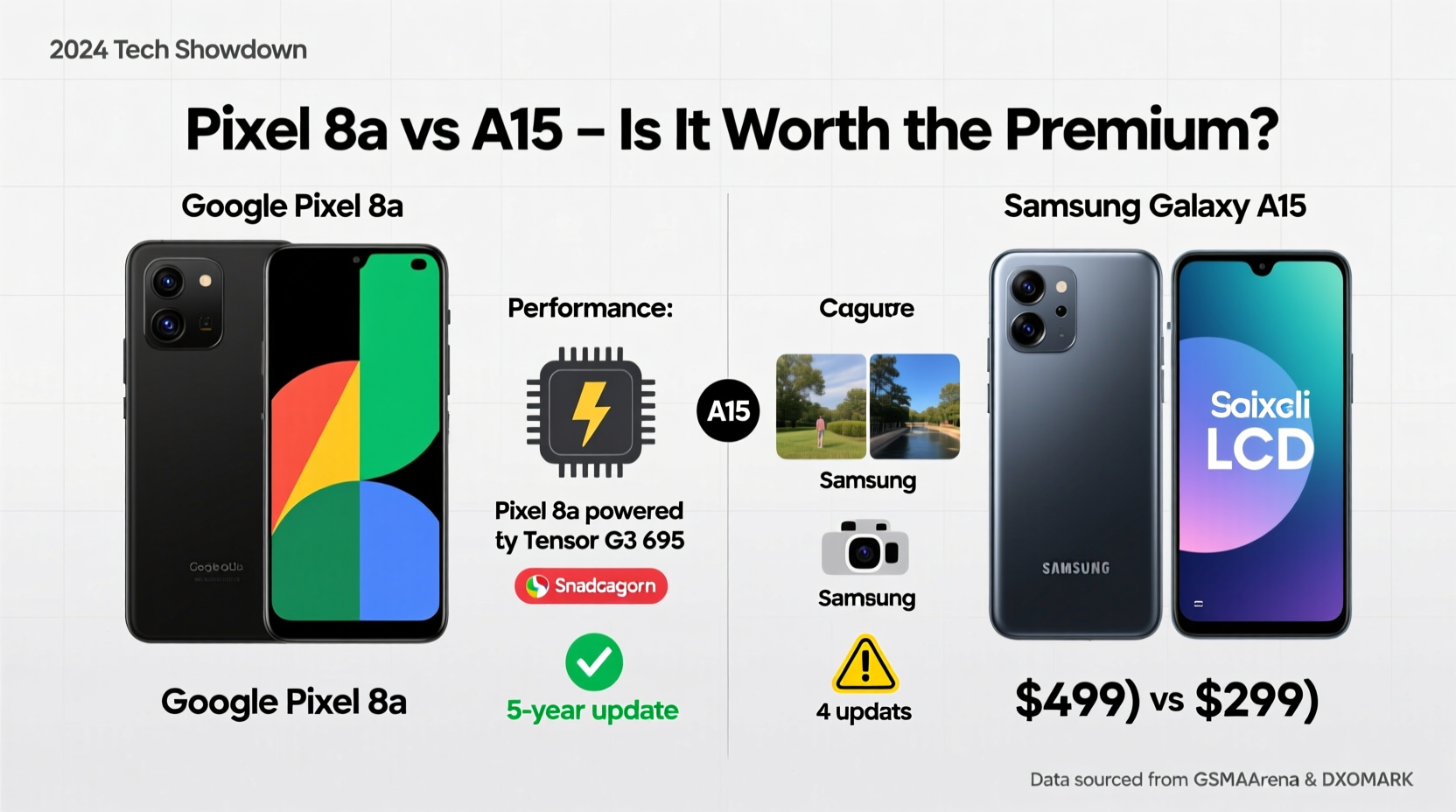
The first noticeable difference lies in how each phone feels in hand. The Pixel 8a features a sleek aluminum frame and a matte polymer back that mimics glass, giving it a refined, minimalist aesthetic. It’s lighter than it looks and fits comfortably, even with one hand. At 186g and IP67 water resistance, it balances durability with elegance—features rarely seen at this price point.
In contrast, the Samsung Galaxy A15 sticks to a plastic build throughout. While practical and lightweight (201g), it lacks the tactile refinement of the Pixel. Its flat edges and glossy back attract fingerprints and feel more utilitarian than premium. The A15 also lacks official water resistance, making it less resilient in unpredictable conditions.
Tip: If you prioritize a phone that feels durable and premium without costing $800+, the Pixel 8a delivers materials and finish typically reserved for flagship devices.Performance and Hardware: Raw Power vs Everyday Efficiency
Under the hood, the Pixel 8a runs on Google’s Tensor G3 chip—a custom processor optimized for AI tasks, photo processing, and voice recognition. Paired with 8GB of RAM, it handles multitasking smoothly and excels in computational photography and real-time language translation. While not the fastest chip for gaming, it’s responsive and efficient for daily use.
The Samsung A15 relies on the MediaTek Helio G99, a capable but older-generation chipset. With 4GB or 6GB RAM options, it struggles slightly with heavy apps or prolonged usage. Users may notice occasional stutters when switching between apps or loading media-heavy websites. However, for basic tasks like messaging, browsing, and streaming, it performs adequately.
Battery life favors the A15 with its 5000mAh cell, offering up to two days of light use. The Pixel 8a’s 4400mAh battery lasts a solid day but doesn’t match Samsung’s endurance. That said, the Pixel supports faster 20W charging and includes adaptive charging to extend battery lifespan over time—small touches that reflect Google’s focus on long-term usability.
Camera Comparison: Computational Magic vs Consistent Basics
This is where the Pixel 8a pulls far ahead. Its 64MP main sensor, combined with Google’s HDR+ and Night Sight algorithms, produces stunning photos in nearly any lighting. Even in dim environments, images retain detail, color accuracy, and dynamic range. Portrait mode blurs backgrounds naturally, and the 13MP ultrawide lens avoids the distortion common in budget phones.
The Samsung A15’s 50MP main camera captures decent daylight shots but falters in low light. Images often appear grainy or oversmoothed due to aggressive noise reduction. The 5MP ultrawide and 2MP macro lenses are underwhelming, serving more as marketing checkboxes than useful tools.
Video recording highlights the gap further. The Pixel 8a supports 4K at 60fps with excellent stabilization and audio zoom. The A15 maxes out at 1080p and lacks advanced stabilization, making clips shaky without a gimbal.
“Google’s computational photography has redefined what mid-range cameras can achieve. The Pixel 8a proves you don’t need multiple lenses if the primary one—and the software behind it—is exceptional.” — Lena Torres, Mobile Imaging Analyst, TechScope Weekly
Software Experience and Longevity: Clean OS vs Bloatware Trade-offs
One of the most compelling arguments for the Pixel 8a is its software. It ships with stock Android 14 and promises seven years of OS and security updates—the longest support window in the Android ecosystem. This means users can expect bug fixes, new features, and protection against emerging threats until 2031.
Samsung offers only four years of OS upgrades and five years of security patches for the A15. While One UI adds useful customization, it comes with preinstalled apps (bloatware) like Microsoft Office, Facebook, and Samsung’s own suite of services. These can’t always be uninstalled and consume storage and background resources.
The Pixel’s clean interface loads faster, receives updates directly from Google within days, and integrates seamlessly with Google Assistant, Photos, and other services. Features like Call Screen, Now Playing, and Live Translate work out of the box and improve over time through AI learning.
Total Value Over Time: Cost Per Year Analysis
To assess true value, consider cost per year of ownership. The Pixel 8a retails around $499, while the A15 starts at $269. On the surface, the A15 saves $230 upfront. But spread over five years:
| Phone | Upfront Cost | Expected Lifespan | Annual Cost | Update Support |
|---|---|---|---|---|
| Google Pixel 8a | $499 | 5–6 years | $83–$100 | 7 years (OS + Security) |
| Samsung Galaxy A15 | $269 | 3–4 years | $67–$90 | 4 years (OS), 5 years (Security) |
While the A15 has a lower annual cost, its shorter usable life and earlier obsolescence mean you’ll likely replace it sooner. The Pixel’s extended software support and superior hardware resilience suggest better long-term value, especially for users who keep phones beyond three years.
Tip: If you upgrade every 2–3 years, the A15 might suffice. But if you want a phone that stays fast, secure, and feature-rich for half a decade, the Pixel 8a is a smarter investment.Real-World Example: Two Users, Two Choices
Take Maria, a freelance photographer who travels frequently. She bought the Pixel 8a for its camera and seamless Google integration. Shooting in low-light markets and uploading directly to Google Photos, she relies on Magic Eraser and AI editing tools to refine images on the go. Three years later, her phone still receives updates and performs reliably.
Meanwhile, James, a college student, chose the A15 for its lower price and large battery. It handled notes, social media, and YouTube well initially. By year two, however, app launches slowed, bloatware consumed storage, and the lack of newer Android versions limited app compatibility. He replaced it earlier than expected, spending more in the long run.
Frequently Asked Questions
Is the Pixel 8a waterproof?
Yes, the Pixel 8a has an IP67 rating, meaning it can survive immersion in up to 1 meter of water for 30 minutes. The Samsung A15 has no official water resistance rating.
Can the Samsung A15 use the latest Android features?
It launched with Android 13 and will receive updates up to Android 17. However, many Pixel-exclusive features like Call Screen, Hold for Me, and advanced AI integrations are unavailable on Samsung devices.
Does the price difference matter for casual users?
If your needs are limited to calls, texts, and light browsing, the A15 is sufficient. But if you value camera quality, clean software, and future-proofing, the Pixel 8a’s extra cost pays off in daily experience and longevity.
Final Verdict: Is the Pixel Worth It?
The Google Pixel 8a isn’t just a phone with a better camera—it’s a thoughtfully engineered device that prioritizes user experience, privacy, and long-term usability. Yes, it costs nearly double the base model of the Samsung A15. But that premium buys you superior materials, intelligent software, industry-leading update support, and a camera system that competes with flagships.
The Samsung Galaxy A15 remains a viable option for budget-conscious buyers who plan to replace their phone quickly. But for those seeking a device that ages gracefully, maintains performance, and integrates deeply with modern digital workflows, the Pixel 8a justifies every dollar.
🚀 Ready to invest in a phone that grows smarter over time? Consider what you value most—short-term savings or long-term excellence. The answer will guide your choice.