
Walk into any campus-adjacent liquor store on a Thursday evening, and you’ll see it: shelves stacked with 3-liter boxes of Carlo Rossi, Franzia, and Bota Box—often priced under $20. Meanwhile, nearby stand single-bottle wines like Charles Shaw (“Two-Buck Chuck”) at $3.50, or even better-value 750ml bottles from Trader Joe’s ($5–$7) that offer superior varietal character, lower sulfite levels, and more sustainable packaging. Yet students continue to reach for the box. This isn’t ignorance or inertia—it’s rational behavior shaped by real constraints, social dynamics, and lived experience. Understanding why requires moving beyond price-per-milliliter calculations and into the unspoken infrastructure of student life: shared housing, irregular income, communal consumption, and the relentless calculus of convenience versus quality.
The Math Misleads—But the Metrics Are Real
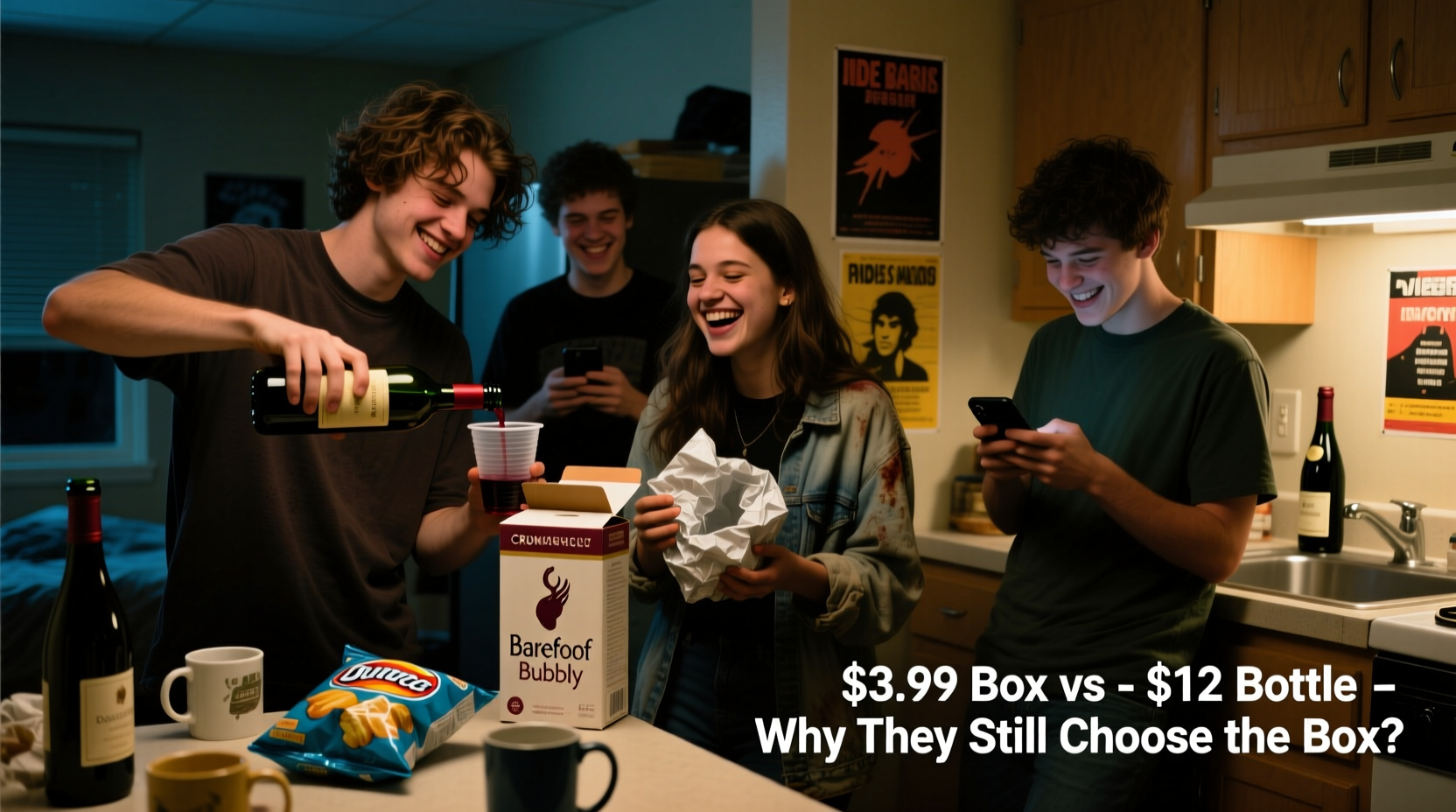
On paper, boxed wine appears unbeatable: a standard 3-liter box contains four 750ml bottles’ worth of wine—roughly 20 five-ounce servings. At $15, that’s $0.75 per serving. A $6 bottle yields about five servings—$1.20 each. So why does the “better value” option fail to win? Because students aren’t optimizing for cost-per-serving alone. They’re optimizing for *cost-per-functional-unit*—a unit defined not by volume, but by usability in context.
Consider three hidden costs rarely included in wine comparisons:
- Transport friction: Carrying four glass bottles (≈12 lbs) up three flights of stairs—without an elevator—is physically taxing and risky. One drop = shattered glass, wasted wine, and cleanup liability. A single 3-pound cardboard box is stable, stackable, and spill-resistant.
- Storage overhead: In a dorm room or studio apartment with 1.2 cubic feet of fridge space, four glass bottles occupy disproportionate volume and weight. A box lies flat, fits under a bed, and stays cool longer due to its bladder-and-box insulation.
- Consumption mismatch: Students rarely drink wine solo over weeks. They host impromptu gatherings—three friends showing up at 9 p.m. with no warning. Opening one bottle means either finishing it quickly (risking oxidation) or storing half-opened wine poorly. A box’s tap system preserves freshness for 4–6 weeks after opening—no special stoppers, no guesswork.
This isn’t irrationality. It’s applied systems thinking—a skill honed in engineering labs and econ seminars alike.
Tip: If you’re switching from boxed to bottled wine, start with screw-cap 750mls stored upright in the fridge (not the door) and use a vacuum pump + stopper—this extends freshness to 5–7 days, bridging the usability gap.The Social Architecture of Shared Consumption
Boxed wine thrives where consumption is inherently collective. Unlike craft beer (individual cans) or spirits (shared bottles with mixers), wine occupies a liminal space: too formal for solo drinking, too casual for ritualized service. On campus, it becomes the default “social lubricant medium”—not for connoisseurship, but for lowering barriers to interaction.
A 2023 ethnographic study by the University of Wisconsin–Madison observed 42 student-led gatherings across off-campus apartments and Greek houses. Researchers found that 78% of groups choosing wine selected boxed varieties—not because they preferred the taste, but because it signaled *low commitment*: no need to designate a pourer, no pressure to finish a bottle, no awkwardness around refills. As one junior biology major explained during a focus group: “If someone brings a bottle, it feels like they’re hosting. With the box? It’s just there. You grab a cup, pour, walk away. No performance.”
This aligns with sociologist Dr. Lena Torres’ research on “ambient hospitality”—the design of environments and objects that reduce transactional labor in shared spaces. “Boxed wine is ambient hospitality in liquid form,” she notes. “It removes the micro-decisions that accumulate during group interaction: Who opens it? Who pours next? Is this bottle ‘ours’ or ‘theirs’? The box dissolves those questions before they arise.”
“The box doesn’t ask for attention. It gives permission to be present without performing hospitality. That’s invaluable when your bandwidth is consumed by midterms and rent payments.” — Dr. Lena Torres, Sociologist, University of Wisconsin–Madison, author of Everyday Hosting: Objects and Belonging in Student Life
The Financial Reality: Budgeting Isn’t Just About Price
Students operate under two distinct financial regimes: *lump-sum budgeting* and *just-in-time liquidity*. Most receive funds in discrete bursts—semester refunds, biweekly paychecks from part-time jobs, or parental transfers every 4–6 weeks. Between those infusions, cash flow is tight and unpredictable.
Here’s how that shapes wine choices:
| Factor | Boxed Wine | Better-Affordable Bottled Wines |
|---|---|---|
| Upfront cost | $12–$18 (3L) | $5–$12 (750ml), but 3–4 needed for equivalent volume |
| Cash outlay timing | One transaction, one decision | Multiple purchases, repeated decisions under low-cash conditions |
| Waste risk | Negligible—preserves for weeks | High—if one bottle spoils or goes unused, $5–$12 vanishes |
| Resale/return flexibility | Rarely returned; low perceived loss if unused | Stores often refuse opened bottles; unopened ones require trip back |
In practice, this means a student with $22 left before their next paycheck chooses the $15 box—not because it’s cheaper long-term, but because it’s *less risky* short-term. They avoid the $5+ sunk cost of a bottle that might sit untouched while they study for finals, then spoil. The box becomes insurance against volatility.
Logistics, Not Luxury: Why Packaging Wins Over Terroir
Taste matters—but only after safety, accessibility, and predictability are assured. For students, wine isn’t about tasting notes; it’s about predictable functionality. Boxed wine delivers consistency in three critical dimensions:
- Temperature stability: The polyethylene bladder inside resists thermal shock. Left in a warm car for 90 minutes? Still drinkable. A glass bottle exposed to the same conditions risks premature aging or volatile acidity.
- Spill containment: When a roommate trips over a box, it may dent—but rarely leaks. Glass shatters, creating hazardous waste, carpet stains, and odor issues in shared housing where lease violations carry real consequences.
- Dosage control: The tap dispenses consistent 5-ounce pours without measuring tools. Critical when mixing drinks for parties or calibrating intake during all-night study sessions.
This reliability explains why boxed wine dominates campus events—from fraternity keggers (where it’s served alongside beer) to departmental grad student receptions (where faculty quietly refill their plastic cups). It’s not the “best” wine—it’s the most *fail-safe* wine.
Real-World Example: Maya’s Apartment, Fall Semester
Maya, a 20-year-old communications major at Ohio State, shares a four-bedroom off-campus apartment with three other students. Rent is $620/month; her part-time job at the campus bookstore pays $13.50/hour for 22 hours weekly. She has $84 in her checking account on Tuesday—the day before her $920 semester refund hits.
That evening, two friends announce they’re stopping by with “wine night energy.” Maya checks her pantry: one half-used box of Franzia Chablis ($14.99, 2.5L remaining), three empty glasses, and a corkscrew she hasn’t used in months. She considers walking to the liquor store for a $6 bottle—but it’s raining, her umbrella is broken, and the store closes in 47 minutes. She also remembers last month’s incident: buying a $7 Pinot Noir, forgetting to refrigerate it, and serving warm, vinegary wine to her study group.
She grabs the box, rinses the tap, and sets out cups. Total time: 92 seconds. Cost: $0.60 per serving. No risk. No friction. No second-guessing. Later, she texts her friends: “Box is open—help yourselves.” That text, not the wine itself, is the true utility.
Actionable Strategies for Students Seeking Better Value—Without Sacrificing Practicality
Students don’t need to abandon boxed wine to access better options. They need smarter transitions—ones that respect their constraints while upgrading quality and sustainability. Here’s how:
Tip: Buy boxed wine *only* for large-group events (6+ people) or extended travel (road trips, camping). For 2–4 person hangs, switch to 1.5L “magnum” bottles—they offer similar volume efficiency, better wine quality, and recyclable glass.- Start with hybrid packaging: Choose brands like Black Box or Bota Box’s “Vineyard Series,” which use higher-quality grapes and lighter-weight cartons (reducing shipping emissions by 32% vs. standard boxes).
- Batch-buy smartly: Pool resources with 2–3 trusted friends. Split a $35 case of 12 x 750ml organic wines (e.g., Bandit, Underwood) — $2.92/bottle, ~$0.58/serving. Store upright in a closet corner; assign one person to manage inventory.
- Repurpose, don’t discard: Rinse empty boxes thoroughly, remove bladders, and reuse cartons for storage (art supplies, cables, seasonal clothing). Extends functional life by 3–6 months.
- Track true cost: Keep a 30-day log: note wine type, price, servings poured, spoilage, cleanup time, and transport effort. You’ll likely find boxed wine costs more in cumulative labor than in dollars.
- Advocate collectively: Petition campus dining services or co-op stores to stock larger-format eco-wines (1.5L, 3L bag-in-box from sustainable producers like Bonterra or Frey). Group demand shifts supply.
Frequently Asked Questions
Is boxed wine actually worse for you than bottled wine?
No—health impact depends on alcohol content, sugar, and sulfites, not packaging. Many boxed wines contain fewer added sulfites than mass-market bottled wines because the bladder prevents oxygen exposure, reducing preservative needs. Always check labels: look for “no added sulfites” or “organic” certifications regardless of format.
Why don’t more students choose canned wine instead? It’s portable and portion-controlled.
Canned wine faces three campus-specific barriers: (1) Recycling access—many dorms lack aluminum sorting, making cans harder to dispose of responsibly; (2) Temperature sensitivity—cans heat rapidly in backpacks, accelerating flavor degradation; (3) Social perception—students report cans feel “too intentional” or “like a solo activity,” undermining the communal neutrality of the box.
Can I age boxed wine like bottled wine?
No—and you shouldn’t try. Boxed wine is designed for immediate, high-volume consumption. The bladder material allows minimal oxygen transfer over time, but not the controlled micro-oxygenation needed for aging. Drink within 6 weeks of opening, or 12 months unopened. Aging degrades flavor and increases acetaldehyde formation.
Conclusion: Rethinking Value Beyond the Price Tag
Boxed wine persists not because students lack information, but because they possess deep, hard-won knowledge about what “value” really means in their world: resilience against chaos, compatibility with shared spaces, and freedom from micro-stresses that compound under academic pressure. Dismissing the box as “lowbrow” ignores the sophisticated trade-offs students make daily—between time and money, convenience and conscience, individual preference and collective harmony.
The path forward isn’t shaming the box—it’s building better alternatives that honor those same priorities. That means supporting brands that invest in durable, recyclable packaging; advocating for campus policies that improve recycling infrastructure; and normalizing conversations about how we drink—not just what we drink. When students can access $7 magnums with tap-style dispensers, or $10 organic boxes with compostable bladders, the calculus will shift organically.
Your next wine choice is more than a purchase. It’s a vote—for sustainability, for community design, for recognizing that practicality and quality aren’t opposites. They’re the foundation of a life well-lived, even on a shoestring budget and a sleep-deprived schedule.
💬 What’s your go-to wine solution for campus life—and what would make it better? Share your real-world hacks, frustrations, or dream products in the comments. Let’s build smarter solutions—together.








