For urban drivers, choosing between an electric vehicle (EV) and a hybrid often comes down to more than just environmental impact—it’s about long-term value. While both options offer improved fuel efficiency over traditional gasoline cars, their real-world operating costs in city environments differ significantly. This article breaks down the actual cost per mile for EVs and hybrids, factoring in electricity and fuel prices, maintenance, tax incentives, depreciation, and typical city driving patterns.
Understanding City Driving Patterns
City driving is defined by frequent stops, low speeds, stop-and-go traffic, and shorter trips—conditions that favor efficient powertrains. In cities like New York, San Francisco, or Chicago, the average daily commute is under 30 miles, with heavy reliance on traffic lights, pedestrian crossings, and congestion. These conditions amplify differences in efficiency between powertrain types.
Hybrids thrive in this environment thanks to regenerative braking and the ability to run on electric power at low speeds. Plug-in hybrids (PHEVs) take it further by allowing short all-electric trips before switching to gas. Fully electric vehicles eliminate fuel use entirely but depend on access to charging infrastructure and battery range confidence.
The key metric for evaluating value in city use isn’t just upfront cost—it’s the total cost per mile over time. That includes:
- Fuel or electricity expenses
- Maintenance and repairs
- Tax credits and incentives
- Depreciation
- Insurance and registration
Cost Per Mile: Electricity vs Gasoline
To compare EVs and hybrids accurately, we calculate the cost per mile based on energy consumption and local utility and fuel prices. Let’s use national averages from the U.S. Energy Information Administration (EIA) and Department of Energy (DOE) for 2024:
- Average electricity rate: $0.15 per kWh
- Average gasoline price: $3.50 per gallon
- Average EV efficiency: 3.5 miles per kWh
- Average hybrid MPG: 50 mpg
- Average PHEV (gas mode): 45 mpg
Using these figures, here's the math:
| Vehicle Type | Energy Used per Mile | Energy Cost per Mile |
|---|---|---|
| Electric Car (EV) | 1 kWh / 3.5 miles = 0.286 kWh/mile | 0.286 × $0.15 = $0.043 |
| Hybrid (HEV) | 1 gal / 50 miles = 0.02 gal/mile | 0.02 × $3.50 = $0.070 |
| Plug-in Hybrid (PHEV) – gas mode | 1 gal / 45 miles = 0.022 gal/mile | 0.022 × $3.50 = $0.077 |
| PHEV – electric mode | Same as EV | $0.043 |
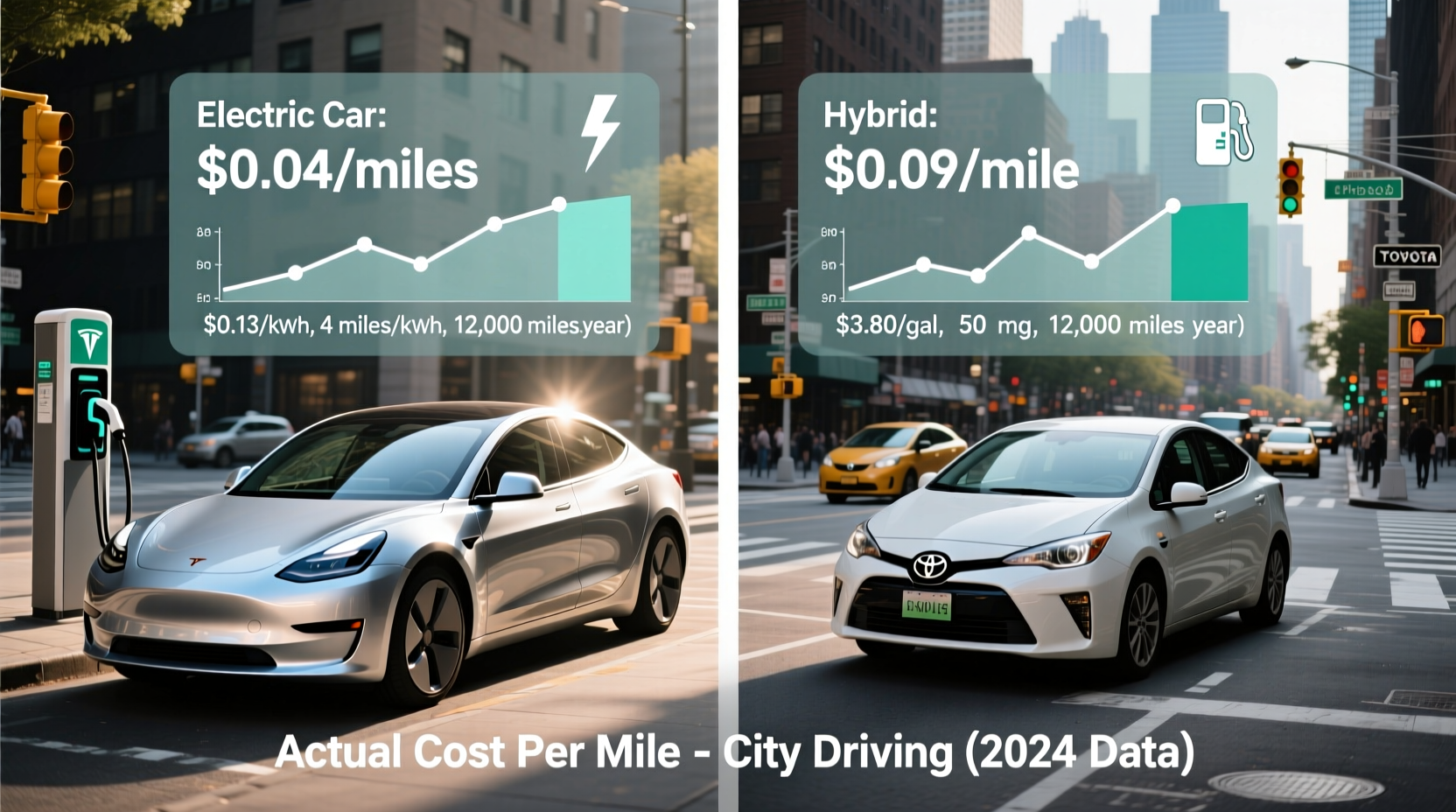
In pure energy terms, EVs cost about 4.3 cents per mile—roughly half the cost of a standard hybrid. Even when accounting for off-peak charging discounts (as low as $0.10/kWh in some regions), hybrids rarely close the gap. For a driver covering 12,000 miles annually in city conditions, the annual energy savings with an EV amount to nearly $320 compared to a hybrid.
“Electric vehicles are inherently more efficient in city environments because they recover energy during braking and don’t burn fuel while idling.” — Dr. Lena Torres, Urban Mobility Researcher, MIT Transportation Lab
Maintenance and Long-Term Ownership Costs
One of the most overlooked advantages of EVs is reduced mechanical complexity. Without internal combustion engines, there’s no need for oil changes, spark plug replacements, timing belts, or exhaust systems. Hybrids still rely on gasoline engines and require many of these services, albeit less frequently than conventional cars.
According to data from Consumer Reports, the average EV owner spends about 33% less on maintenance and repairs over the first 10 years compared to hybrids.
Key maintenance differences include:
- Brakes: EVs and PHEVs use regenerative braking, which reduces wear on friction brakes. Many EV owners report brake pad life exceeding 60,000 miles.
- Battery longevity: Modern EV batteries are warrantied for 8 years/100,000 miles. Most retain 80–90% capacity after 10 years of city driving.
- Coolant and transmission: Hybrids require coolant flushes and transmission servicing every 60,000–100,000 miles.
Here’s a realistic 5-year maintenance cost estimate for city drivers:
| Service | EV (Est. Cost) | Hybrid (Est. Cost) |
|---|---|---|
| Oil Changes | $0 | $300 (10 changes @ $30) |
| Brake Pads/Replacement | $150 (once) | $400 (twice) |
| Transmission Service | $0 | $250 |
| Coolant Flush | $100 (battery system) | $200 (engine + hybrid system) |
| Tire Rotation & Alignment | $300 | $300 |
| Total | $550 | $1,450 |
This $900 difference over five years adds another 1.5 cents per mile in favor of EVs. When combined with fuel savings, the total operational advantage grows substantially.
Depreciation, Incentives, and Upfront Pricing
While EVs save money in operation, their higher purchase price remains a barrier. However, federal and state incentives can dramatically reduce net cost. As of 2024, the U.S. offers up to $7,500 in federal tax credits for new EVs, with additional state rebates (e.g., $2,000 in California).
Let’s compare two real-world models commonly used for city commuting:
- 2024 Nissan Leaf S: $28,000 MSRP, eligible for $7,500 credit → net $20,500
- 2024 Toyota Prius LE (Hybrid): $27,950 MSRP, no federal credit → net $27,950
Despite similar starting prices, the Leaf ends up $7,450 cheaper after incentives. Over five years and 15,000 miles annually (75,000 miles), depreciation rates also differ:
- Nissan Leaf: Loses ~45% value (resale ~$11,275)
- Toyota Prius: Loses ~38% value (resale ~$17,330)
While the Prius holds value better, the lower initial outlay of the Leaf narrows the gap. When annualized, the Leaf’s ownership cost is still competitive, especially when factoring in lower running expenses.
Tip: Always check eligibility for EV tax credits—some models no longer qualify due to battery sourcing rules.Mini Case Study: Sarah’s Commute in Seattle
Sarah lives in downtown Seattle and drives 28 miles round-trip to work, mostly through city streets and occasional highway. She charges her 2023 Chevrolet Bolt EUV at home using a Level 2 charger during off-peak hours ($0.11/kWh). Her annual mileage: 12,000 miles.
She considered a Toyota Prius Prime (PHEV) but chose the Bolt for its all-electric range (247 miles) and lower per-mile cost.
Her annual costs:
- Electricity: 12,000 ÷ 3.5 = ~3,429 kWh × $0.11 = $377
- Maintenance: $110/year (rotations, cabin filter, software updates)
- Insurance: $980/year (slightly higher than hybrid due to repair costs)
- Total: $1,467/year or **$0.122 per mile**
If she had chosen the Prius Prime (with 44-mile electric range), she’d drive ~8,000 miles on electricity and 4,000 on gas (assuming full charge each day). Her costs:
- Electricity: 8,000 ÷ 3.5 ≈ 2,286 kWh × $0.11 = $251
- Gasoline: 4,000 ÷ 50 mpg = 80 gal × $3.50 = $280
- Maintenance: $250/year
- Insurance: $920/year
- Total: $1,701/year or **$0.142 per mile**
Sarah saves $234 annually—$0.02 per mile—by choosing the EV. Over five years, that’s $1,170 in direct savings, not including the $7,500 federal credit she received.
Step-by-Step Guide: Choosing the Right Option for Your City Lifestyle
Follow this decision framework to determine whether an EV or hybrid makes more sense for your urban driving needs:
- Map your daily driving distance. If it’s consistently under 40 miles, an EV can handle it on battery alone.
- Check home charging access. Off-street parking or a garage with outlet access makes EV ownership practical. No access? Public charging may add time and cost.
- Review local electricity and gas prices. In states like Washington or Idaho ($0.10/kWh), EVs shine. In areas with high electricity rates (Hawaii, California peak times), the gap shrinks.
- Verify tax credit eligibility. Use the IRS Qualified Vehicle list to confirm if your desired EV qualifies for the $7,500 credit.
- Compare insurance quotes. EVs often cost 10–20% more to insure due to battery replacement costs.
- Factor in public transit backup. If you rely on ride-sharing or transit occasionally, a smaller EV may suffice. Frequent road trips? A PHEV might offer more flexibility.
FAQ
Do hybrids really save money in city driving?
Yes, compared to gas-only vehicles—but not compared to EVs. Hybrids reduce fuel use in stop-and-go traffic, but they still require engine maintenance and pay for gasoline. In most metro areas, EVs deliver lower total cost per mile.
Are EV batteries expensive to replace after warranty?
While a full battery replacement can cost $5,000–$15,000, most modern EVs retain strong capacity over time. Few city drivers exceed battery lifespan within the vehicle’s useful life. Battery prices have dropped 89% since 2010, and recycling programs are expanding.
Can I charge an EV without a garage?
Yes, but it requires planning. Apartment dwellers can use public Level 2 chargers (often $0.30–$0.50/kWh), workplace charging, or curbside pilot programs. Some cities now mandate EV-ready parking in multifamily units.
Conclusion: The Smart Choice for City Drivers
When analyzing true cost per mile—including energy, maintenance, incentives, and depreciation—electric cars consistently outperform hybrids for city driving. The combination of lower electricity costs, minimal maintenance, and strong federal incentives creates a compelling financial case. For drivers with predictable routes under 40 miles and access to charging, EVs aren’t just greener—they’re cheaper to operate.
Hybrids remain a solid transitional option, especially for those without reliable charging or who frequently leave the city. But as battery prices fall and charging networks expand, the economic edge of EVs will only grow.
💬 Ready to cut your driving costs? Calculate your personalized cost per mile using your local rates and daily mileage. Share your findings or questions in the comments below—we’ll help you find the best fit for your urban lifestyle.








