
As the digital infrastructure landscape evolves, aspiring network engineers face a critical career decision: where to focus their learning and certification efforts. For decades, Cisco has dominated enterprise networking, shaping curricula, job descriptions, and global IT standards. But with companies like Samsung expanding aggressively into 5G, SD-WAN, and hybrid cloud environments, the question arises—has the balance shifted? In 2025, does Cisco still hold its crown as the gold standard for network engineering careers, or is Samsung emerging as a viable alternative?
The answer isn’t binary. While Cisco remains deeply entrenched in enterprise networks, data centers, and service provider ecosystems, Samsung’s strategic pivot into telecom infrastructure and open networking solutions presents new pathways. Understanding the nuances between these two tech giants is essential for anyone planning a long-term career in networking.
The Legacy of Cisco in Networking
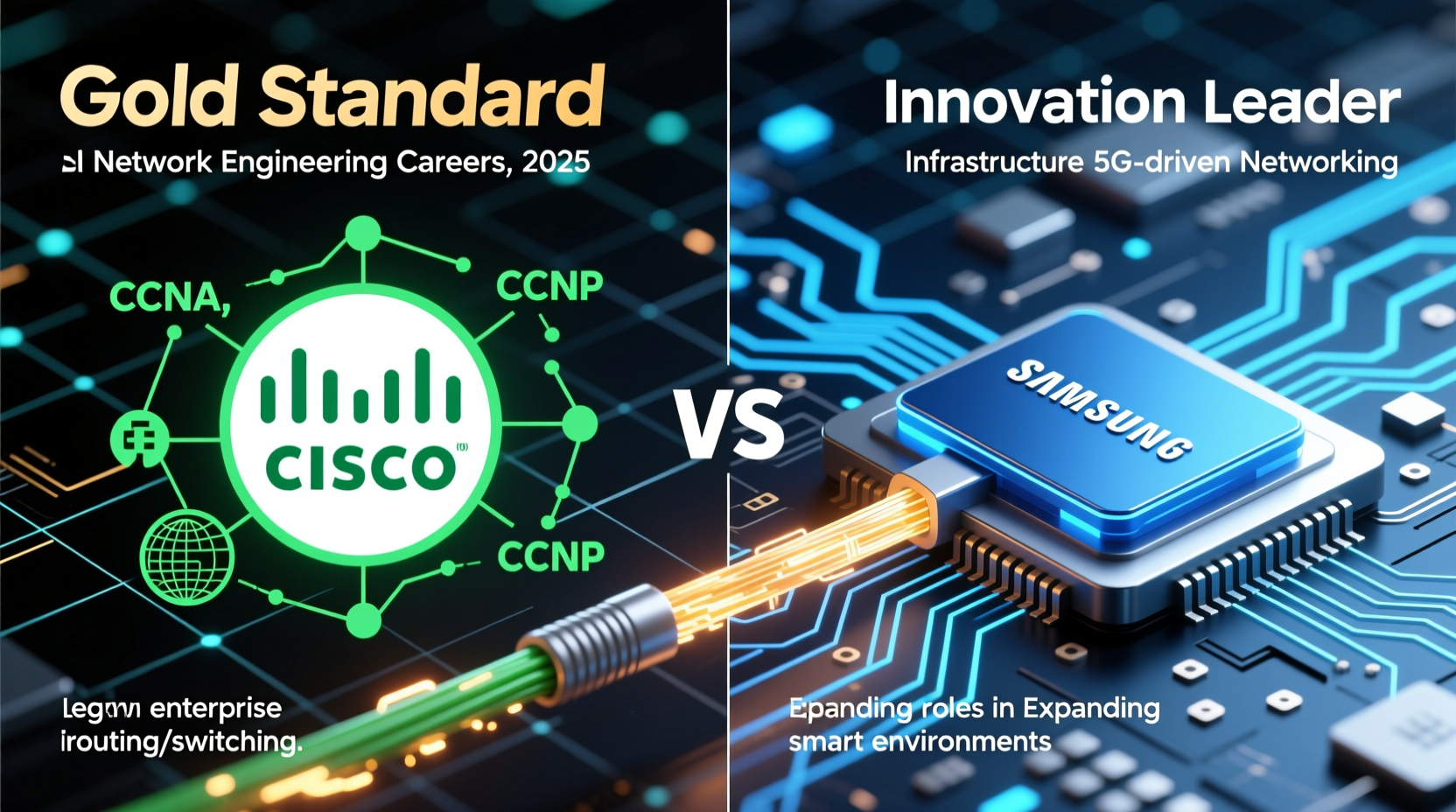
Cisco Systems has been synonymous with networking since the 1990s. Its routers, switches, firewalls, and collaboration tools form the backbone of most corporate and government networks worldwide. The company’s certification programs—CCNA, CCNP, and CCIE—are widely regarded as industry benchmarks. These credentials are not just technical validations; they’re often prerequisites for mid-to-senior-level network roles.
What sets Cisco apart is its ecosystem depth. From IOS-XE to NX-OS, Cisco controls both hardware and software layers, enabling tightly integrated solutions. This vertical integration ensures reliability but also creates vendor lock-in—a reality many enterprises accept for stability.
“Cisco certifications remain the most recognized currency in global networking. An engineer with a CCIE still commands respect—and salary premiums—in any data center.” — Rajiv Mehta, Senior Network Architect at Telstra GlobalTip: Even if you work in a multi-vendor environment, understanding Cisco's CLI and architecture gives you a foundational advantage in troubleshooting and design.
Samsung’s Rise in Network Infrastructure
Samsung is often associated with consumer electronics, but its B2B division, particularly Samsung Networks, has made significant inroads in telecommunications. Unlike Cisco’s broad enterprise focus, Samsung specializes in wireless infrastructure—especially 5G radio access networks (RAN), Open RAN solutions, and private LTE/5G deployments.
In recent years, Samsung has won major contracts with U.S. carriers like Verizon and AT&T, supplying 5G equipment to compete with Ericsson and Nokia. It’s also partnering with AWS and Microsoft Azure to deliver edge computing solutions powered by its radio and core network technologies.
However, Samsung does not offer public certification programs comparable to Cisco’s. Training is typically restricted to partners, integrators, or employees. This lack of accessible credentialing limits individual engineers’ ability to showcase expertise independently.
That said, working with Samsung means exposure to cutting-edge wireless protocols, virtualized network functions (VNFs), and cloud-native 5G cores—skills increasingly valuable in telco and industrial IoT sectors.
Comparative Analysis: Cisco vs Samsung in 2025
| Category | Cisco | Samsung |
|---|---|---|
| Primary Focus | Enterprise networking, data centers, security, collaboration | Wireless infrastructure, 5G RAN, Open RAN, private networks |
| Certification Availability | Public (CCNA, CCNP, DevNet, CCIE) | Limited to partners and employees |
| Market Penetration | Global enterprise dominance | Strong in North America & Asia telecom; limited enterprise presence |
| Learning Resources | Abundant (books, labs, online courses, simulators) | Scarce for non-partners |
| Career Mobility | High—recognized across industries | Niche—primarily in telecom and system integration roles |
| Future Trends Alignment | Hybrid cloud, AI-driven networking, intent-based systems | Open RAN, 5G standalone, edge computing |
Real-World Career Pathways: A Mini Case Study
Consider two engineers entering the field in 2023:
- Alex pursued a CCNA, then landed an internship at a managed service provider. Within two years, Alex earned a CCNP and transitioned to a network operations role at a Fortune 500 company, managing Cisco SD-WAN and Catalyst switches.
- Jin, fluent in Korean and interested in wireless tech, joined a Samsung partner firm specializing in smart factory deployments. Jin worked on integrating Samsung’s private 5G network with industrial automation systems, gaining deep expertise in spectrum management and edge orchestration.
By 2025, Alex enjoys broad job flexibility—able to apply for roles in finance, healthcare, or cloud providers. Jin, while highly specialized, faces fewer public job postings requiring Samsung-specific knowledge but commands high value within niche industrial and telecom projects.
This illustrates a key divergence: Cisco opens doors across sectors; Samsung offers depth in specific, growing domains.
Action Plan: Building a Competitive Edge in 2025
Regardless of your preferred vendor, success in network engineering requires more than brand loyalty. Here’s a step-by-step guide to positioning yourself effectively:
- Master Fundamentals First: Understand TCP/IP, subnetting, routing protocols (OSPF, BGP), and switching concepts before diving into vendor specifics.
- Earn a Cisco Certification: Start with CCNA—even if you plan to work with other vendors, it builds credibility and fills knowledge gaps.
- Gain Hands-On Experience: Use platforms like Packet Tracer, GNS3, or CML to simulate real networks. Volunteer for lab setups or internships.
- Specialize Strategically: If interested in wireless and 5G, explore Samsung’s technology through partner training or vendor-neutral certifications like those from the Wireless Innovation Forum.
- Develop Automation Skills: Learn Python, Ansible, and REST APIs. Both Cisco (via DNA Center) and Samsung (through cloud-managed RAN) rely on programmability.
Frequently Asked Questions
Can I get a network engineering job without Cisco certifications?
Yes, especially in organizations using Juniper, Arista, or open-source solutions. However, lacking Cisco knowledge may limit opportunities in traditional enterprise environments. Many hiring managers still view CCNA as a baseline competency.
Is Samsung replacing Cisco in modern networks?
No. They operate in different domains. Samsung competes with Ericsson and Nokia in telecom, not directly with Cisco in enterprise LAN/WAN. In fact, Samsung-powered 5G networks often connect back to Cisco core infrastructure.
Should I learn Samsung technologies if I want to work in 5G?
If you're targeting telecom operators or industrial IoT deployments, yes. But prioritize understanding 3GPP standards, Open RAN architecture, and network slicing first. Vendor-specific implementation follows.
Checklist: Preparing for a Network Engineering Career in 2025
- ✅ Complete CCNA or equivalent foundational knowledge
- ✅ Gain experience with CLI-based configuration (Cisco IOS or similar)
- ✅ Learn basic Python for network automation
- ✅ Understand cloud networking (AWS VPC, Azure ExpressRoute)
- ✅ Explore wireless fundamentals (Wi-Fi 6/7, 5G NR)
- ✅ Decide whether to specialize in enterprise (Cisco-aligned) or telecom (Samsung-relevant) paths
- ✅ Build a home lab or use cloud-based network simulators
Conclusion: Is Cisco Still the Gold Standard?
In 2025, Cisco remains the de facto gold standard for network engineering jobs—not because it’s the only player, but because its footprint spans continents, industries, and generations of technology. Its certifications are trusted, its platforms are pervasive, and its influence on networking education is unmatched.
Samsung, while formidable in 5G and private wireless, operates in a narrower band of the market. It offers exciting opportunities, particularly in next-gen telecom and smart infrastructure, but lacks the breadth and accessibility that make Cisco a reliable career launchpad.
The smartest engineers don’t choose one over the other blindly. They use Cisco to build foundational credibility and then layer on emerging skills—including those relevant to Samsung’s ecosystem—to stay competitive. In a world shifting toward hybrid, automated, and wireless-first networks, versatility wins.
🚀 Ready to take control of your network engineering career? Start with CCNA, deepen your automation skills, and keep one eye on the future of wireless. The best opportunities go to those who blend proven expertise with forward-looking adaptability.