When it comes to building a strong, defined core without relying on weights or machines, two disciplines consistently rise to the top: yoga and Pilates. Both are accessible, require no special equipment, and emphasize body awareness and controlled movement. But if your primary goal is visible core toning—firmer abs, improved posture, and greater midsection stability—which practice delivers faster, more effective results?
The answer isn’t always straightforward. While both methods engage the deep abdominal muscles, their approach, intensity, and focus differ significantly. Understanding these differences can help you choose the right path based on your fitness level, goals, and lifestyle.
Understanding Core Toning: What It Really Means
Toning the core doesn’t just mean getting “six-pack abs.” True core strength involves activating and strengthening a network of muscles: the rectus abdominis (the surface abs), transverse abdominis (the deep corset-like muscle), obliques (side support), and the erector spinae (lower back stabilizers). A well-toned core improves balance, protects the spine, enhances athletic performance, and supports everyday movements like bending, twisting, and lifting.
Without equipment, the challenge becomes maximizing muscle engagement through bodyweight control, breath, and precision. This is where both yoga and Pilates excel—but in different ways.
Tip: Focus on quality over quantity. Five minutes of precise, engaged core work is more effective than 30 minutes of unfocused movement.How Yoga Engages the Core
Yoga uses dynamic poses and static holds to build endurance, flexibility, and internal strength. Many foundational postures inherently activate the core as a stabilizer. For example:
- Plank Pose (Phalakasana): Requires full-body tension with core bracing to maintain alignment.
- Boat Pose (Navasana): Directly targets the rectus abdominis and hip flexors.
- Side Plank (Vasisthasana): Challenges obliques and lateral stability.
- Warrior III (Virabhadrasana III): Demands core engagement to balance on one leg while extending the torso and opposite leg.
Styles like Vinyasa and Ashtanga are particularly effective for core toning due to their flowing sequences that link breath with movement, creating continuous muscular demand. However, Hatha or Yin yoga may offer less direct core activation unless modified with intentional engagement cues.
One of yoga’s strengths lies in its holistic integration. The core is not isolated—it works in concert with breath (pranayama) and mindfulness. This leads to subtle but lasting improvements in posture and intra-abdominal pressure regulation, which contribute to long-term toning.
“Yoga teaches you to engage your core from within—not just for aesthetics, but for functional stability and spinal protection.” — Dr. Lena Torres, Physical Therapist & Certified Yoga Instructor
Pilates: Precision Training for Core Definition
Pilates was literally designed to strengthen the core. Developed by Joseph Pilates in the early 20th century, the method centers around what he called the “powerhouse”—the muscles of the abdomen, lower back, hips, and glutes. Every Pilates exercise, even those targeting limbs, originates from this central hub.
Unlike yoga, Pilates emphasizes small, controlled movements with intense muscular focus. Exercises such as the Hundred, Roll-Up, Saw, and Single Leg Stretch directly isolate and fatigue the abdominal muscles using minimal range but high repetition and resistance created by body mechanics.
Mat-based Pilates—performed entirely on the floor with no equipment—is especially effective for core toning. Because it prioritizes form and muscle recruitment over flexibility or spiritual elements, progress can be measured more concretely in terms of endurance, control, and visible definition.
A 2020 study published in the *Journal of Sports Science & Medicine* found that participants who practiced mat Pilates three times per week for eight weeks showed significant reductions in waist circumference and increases in trunk muscle endurance compared to a control group.
Comparing Effectiveness: Speed and Results
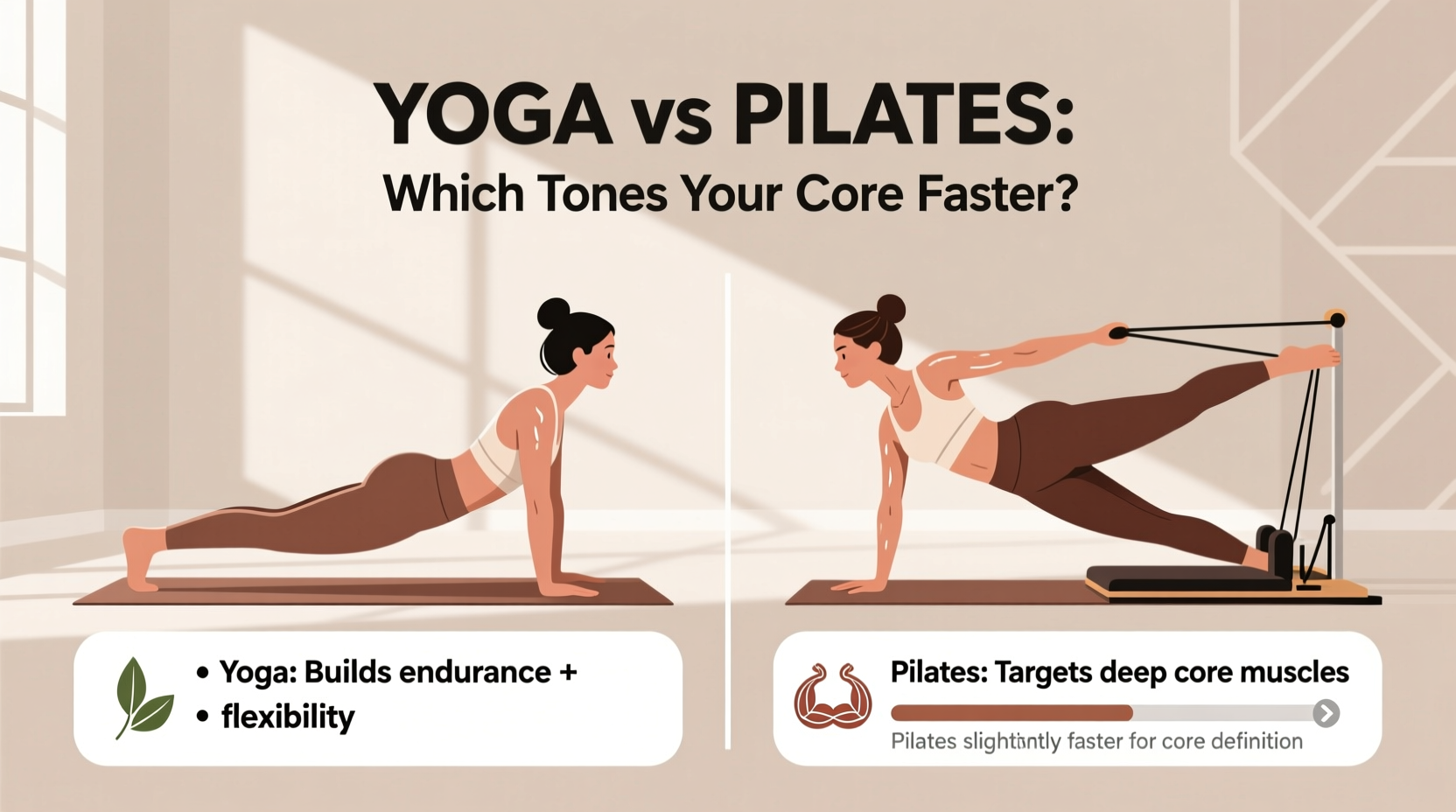
So which method tones the core faster? The evidence leans toward Pilates when speed and targeted definition are the priority. Here's why:
| Factor | Yoga | Pilates |
|---|---|---|
| Core Activation Level | Moderate to high (varies by style) | Consistently high across all exercises |
| Focused Abdominal Work | Indirect; integrated into poses | Direct; central to every movement |
| Speed of Visible Toning | Slower (4–8 weeks with consistency) | Faster (noticeable in 3–6 weeks) |
| Equipment Needed | None (mat optional) | None (mat recommended) |
| Best For | Overall balance, flexibility, mind-body connection | Core definition, posture correction, muscular endurance |
Pilates systematically isolates and fatigues the abdominal muscles, creating micro-tears that lead to muscle adaptation and toning—similar to resistance training. Yoga, while beneficial, often spreads effort across multiple systems, diluting the intensity on the core unless specifically programmed.
Tip: To maximize core engagement in yoga, consciously draw the navel toward the spine in every pose—even forward folds and twists.Real Example: Sarah’s 6-Week Transformation
Sarah, a 34-year-old office worker, wanted to strengthen her core after years of sitting at a desk. She had no injuries but struggled with lower back pain and weak posture. She committed to two routines:
First 3 Weeks – Yoga Only: Practiced 30-minute Vinyasa sessions 5x/week. Focused on sun salutations, boat pose, and side planks. Noticed improved breathing and slight tightening in the midsection, but minimal visual change.
Next 3 Weeks – Switched to Mat Pilates: Followed a beginner-level Pilates program emphasizing the Hundred, roll-ups, and single-leg stretches. Within two weeks, she could hold a plank for 90 seconds (up from 30), and her waist measurement decreased by 1.5 inches. Her back pain diminished significantly.
“I didn’t realize how little I was actually using my deep abs until Pilates forced me to,” she said. “Yoga made me feel better, but Pilates made me look stronger.”
Step-by-Step Guide to Maximizing Core Toning Without Equipment
Whether you choose yoga, Pilates, or a blend of both, follow this six-week plan to accelerate core toning:
- Week 1–2: Build Foundation
Practice 3x/week. Choose either a beginner Pilates mat routine or a core-focused Vinyasa flow. Focus on mastering form, not duration. Hold key poses (plank, boat) for 20–30 seconds. - Week 3–4: Increase Intensity
Add 1–2 dedicated core mini-sessions (10 minutes) on non-practice days. Include Pilates’ Hundred (3 sets of 10 breaths) or yoga’s Navasana with supported legs. - Week 5–6: Combine & Challenge
Alternate days: Pilates on Monday/Wednesday/Friday, yoga on Tuesday/Thursday. Sunday = rest. By week 6, aim to hold a full plank for 60+ seconds and perform 10 controlled roll-ups.
Track progress weekly: measure waist circumference, note plank endurance, and take front/side photos under consistent lighting.
Checklist: Are You Maximizing Your Core Workout?
- ✅ Engage transverse abdominis by drawing navel to spine before each movement
- ✅ Breathe properly—exhale during exertion (e.g., lifting legs or rolling up)
- ✅ Avoid neck strain—keep chin slightly tucked during crunch-like motions
- ✅ Maintain neutral spine; don’t let lower back arch excessively
- ✅ Perform exercises slowly—speed reduces muscle time under tension
- ✅ Practice consistently—at least 3–4 times per week for visible results
Can You Combine Yoga and Pilates?
Absolutely—and many fitness professionals recommend it. Blending both disciplines leverages their unique benefits:
- Pilates builds strength and definition.
- Yoga enhances flexibility, balance, and breath coordination.
For example, start with a Pilates core sequence to activate and fatigue the abs, then transition into yoga poses like Crow or Arm Balances that require core stability. Or end a yoga session with 10 minutes of Pilates-specific ab work to “finish” the core.
This hybrid approach prevents plateaus, keeps workouts engaging, and develops a functional, resilient core that performs well in real-life situations.
Frequently Asked Questions
Can you tone your core without losing weight?
Yes. Core toning is about muscle development, not fat loss. While reduced body fat makes muscles more visible, consistent core training will firm and strengthen the area regardless of scale changes.
Which is better for diastasis recti or post-pregnancy recovery?
Pilates is often recommended by physical therapists for postpartum recovery due to its emphasis on transverse abdominis reactivation. However, specialized prenatal/postnatal yoga programs can also be effective when guided by a trained instructor.
Do I need a mat for either practice?
A yoga or exercise mat is highly recommended for comfort and joint protection, especially during floor-based exercises. However, neither yoga nor Pilates requires any other equipment to begin.
Final Verdict: Which One Tones Faster?
If your sole objective is faster, more noticeable core toning using only bodyweight, **Pilates has the edge**. Its systematic, targeted approach to abdominal conditioning produces measurable results in a shorter timeframe. The precision, repetition, and focus on the “powerhouse” make it one of the most efficient equipment-free methods for building a defined midsection.
That said, yoga should not be dismissed. For those seeking a balanced approach that includes mental clarity, flexibility, and overall well-being alongside core strength, yoga offers profound long-term benefits. And when practiced in dynamic styles with intentional core engagement, it can still deliver meaningful toning—just typically at a slower pace.
The smartest strategy? Use Pilates to build and define your core, and use yoga to maintain mobility, prevent injury, and deepen mind-body awareness. Together, they create a powerful synergy that goes beyond aesthetics to cultivate true functional strength.
🚀 Ready to transform your core? Start with 3 Pilates sessions this week, focusing on the Hundred and Roll-Up. Track your progress, stay consistent, and feel the difference in just 21 days.








