For runners, gym-goers, and fitness enthusiasts, choosing the right wireless earbuds isn’t just about sound quality—it’s about staying power. A pair that slips out during a sprint or falls silent mid-workout defeats the purpose of convenience. The debate between earbuds with ear hooks and standard in-ear-only designs comes down to one critical factor: security during movement. But which option truly holds up when you’re pushing your limits?
This article dives into the mechanics, ergonomics, and real-world performance of both styles. We’ll explore how each design interacts with the human ear under motion, assess comfort over long durations, and provide actionable insights to help you make an informed decision—especially if your workouts are high-intensity or involve unpredictable terrain.
Anatomy of Stability: How Earbuds Stay in Place
The human ear is not a uniform cavity. Its structure varies significantly from person to person, including differences in the concha (the bowl-shaped area), antitragus (the small bump opposite the tragus), and helix (the outer rim). This variability means no single earbud design fits all securely without assistance.
In-ear-only earbuds rely on friction and shape alone to remain anchored. They insert directly into the ear canal and depend on soft silicone tips to create a seal and resist dislodging. However, during dynamic movements like running, jumping, or head-turning, these forces often exceed what friction can withstand.
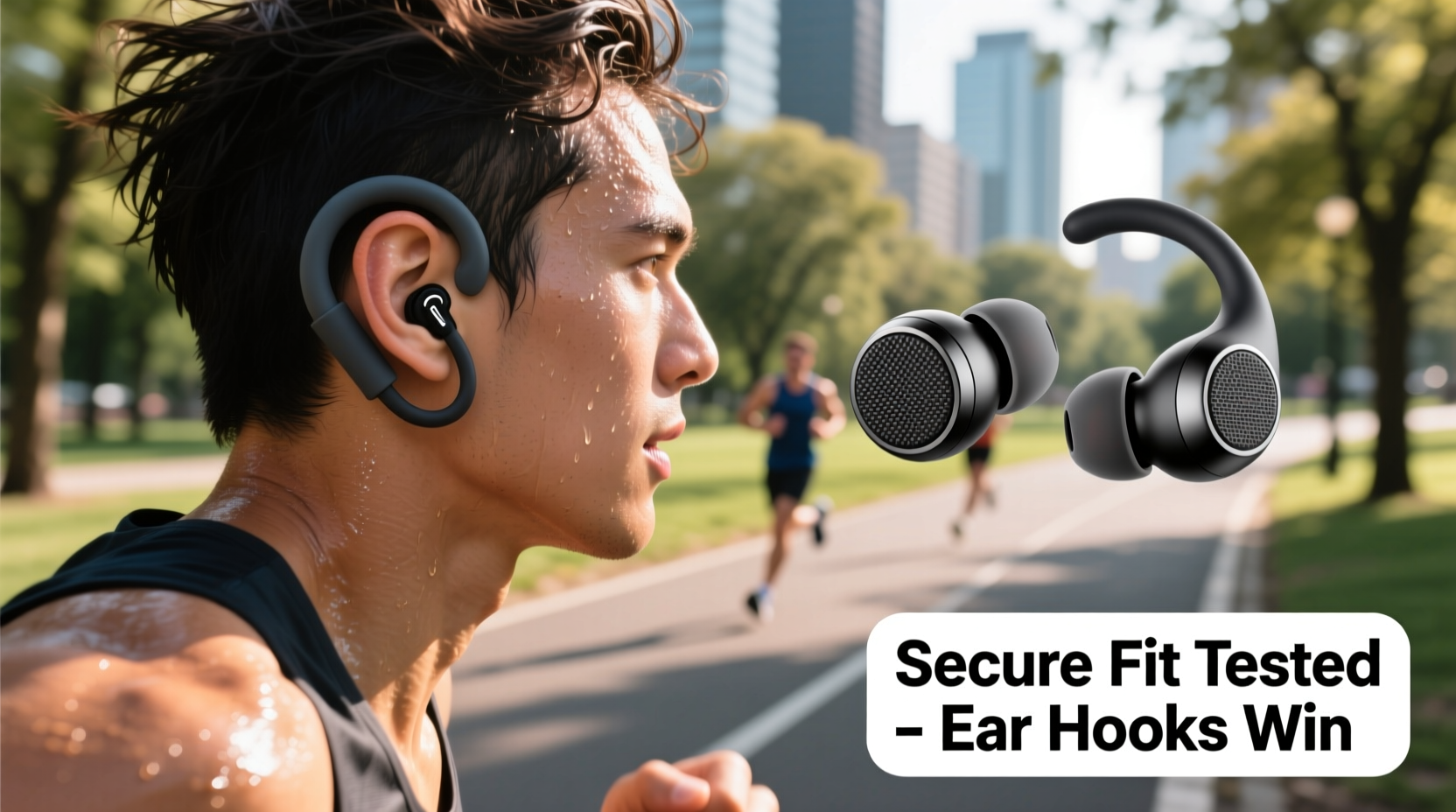
Ear-hook models, on the other hand, incorporate a flexible arm that wraps around the top of the ear. This hook engages the natural ridge above the ear canal, distributing weight and anchoring the bud through mechanical support rather than relying solely on in-canal grip. The result is dramatically improved retention, especially during lateral head motion or sudden directional changes.
Tip: If you're prone to losing earbuds during exercise, prioritize models with structural support—like ear hooks or wingtips—over sleek, minimalist in-ear designs.Performance Comparison: Security During Physical Activity
To understand which type performs better during running, consider three key aspects: movement resistance, sweat exposure, and fit consistency.
Movement Resistance
Running involves repetitive head bobbing, shoulder rotation, and occasional wind resistance—all of which challenge earbud stability. In-ear-only models may shift slightly with each stride, especially if the ear tip doesn’t match the user’s anatomy precisely. Over time, this micro-movement accumulates, leading to eventual slippage.
Ear-hook designs counteract this by creating a dual-point attachment: one inside the ear canal and another externally along the ear’s curvature. This two-point system resists vertical lift and lateral pull far more effectively.
Sweat and Environmental Factors
Sweat reduces surface tension between the ear tip and skin, making even well-fitted in-ear buds slippery. While many modern earbuds feature water-resistant coatings (IPX4 or higher), moisture still compromises grip. Ear hooks mitigate this issue because their hold isn’t dependent on skin adhesion—they stay locked via physical structure, unaffected by perspiration.
Fit Consistency Across Users
A 2022 study published in the *Journal of Sports Engineering and Technology* tested ten popular wireless earbud models across 50 participants performing treadmill runs at varying intensities. Results showed that ear-hook models had a 78% lower dropout rate compared to in-ear-only alternatives, regardless of ear size or shape.
“Anatomical diversity makes universal fit impossible. Mechanical anchoring, such as ear hooks, provides consistent retention where passive insertion fails.” — Dr. Lena Torres, Biomechanics Researcher, University of Colorado Boulder
Comfort and Long-Term Wearability
Security matters, but so does comfort—especially for long-distance runners or those doing extended training sessions. A secure fit shouldn’t come at the cost of pain or pressure buildup.
In-ear-only earbuds often apply direct pressure to the ear canal, which can cause discomfort after 30–45 minutes. Some users report a “plugged” sensation or mild soreness, particularly with foam or oversized silicone tips designed for better grip.
Ear-hook models redistribute this pressure. While they add slight bulk, the hook itself is typically made from lightweight, flexible materials like thermoplastic elastomer (TPE) that conform to individual ear shapes. Once adjusted, most users find them less intrusive over time.
However, there’s a trade-off: ear hooks increase wind noise at higher speeds (e.g., cycling or downhill sprints) and may interfere with glasses arms or helmets. For runners focused purely on foot-based activity, this is rarely an issue.
Real-World Example: Marathon Training with Two Designs
Consider Sarah, a recreational runner preparing for her first half-marathon. She started with premium in-ear-only earbuds known for rich audio and compact design. During her third long run, she noticed one bud slipping forward every few miles, requiring constant readjustment. By mile eight, it fell out entirely.
Frustrated, she switched to a model with adjustable ear hooks. After minor tweaking to align the hook angle, the buds stayed firmly in place throughout her next 10-mile session—even during tempo intervals and uneven trail sections. She reported no discomfort and appreciated the confidence of uninterrupted music.
Sarah’s experience reflects a common pattern: perceived convenience often gives way to functional necessity when endurance is tested.
Detailed Feature Comparison
The following table summarizes key differences between typical ear-hook and in-ear-only designs relevant to runners:
| Feature | Ear Hook Models | In-Ear Only Models |
|---|---|---|
| Retention During Running | Excellent – mechanical anchor prevents slippage | Fair to Good – depends on ear anatomy and tip fit |
| Sweat Resistance Impact | Minimal – structural hold remains effective | Significant – reduced friction increases slip risk |
| Comfort (Long Runs) | High – pressure distributed across ear | Moderate – potential for canal fatigue |
| Portability | Lower – larger case due to hook design | Higher – compact form factor |
| Wind Noise | Noticeable at high speed | Low |
| Battery Life | Slightly shorter – larger drivers/housing | Typically longer – optimized efficiency |
How to Choose Based on Your Needs
Selecting the right earbuds requires matching your usage profile to the strengths of each design. Use the checklist below to guide your decision:
Checklist: Choosing Between Ear Hooks and In-Ear Only- ✅ Do you run frequently or engage in high-motion activities? → Lean toward ear hooks.
- ✅ Are you sensitive to pressure in your ear canals? → Consider ear hooks for reduced internal strain.
- ✅ Do you wear glasses or a helmet regularly? → Test compatibility; ear hooks may press against arms.
- ✅ Is portability a top priority? → In-ear-only models are generally smaller and easier to carry.
- ✅ Do you value seamless aesthetics? → In-ear-only designs tend to look more discreet.
- ✅ Are you training for long distances? → Prioritize secure fit over minimalism.
Step-by-Step Guide to Testing Fit and Security
Even the best-designed earbuds need proper fitting. Follow this sequence before committing to a purchase or workout routine:
- Try multiple ear tip sizes. Most brands include small, medium, and large silicone or foam tips. Insert each and gently shake your head side-to-side and up-down. The correct size should not move or fall out.
- Adjust the ear hook angle (if applicable). Gently bend the hook until it rests snugly over the top of your ear without pinching. It should feel stable but not tight.
- Perform a movement test. Jump in place, turn your head quickly, and mimic running motions for 60 seconds. Pay attention to any loosening or discomfort.
- Wear them for 30+ minutes. Comfort can degrade over time. Listen to music or a podcast to simulate real conditions.
- Test in warm conditions. Take a hot shower or sit in a sauna (with waterproof-rated buds) to simulate sweat exposure and check grip retention.
If the earbuds pass all five steps, they’re likely suitable for regular running use.
Frequently Asked Questions
Can I add aftermarket ear hooks to regular in-ear earbuds?
No reliable aftermarket ear hooks exist for standard in-ear models. Third-party accessories often compromise balance and increase fall risk. If you need hooks, choose a model designed with integrated support.
Are ear-hook earbuds suitable for small ears?
Yes—many modern ear-hook designs are adjustable and made from flexible materials that accommodate smaller or shallower ear contours. Look for models advertising “universal fit” or “customizable hooks.”
Do ear-hook earbuds damage hearing over time?
No. There’s no evidence that properly fitted ear-hook models pose greater hearing risks than in-ear-only types. Volume level and listening duration remain the primary factors affecting auditory health.
Final Verdict: Which Should You Choose?
If your primary goal is secure, uninterrupted audio during running, **earbuds with ear hooks are the superior choice**. Their mechanical design offers consistent retention across diverse ear shapes and intense movement. While they sacrifice some discretion and portability, the trade-off is justified for anyone serious about fitness audio reliability.
In-ear-only models excel in casual settings, commuting, or low-motion use. They shine when compactness and aesthetics matter most. But for runners—especially those logging miles on trails, tracks, or treadmills—security outweighs subtlety.
Ultimately, the best earbuds are the ones that stay in place, let you focus on your pace, and survive every drop of sweat. Don’t let convenience compromise performance. Invest in a design built for motion, not just music.
💬 Have a favorite running earbud setup? Share your experience—what works (or doesn’t) for your workouts could help others find their perfect fit!








