Radio telescopes and optical telescopes both allow us to observe distant celestial objects, but they operate on fundamentally different principles. One of the most striking differences between them is size: radio telescopes are often vastly larger than their optical counterparts. The 500-meter FAST telescope in China or the now-collapsed Arecibo Observatory dwarf even the largest optical instruments like the Keck or VLT. This size disparity isn’t arbitrary—it stems from the physics of the signals they detect and the challenges of capturing faint cosmic whispers across vast distances.
The Nature of Radio Waves vs. Visible Light
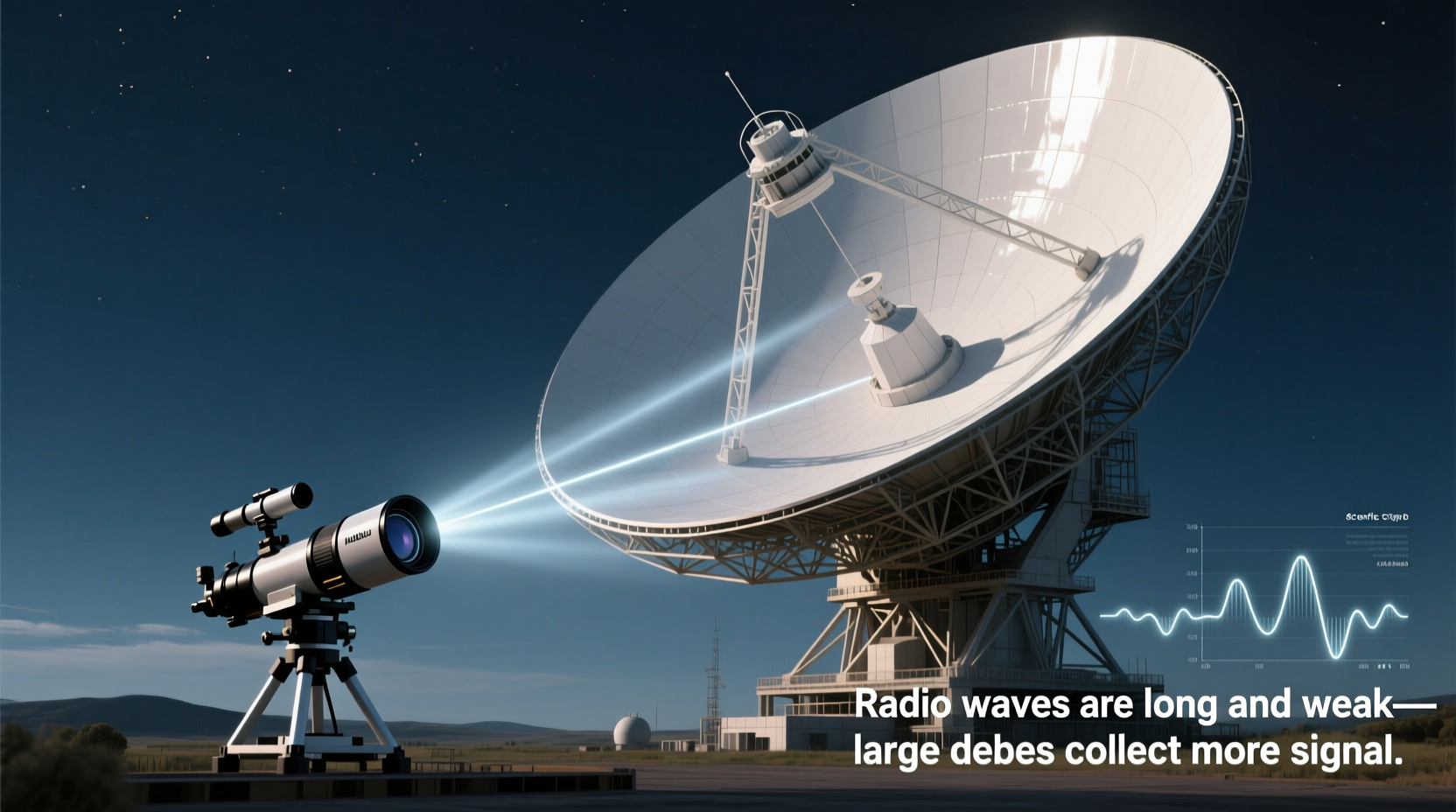
At the heart of the size difference lies the nature of the electromagnetic radiation each telescope is designed to capture. Optical telescopes collect visible light, which has wavelengths ranging from about 400 to 700 nanometers. In contrast, radio telescopes detect radio waves, which can have wavelengths from millimeters to tens of meters long—up to a million times longer than visible light.
Because of this, the energy carried by individual radio photons is extremely low. Cosmic radio sources—such as pulsars, quasars, or cold hydrogen gas clouds—are often incredibly faint. To gather enough signal to form meaningful data, radio telescopes must collect these weak waves over a large surface area. The larger the collecting area, the more radio waves it can intercept, improving sensitivity.
Tip: Sensitivity in radio astronomy scales with the square of the dish diameter—doubling the size quadruples the signal collection capability.Angular Resolution and Wavelength Limitations
Another key factor is angular resolution—the ability to distinguish fine details in an observed object. Resolution depends on both the wavelength of the observed radiation and the diameter of the telescope’s aperture. The formula for diffraction-limited resolution is:
θ ≈ λ / D
Where θ is the angular resolution (in radians), λ is the wavelength, and D is the diameter of the telescope. Because radio waves have much longer wavelengths than visible light, achieving the same resolution requires a proportionally larger telescope.
For example, to match the resolution of a modest 1-meter optical telescope observing green light (λ ≈ 500 nm), a radio telescope observing at a wavelength of 21 cm (the hydrogen line) would need a diameter of approximately 420 kilometers. Clearly, building such a single structure is impossible, so astronomers use interferometry—linking multiple smaller dishes across continents—to simulate a much larger aperture.
Engineering Challenges and Design Trade-offs
Despite advances in materials and engineering, constructing massive single-dish radio telescopes presents unique challenges. Unlike optical mirrors, which must be polished to near-perfect smoothness on the scale of light wavelengths (nanometers), radio dishes only need to maintain shape accuracy within a fraction of the radio wavelength they observe—typically centimeters. This allows for lighter, mesh-based reflectors that reduce weight and cost.
However, structural integrity remains critical. Large dishes like FAST rely on active surface control systems—adjustable panels that correct for gravitational deformation as the telescope moves. These innovations enable unprecedented precision without requiring impossibly rigid materials.
“Radio astronomy pushes the limits of both physics and engineering. We’re not just building telescopes—we’re building giant ears to listen to the universe.” — Dr. Fiona Reyes, Radio Astronomer, National Radio Astronomy Observatory
Comparison: Optical vs. Radio Telescopes
| Feature | Optical Telescope | Radio Telescope |
|---|---|---|
| Wavelength Range | 400–700 nm | 1 mm – 10+ m |
| Typical Diameter | 0.1 – 10 m | 10 – 500 m |
| Surface Precision Required | ~10 nm | ~1 cm |
| Primary Detection Target | Stars, galaxies, planets (emitting visible light) | Cold gas, pulsars, cosmic microwave background |
| Observation Time (Typical) | Minutes to hours | Hours to days |
| Affected by Weather? | Yes (clouds, turbulence) | Largely no (except strong interference) |
Real-World Example: The Discovery of Pulsars
In 1967, Jocelyn Bell Burnell detected regular radio pulses from a distant star using the Interplanetary Scintillation Array—a radio telescope with a collecting area of 18,000 square meters, though spread across many small antennas. The signal was so precise it was initially dubbed “LGM-1” (Little Green Men), sparking speculation about extraterrestrial intelligence. It turned out to be the first observed pulsar: a rapidly rotating neutron star emitting beams of radio waves.
This discovery underscored the importance of large collecting areas. The pulses were extremely faint and required long integration times. Had the telescope been smaller, the signal-to-noise ratio would have been too low to detect. Today, large radio dishes like FAST continue searching for new pulsars, some of which serve as natural laboratories for testing general relativity.
Interferometry: Overcoming Size Limits
To achieve high resolution without building continent-sized dishes, astronomers use interferometry. By combining signals from multiple radio telescopes separated by great distances, they simulate a single instrument as large as the maximum separation between them. The Event Horizon Telescope (EHT), which captured the first image of a black hole shadow, linked observatories from Hawaii to Antarctica, creating a virtual telescope nearly the size of Earth.
This technique doesn’t eliminate the need for large individual dishes—each still needs sufficient collecting area to detect faint signals—but it dramatically improves resolution. Still, even with interferometry, maximizing sensitivity requires large apertures at each site.
Tip: Interferometers work best when individual telescopes are large—bigger dishes mean stronger signals and cleaner data when combined.Checklist: Key Reasons Why Radio Telescopes Are Larger
- Radio waves carry less energy than visible light, requiring larger surfaces to collect enough signal.
- Longer wavelengths demand larger apertures to achieve usable angular resolution.
- Faint cosmic sources (like neutral hydrogen or distant galaxies) emit weak radio signals needing high sensitivity.
- Structural tolerances are looser, making very large dishes feasible with modern engineering.
- Interferometry enhances resolution, but individual dishes still need size for sensitivity.
Frequently Asked Questions
Can optical telescopes be as large as radio telescopes?
No, due to engineering and physical constraints. Optical mirrors must maintain nanometer-level precision across their entire surface, which becomes exponentially harder as size increases. Gravity, thermal expansion, and material limitations make mirrors larger than about 10 meters extremely complex. Radio dishes, needing only centimeter-level accuracy, can be built much larger.
Do larger radio telescopes see farther into space?
Not necessarily in distance, but in sensitivity. A larger telescope can detect fainter objects, whether nearby or far away. This allows astronomers to observe dim galaxies, trace cold gas in early universe structures, or detect exoplanet signatures that smaller instruments would miss.
Why don’t we just build more small radio telescopes instead of one huge one?
We do—arrays like the Very Large Array (VLA) combine many smaller dishes. However, there are advantages to single large dishes: they excel at deep, pointed observations, spectroscopy, and detecting transient events. Some science goals require the unmatched sensitivity of a single large collector.
Conclusion
The immense size of radio telescopes is not a matter of preference but necessity. The universe speaks in whispers across the radio spectrum—faint emissions from ancient hydrogen, spinning neutron stars, and the echoes of the Big Bang. Capturing these signals demands enormous collecting areas, pushing the boundaries of engineering and innovation. While optical telescopes reveal the bright, energetic cosmos, radio telescopes unveil its hidden, cold, and dynamic layers.
As technology advances, the next generation of instruments—like the Square Kilometre Array (SKA), with thousands of antennas spanning South Africa and Australia—will open new frontiers. Understanding why these tools must be so large is key to appreciating how deeply they expand our view of reality.
🚀 Explore the invisible universe. Support radio astronomy initiatives, follow discoveries from FAST or the SKA, and consider how even silent signals from space can reshape our understanding of existence.








