Tennis has long been celebrated for its elegance, precision, and tradition—but few aspects of the sport puzzle newcomers more than its scoring system. Why do points go 15, 30, 40, and then game? Why not 10, 20, 30, 40? And why does “deuce” exist instead of simply calling it 40–all? The logic behind this seemingly arbitrary progression is rooted in history, mathematics, and even clock faces. While no single definitive source confirms the exact origin, several compelling theories explain how and why tennis arrived at its distinctive scoring format.
The Historical Roots of Tennis Scoring
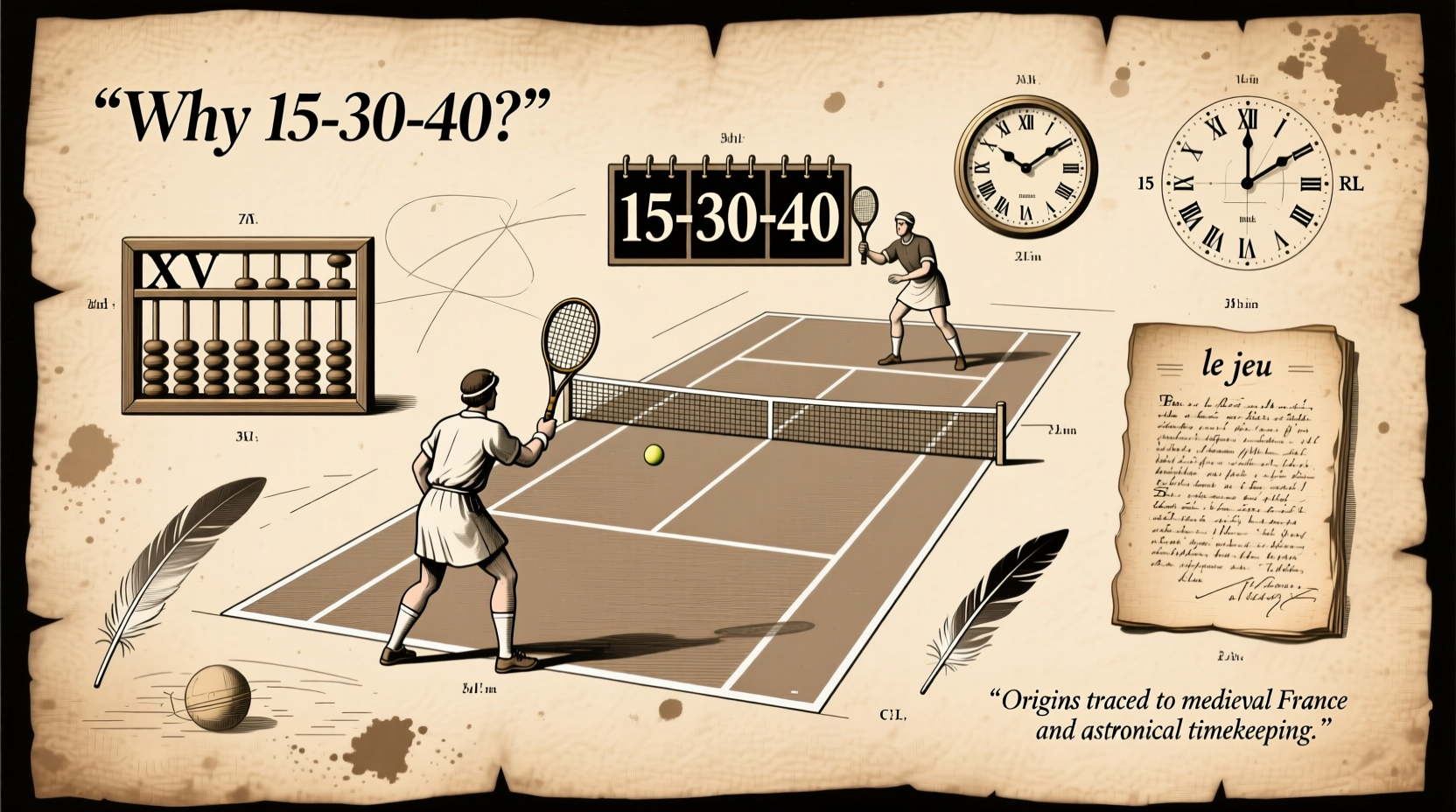
Modern tennis evolved from a 12th-century French handball game called *jeu de paume* (\"game of the palm\"). Players originally used their hands to strike the ball across a courtyard or indoor court. As rackets were introduced in the 16th century, the game spread across Europe and eventually formalized into what we now recognize as lawn tennis by the late 1800s.
Crucially, early versions of the game used clocks to track scores. A clock face was placed near the court, and the hand moved one-quarter around the dial with each point: from 15 to 30 to 45—and finally to 60, which signaled the end of the game. This method provided a visual way to follow progress without needing written records.
Over time, linguistic evolution altered \"45\" into \"40.\" One theory suggests that French players shortened \"quarante-cinq\" (forty-five) to \"quarante\" (forty) for ease of pronunciation during fast-paced play. Another proposes that scribes abbreviating scores wrote \"45\" as \"40\" to save space. Whatever the reason, the shift stuck—and so did the unusual sequence: 15, 30, 40.
Tip: When teaching new players, compare the score progression to quarters on a clock—15, 30, 45 (now 40)—to help them visualize the logic.Why Not 15, 30, 45?
If the clock theory holds, then \"45\" should be the third point. Yet today’s game uses \"40\" instead. Several explanations attempt to reconcile this discrepancy:
- Linguistic simplification: In spoken French, \"quarante-cinq\" is cumbersome. Saying \"quarante\" after \"trente\" flows better rhythmically during gameplay.
- Scoring clarity: On analog clocks, moving from 45 to 60 is only 15 minutes, just like the prior intervals. But writing \"45\" could be confused with a full score if misread. Reducing it to \"40\" created a clear buffer before game point.
- Game balance: Using 40 instead of 45 may have introduced an asymmetry that increased tension. Moving from 40 to \"game\" isn’t a neat quarter-step—it signals finality and forces players to win by two clear points, leading to deuce and advantage rules.
This subtle change from 45 to 40 didn’t just simplify speech—it reshaped the psychological dynamics of the game, making comebacks and extended rallies more common.
Deuce and Advantage: The Logic Behind Two-Point Wins
In tennis, a player must win by two points once both reach 40 (called \"deuce\"). This rule ensures that victory isn't decided by a fluke or lucky shot. Instead, dominance must be demonstrated through consecutive successful plays.
The term “deuce” likely comes from the French phrase *à deux le jeu*, meaning “to both is the game,” indicating that either player can win from that state. To break the tie, a player must win the next point (earning \"advantage\") and then hold serve or break again to win the game. If they lose the following point, the score returns to deuce.
“The scoring system creates drama and rewards consistency. You can dominate three points in a row and still not win the game—that’s intentional.” — Dr. Richard Mallory, Sports Historian at Oxford University
This structure adds suspense and emphasizes mental resilience. Unlike most sports where a one-point lead ends a set or match, tennis demands sustained excellence under pressure.
A Step-by-Step Timeline of Tennis Scoring Evolution
Understanding how scoring developed over time helps clarify why it appears so odd today. Here's a chronological overview:
- 12th Century: French monks play *jeu de paume* in monastery courtyards using hands; rudimentary scoring based on physical movement across the court.
- 15th–16th Century: Nobility adopt the game; clocks are used to track points visually—each point advances the hand by 15 minutes.
- 17th Century: \"45\" gradually becomes \"40\" in common usage, possibly due to linguistic shorthand or clerical notation.
- 1874: Major Walter Clopton Wingfield patents a version of lawn tennis with standardized rules, including the 15–30–40 system.
- 1882: The All England Croquet Club (later Wimbledon) adopts the modern scoring framework, cementing its place in official play.
- 20th Century–Present: Global standardization through ITF and ATP/WTA rules preserves traditional scoring despite calls for simplification.
Common Misconceptions About Tennis Scoring
Several myths persist about the numbering system. Let’s clarify them with factual context:
| Misconception | Reality |
|---|---|
| The numbers represent feet or court distance. | No evidence supports this; the clock-face theory is far better documented. |
| “Love” means zero because of the egg-shaped zero resembling a duck (French: *l’oeuf*). | Plausible but unproven. “Love” may derive from “l’oeuf,” but some scholars argue it stems from playing “for love” (no wager). |
| Scoring was designed to confuse outsiders. | No—tradition and practical tools (clocks) shaped it, not exclusivity. |
| All tennis formats use the same scoring. | Variants exist: no-ad scoring, tiebreak sets, and pro sets modify traditional rules for speed. |
Practical Tips for Understanding and Teaching Tennis Scoring
For coaches, players, or fans trying to grasp or explain the system, here’s a checklist to demystify the process:
Checklist: Mastering Tennis Scoring- ✅ Memorize the point sequence: 15, 30, 40, game.
- ✅ Understand that \"deuce\" occurs when both players have 40.
- ✅ Know that winning after deuce requires two consecutive points.
- ✅ Learn that \"advantage\" means one player leads by a single point post-deuce.
- ✅ Recognize that \"love\" equals zero in all contexts (love–15, love–all, etc.).
- ✅ Practice announcing scores aloud: server’s score first (e.g., “30–love”).
Real Example: A Beginner Learns the Ropes
Sophie, a college student attending her first recreational tennis clinic, struggled to follow the score. After watching a doubles match where the umpire called “40–30,” she asked, “Why isn’t it 40–35?” Her coach explained the historical clock analogy, showing how each point filled a quarter of the game. Later, during a practice rally, Sophie reached deuce and won the next two points. When the coach said, “You broke deuce with advantage and sealed it,” she smiled. “So it’s like finishing a race—you can’t just barely cross first. You have to prove you’re ahead.” That moment transformed confusion into appreciation for the sport’s design.
Frequently Asked Questions
Why doesn’t tennis use 1, 2, 3, 4 for points?
Because the system predates modern numerical conventions in sports. It evolved from medieval games that used clocks and French terminology. Changing it now would disrupt centuries of tradition and global consistency.
Is there a move to simplify tennis scoring?
Yes—some tournaments use “no-ad” scoring (first to 4 points wins, no need to win by two), and tiebreaks replace long sets. However, Grand Slams retain traditional scoring to preserve heritage and competitive depth.
Why is 40 used instead of 45 if it came from a clock?
Likely due to linguistic convenience in French (*quarante* vs. *quarante-cinq*) and possible clerical shortening. The shift also created a non-symmetrical buildup to game point, enhancing tension.
Conclusion: Embracing Tradition in a Modern Game
The 15–30–40 scoring system may never make perfect mathematical sense—but that’s part of its charm. Rooted in medieval pastimes, shaped by language and timekeeping, and refined through centuries of play, it reflects tennis’s journey from monastic recreation to global spectacle. More than mere numbers, the score tells a story of endurance, strategy, and elegance.
💬 Did this explanation change how you see tennis scoring? Share your thoughts or favorite scoring quirks in the comments—let’s keep the conversation going!








