Kombucha is often marketed as a “healthy, non-alcoholic probiotic tea.” Yet many home brewers and even consumers of commercial brands have been surprised—sometimes alarmed—to learn their fizzy, tangy drink contains measurable alcohol. In 2010, Whole Foods temporarily pulled several popular kombucha brands from shelves after lab tests revealed alcohol levels exceeding the 0.5% ABV threshold legally defining “non-alcoholic” beverages in the U.S. That incident wasn’t an anomaly—it was a wake-up call about a fundamental truth: kombucha is inherently alcoholic by nature. Not because of contamination or error, but because of the very biology of its fermentation.
This isn’t cause for alarm—but it is cause for understanding. Alcohol isn’t a flaw in kombucha; it’s a biochemical inevitability. When yeast metabolizes sugar, ethanol and carbon dioxide are primary byproducts. The SCOBY (symbiotic culture of bacteria and yeast) doesn’t “choose” whether to make alcohol—it produces it as reliably as a baker’s sourdough starter produces lactic acid. What varies—and what you can control—is how much alcohol accumulates before bottling, refrigeration, or consumption. This article demystifies the science behind kombucha’s natural alcohol content, explains why levels fluctuate, and gives you practical, evidence-based tools to manage ABV with confidence—whether you brew at home or choose bottles at the market.
The Fermentation Equation: How Sugar Becomes Alcohol (and Why It Can’t Be Avoided)
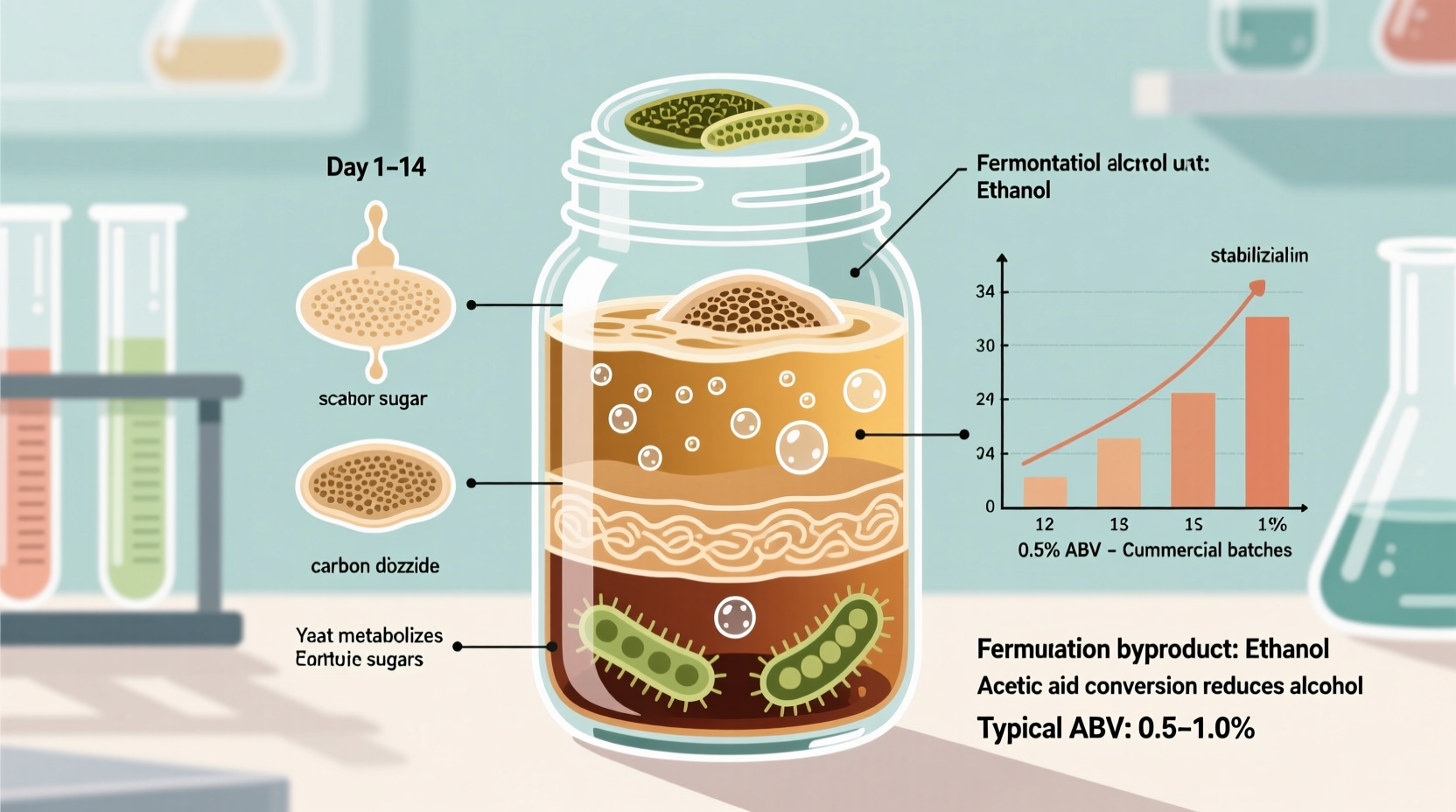
Fermentation is a metabolic process where microorganisms convert carbohydrates into energy without oxygen. In kombucha, two microbial groups drive this process: yeasts (primarily Saccharomyces cerevisiae, Brettanomyces bruxellensis, and Zygosaccharomyces bailii) and acetic acid bacteria (mainly Acetobacter and Gluconobacter). Their roles are distinct—and interdependent.
Yeast consumes sucrose (table sugar), breaking it down first into glucose and fructose via invertase, then fermenting those monosaccharides into ethanol and CO₂ through glycolysis and alcoholic fermentation:
C₆H₁₂O₆ (glucose) → 2 C₂H₅OH (ethanol) + 2 CO₂ + energy
Meanwhile, acetic acid bacteria oxidize a portion of that ethanol into acetic acid—the compound responsible for kombucha’s sharp tang and preservative effect. But this oxidation isn’t instantaneous or complete. A significant fraction of ethanol remains unconverted, especially during active primary fermentation (days 1–7) and particularly during secondary fermentation (bottling), when oxygen is limited and bacterial activity slows.
Crucially, no amount of “good” brewing practice eliminates alcohol formation. Even under ideal conditions—perfect temperature, balanced SCOBY, strict sanitation—alcohol is produced. What determines final ABV is the *balance* between yeast-driven ethanol production and bacteria-driven ethanol oxidation, plus environmental factors like time, temperature, oxygen exposure, and sugar concentration.
Tip: If your kombucha tastes overly sweet after 7 days, fermentation may be stalled—not absent. Low acidity and high residual sugar often mean yeast activity is sluggish (e.g., due to cold temps), but once revived, it will resume ethanol production rapidly.What’s “Normal”? Typical ABV Ranges Across Kombucha Types
Alcohol by volume (ABV) in kombucha is not fixed. It exists on a spectrum shaped by process, ingredients, and intent. Below is a realistic breakdown of typical ranges based on peer-reviewed studies (e.g., Food Microbiology, 2021), FDA testing data, and home-brewer lab submissions to third-party labs like BSG Labs and Kombucha Brewers International (KBI) certified labs.
| Type | Typical ABV Range | Key Influencing Factors |
|---|---|---|
| Commercial “Non-Alcoholic” (Refrigerated) | 0.2% – 0.5% | Cold storage halts yeast activity; strict timing; pasteurization or filtration in some cases; added citric acid to inhibit yeast |
| Home-Brewed (Primary Ferment, 7–10 days) | 0.5% – 1.2% | Room temp (20–26°C), standard sugar ratio (1 cup per gallon), healthy SCOBY, no secondary ferment |
| Home-Brewed (Secondary Ferment, 2–5 days) | 1.0% – 2.5%+ | Added fruit/juice (extra fermentables); warm ambient temps; sealed bottles trapping CO₂ and limiting O₂ for bacteria |
| “Hard Kombucha” (Commercial, Intentional) | 3.0% – 7.0% | Yeast strain selection (e.g., wine or champagne yeasts); extended fermentation; nutrient supplementation; controlled oxygen exclusion |
| Over-Fermented/Contaminated | 2.0% – 4.0%+ (unintended) | Prolonged room-temp storage post-bottling; high-sugar additions without acid balance; mold or wild yeast contamination |
Note: These are averages—not guarantees. One batch brewed identically to another may test 0.7% ABV while its sibling hits 1.4%, due to subtle differences in SCOBY vitality, seasonal humidity, or even water mineral content. Consistency comes from measurement—not assumption.
A Real-World Example: Sarah’s “Ginger Zing” Batch Gone Unexpectedly Potent
Sarah, a home brewer in Portland, OR, followed her usual recipe: 1 gallon black tea, 1 cup organic cane sugar, 12 oz mature starter tea, and a vigorous SCOBY. Primary fermentation lasted 8 days at 22°C—taste-testing daily until pH hit 3.2 and tartness felt balanced. She then added ½ cup fresh ginger juice and ¼ cup apple juice for secondary fermentation in swing-top bottles, sealing them tightly at room temperature for 3 days.
On day 4, she opened a bottle expecting bright fizz and spice. Instead, she detected pronounced ethanol aroma—like light cider—and felt mild warmth in her chest after two sips. Lab testing (via a local craft beverage lab) confirmed 2.8% ABV.
Why? Three converging factors: First, the apple juice provided readily fermentable fructose, bypassing yeast’s need to invert sucrose. Second, the sealed bottles created near-anaerobic conditions, suppressing acetic acid bacteria while yeast thrived. Third, ambient temperatures rose unexpectedly to 25°C during those 3 days—accelerating yeast metabolism by ~30% (Q₁₀ rule). Sarah hadn’t made a mistake—she’d optimized conditions for ethanol production without realizing it.
Her solution? She now measures pH *and* specific gravity (with a hydrometer) before bottling, limits secondary fermentation to 24–48 hours for fruit-only additions, and stores bottles in a cooler spot (18°C). Her next “Ginger Zing” batch tested at 0.9% ABV—still lively and flavorful, but comfortably within expected non-alcoholic range.
Practical Control: A 5-Step Timeline to Manage ABV Confidently
You don’t need a microbiology degree to influence alcohol levels—you need observation, timing, and simple tools. Here’s how experienced brewers intervene at key points:
- Day 0: Start with Data — Record initial specific gravity (SG) using a hydrometer or refractometer. Pure sweet tea (1 cup sugar/gallon) typically reads SG ≈ 1.032–1.036. This baseline lets you calculate potential ABV later.
- Days 3–7: Monitor Daily — Taste, smell, and measure pH. Target pH 3.0–3.5 indicates sufficient acid to inhibit pathogens *and* slow yeast. If pH drops below 3.0 too quickly (<5 days), yeast may be outpacing bacteria—consider stirring gently to reintroduce oxygen for Acetobacter.
- Day 7–10: Decide & Measure — When taste balances sweetness and sourness, take a final SG reading. Use the formula: ABV ≈ (Initial SG − Final SG) × 131.2. Example: 1.034 → 1.010 = 0.024 × 131.2 ≈ 3.15% potential ABV (but remember—bacteria consume some ethanol, so actual ABV will be lower).
- Before Bottling: Chill & Stabilize — Refrigerate the entire batch for 24–48 hours. Cold shock dramatically slows yeast activity. Add ¼ tsp potassium sorbate per gallon *only if* actively bottling for shelf stability (not recommended for raw, probiotic-focused batches).
- During Secondary Ferment: Time Strictly — Set a timer. For juice/fruit additions: 24 hours at 20°C, 36 hours at 18°C, max 48 hours. Then refrigerate immediately. Never leave bottles at room temp beyond 48 hours unless intentionally making hard kombucha.
Expert Insight: What Science Says About Safety and Regulation
Dr. Elena Rodriguez, PhD in Food Microbiology and lead researcher at the University of California, Davis’ Fermentation Science Program, emphasizes context over fear:
“Ethanol in kombucha isn’t inherently dangerous—it’s a natural metabolite, like lactic acid in yogurt or ethanol in ripe bananas (which contain up to 0.04% ABV). The real risk isn’t intoxication from 0.5% ABV—it’s mislabeling, lack of transparency, or uncontrolled fermentation leading to unintended high-ABV batches. Regulatory thresholds exist not because low-level ethanol is toxic, but to ensure consumer expectations align with product reality—especially for children, pregnant individuals, or those avoiding alcohol for medical or religious reasons.” — Dr. Elena Rodriguez, UC Davis
She notes that the 0.5% ABV legal cutoff for “non-alcoholic” labeling in the U.S. and EU is pragmatic, not biological. It reflects detection limits of standard assays and a clear line for taxation and distribution. From a food safety standpoint, properly fermented kombucha (pH ≤ 3.5, no mold, no off-odors) poses negligible risk—even at 1.5% ABV—because its acidity and microbial ecology inhibit pathogens like E. coli and Salmonella.
FAQ: Your Top Questions Answered
Can I test ABV at home without sending samples to a lab?
Yes—with limitations. Hydrometers measure sugar density, not ethanol directly. They estimate *potential* ABV based on sugar loss, but don’t account for ethanol consumed by bacteria. For true ABV, you need gas chromatography (GC), which labs perform. However, consistent hydrometer use *alongside* pH tracking gives reliable relative trends: if your typical batch goes from SG 1.034 to 1.012, and ABV has historically tested ~0.8%, a drop to 1.008 suggests higher ABV (~1.2%). Paired with sensory cues (increased heat, solvent-like aroma), it’s a robust early-warning system.
Does refrigeration stop alcohol production completely?
No—it slows it significantly. Yeast remains metabolically active down to 4°C, though at <1% of room-temperature rates. Over weeks or months, measurable ABV increases can occur in refrigerated kombucha, especially if residual sugar is high. For long-term storage (>2 weeks), consider freezing starter tea (in ice cube trays) and brewing fresh batches weekly rather than holding finished kombucha cold indefinitely.
Are “alcohol-free” kombucha brands truly zero percent?
No commercially available kombucha is 0.00% ABV. “Alcohol-free” is a marketing term meaning <0.05% ABV—achievable only through processes like vacuum distillation or reverse osmosis, which also remove volatile aromatics, live cultures, and delicate acids. Most brands labeled “non-alcoholic” fall within the 0.2–0.5% range. If absolute zero ethanol is medically required, plain brewed tea or filtered water remain the only guaranteed options.
Conclusion: Brew with Awareness, Not Anxiety
Your kombucha contains alcohol because fermentation is alive—and life, at the microbial level, follows immutable biochemical laws. Recognizing this doesn’t diminish kombucha’s value; it deepens your respect for the process. You’re not failing when ABV rises—you’re observing yeast doing exactly what evolution equipped it to do. The power lies not in eliminating alcohol, but in understanding its levers: time, temperature, sugar, oxygen, and acidity. With a hydrometer, a pH strip, and disciplined timing, you shift from guessing to guiding. You transform uncertainty into intention—from “Why is my kombucha alcoholic?” to “How can I shape its alcohol profile to match my goals?”
Whether you prioritize probiotic potency, gentle effervescence, or family-friendly serving, the knowledge here puts you in charge—not the microbes. Start today: measure your next batch’s starting gravity, log daily pH, and note when tartness peaks. In two weeks, compare notes. You’ll see patterns emerge. You’ll gain confidence. And you’ll join a growing community of informed fermenters who honor tradition not by ignoring science, but by mastering it.
💬 Share your ABV tracking insights or a “lesson learned” batch story in the comments. Your experience helps others navigate fermentation with clarity—and maybe just a little less surprise.








