Walk onto nearly any outdoor basketball court—schoolyard, park, or urban playground—and there’s a good chance you’ll encounter a double-rimmed hoop. Unlike the single rims commonly found indoors, these thicker, dual-layered rims are a staple of public courts. But why do they exist? What advantages do they offer, and what trade-offs come with them? Understanding the design, purpose, and real-world implications of double rims reveals more than just engineering choices—it sheds light on durability, performance, and the evolving needs of community basketball.
The Purpose Behind Double Rim Basketball Hoops
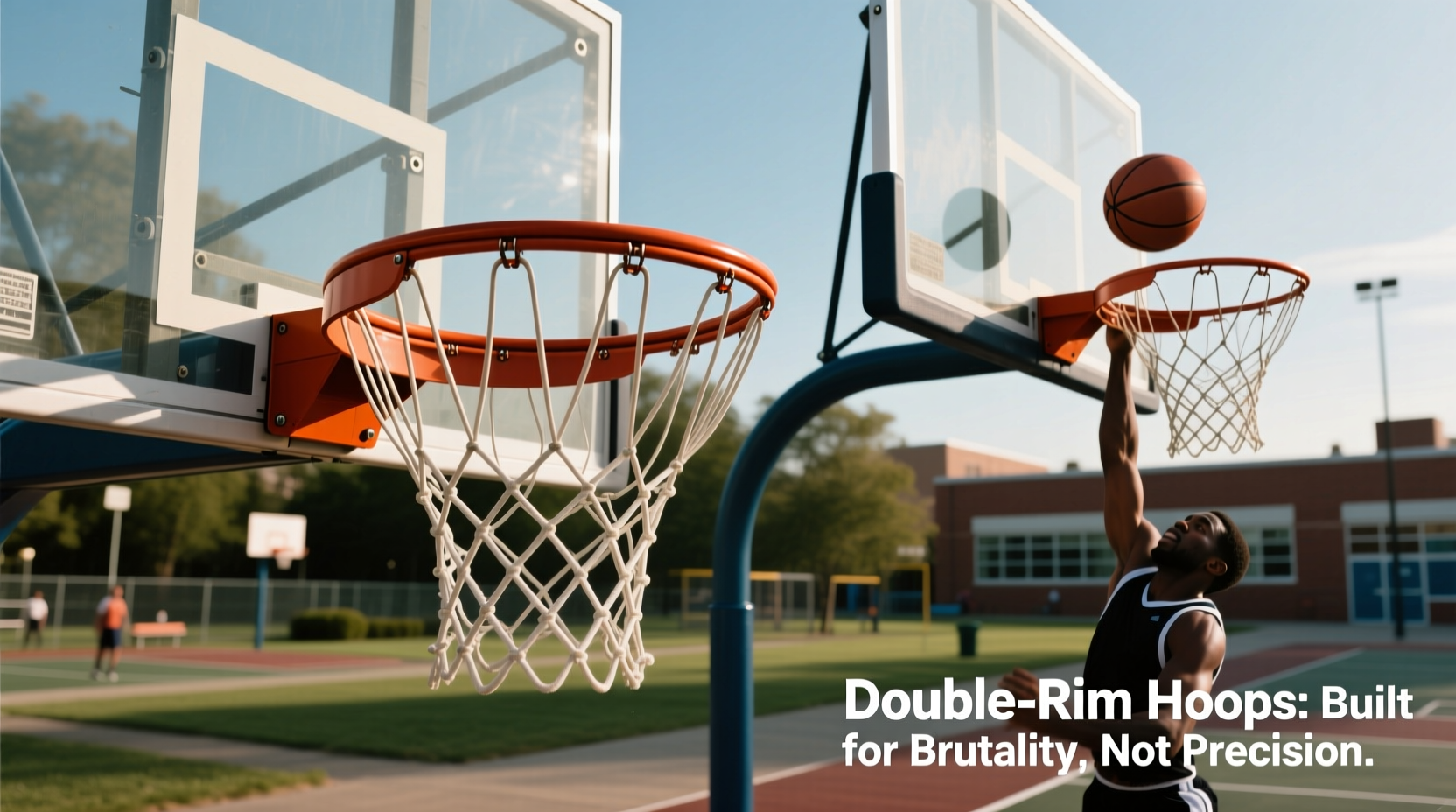
Double rim basketball hoops feature two concentric metal rings fused together, forming a thicker, sturdier structure than standard single rims. This design wasn’t created for performance enhancement but rather out of necessity: to withstand relentless use and abuse. Public courts see constant play, often without supervision or maintenance. Players dunk, hang, and sometimes misuse equipment, leading to rapid wear and deformation of standard hoops.
The primary purpose of a double rim is structural reinforcement. By doubling the thickness of the rim, manufacturers significantly increase resistance to bending, warping, and breakage. This makes them ideal for high-traffic outdoor environments where replacement costs and maintenance downtime are major concerns.
“Double rims were never about improving shooting—they were about surviving it.” — Marcus Tran, Court Design Consultant at Urban Hoop Systems
In essence, the double rim serves as a cost-effective solution to prolong the lifespan of basketball systems in uncontrolled environments. While not designed to improve player experience, its presence reflects a pragmatic balance between functionality, safety, and budget constraints.
Pros of Double Rim Basketball Hoops
- Enhanced Durability: The most significant advantage is resilience. Double rims resist deformation from repeated dunking and hanging, common in recreational and youth leagues.
- Lower Maintenance Costs: With reduced risk of bending or breaking, municipalities and schools save on long-term repair and replacement expenses.
- Better Longevity: In harsh weather conditions—rain, snow, UV exposure—the reinforced structure holds up better over time, especially when paired with rust-resistant coatings.
- Safer Play: A stable, non-flexing rim reduces the risk of injury caused by sudden rim failure during aggressive moves like dunks or rebounds.
- Vandalism Resistance: In areas prone to misuse, double rims are less likely to be bent or damaged intentionally due to their rigidity.
Cons of Double Rim Basketball Hoops
Despite their durability, double rims come with notable drawbacks that affect gameplay and skill development.
- Harsher Bounce: Balls hitting the rim tend to bounce more unpredictably due to the rigid, flat surface. This can lead to frustrating rollouts or unexpected caroms, even on well-taken shots.
- Poor Shot Feedback: Single rims provide subtle feedback through slight flex, helping players gauge shot quality. Double rims eliminate this nuance, making it harder to refine touch and consistency.
- Discourages Shooting Practice: Many players report feeling discouraged after repeated “good” shots fail to drop due to the unforgiving nature of the rim.
- Not NBA or FIBA Standard: Competitive players training exclusively on double rims may struggle to adjust to the responsive, spring-loaded feel of regulation single rims used in official games.
- Aesthetic and Functional Outdatedness: Some newer composite and breakaway rim technologies now offer superior durability without sacrificing performance, making traditional double rims seem outdated.
Comparison: Single vs. Double Rim Hoops
| Feature | Single Rim | Double Rim |
|---|---|---|
| Durability | Moderate (requires breakaway mechanism) | High (resists bending and impact) |
| Shot Response | Responsive, with slight flex | Rigid, unpredictable bounce |
| Best For | Indoor gyms, competitive training | Outdoor public courts, high-use areas |
| Maintenance Needs | Higher (spring mechanisms wear) | Lower (minimal moving parts) |
| Cost Over Time | Higher initial + maintenance | Lower long-term investment |
Real-World Example: The Brooklyn Playground Dilemma
In 2021, the Prospect Park Recreation Center faced a recurring issue: their indoor-grade single-rim hoops were being installed on outdoor courts due to budget cuts. Within six months, three rims were bent beyond repair from nightly pickup games featuring frequent dunking. After consulting with local coaches and facility managers, the city replaced them with double rims. Though players initially complained about missed shots bouncing off harshly, attendance remained high, and no rim failures occurred over the next two years. Coaches noted that while skill refinement suffered slightly, the consistent availability of functional hoops encouraged more regular participation.
This case illustrates the compromise cities must make: optimal performance versus reliable access. For communities where court time is precious, a slightly tougher rim ensures the game continues—literally.
Expert Insight: Engineering for Real-World Use
“The average public court sees 500+ hours of play per year. If your goal is equitable access, you don’t design for perfection—you design for survival.” — Dr. Lena Patel, Sports Infrastructure Researcher at MIT Urban Mobility Lab
Dr. Patel’s research emphasizes that equipment choices in public spaces must prioritize longevity and equity. While elite athletes train on responsive, competition-grade systems, everyday players benefit more from consistently available, if imperfect, infrastructure. Double rims, therefore, represent a form of inclusive design—one that sacrifices finesse for reliability so that more people can play, regardless of supervision or funding.
Should You Train on Double Rims?
For casual players and those using public courts, double rims are simply part of the environment. However, serious athletes should be aware of the limitations. Practicing exclusively on double rims can distort perception of shot accuracy. A ball that hits deep on the front of a double rim might bounce straight out, whereas on a single rim, the same shot might gently drop in due to slight give.
If possible, diversify your practice locations. Use double-rim courts for endurance, defense, and physical play, but seek out single-rim facilities when working on shooting mechanics. This balanced approach builds adaptability—a crucial trait for competitive success.
FAQ
Do double rims affect shooting percentage?
Yes, indirectly. They don’t change a player’s skill, but their rigid structure increases the likelihood of made-looking shots bouncing out due to lack of rim flex. Over time, this can impact confidence and shot selection.
Are double rims used in professional basketball?
No. All NBA, WNBA, and FIBA-sanctioned games use high-quality single rims with breakaway mechanisms. These rims flex slightly under pressure and return to shape, offering both safety and consistent performance.
Can you replace a double rim with a single rim on an outdoor court?
Technically yes, but it’s often impractical. Without additional reinforcement, single rims on heavy-duty poles may still bend under stress. Modern solutions include reinforced breakaway single rims designed for outdoor use, though they come at a higher cost.
Conclusion: Balancing Function and Fairness
Double rim basketball hoops exist because they solve a fundamental problem: how to keep the game accessible despite limited resources and high demand. They aren’t designed to please purists or sharpen shooting touch—they’re built to endure. Their presence speaks to a deeper truth about public sports infrastructure: sustainability often trumps perfection.
As new materials and designs emerge, the future may bring rims that combine the toughness of double rims with the responsiveness of single ones. Until then, understanding the role of double rims helps players, coaches, and communities make informed decisions about where and how to play.
🚀 Take action: Advocate for better-maintained courts in your area. Share this knowledge with local leagues or school boards to support smarter investments in durable, player-friendly equipment.








