Every home fermenter who’s ever tasted a bottle of ginger beer—only to find one batch pleasantly effervescent with barely a whisper of alcohol, while the next delivers a surprising, almost wine-like warmth—has asked this question. It’s not random. It’s not bad luck. It’s fermentation physics, microbiology, and environmental nuance playing out in your kitchen. Homemade ginger beer is a living product: a delicate dance between wild yeasts, cultivated strains, sugar metabolism, temperature shifts, and time. When alcohol content swings from 0.3% ABV to over 2.5% ABV across batches, it’s not just inconsistent—it’s a signal that one or more critical levers are slipping out of your control. Understanding why requires moving beyond recipes and into process literacy.
The Core Issue: Fermentation Is Not a Set-and-Forget Process
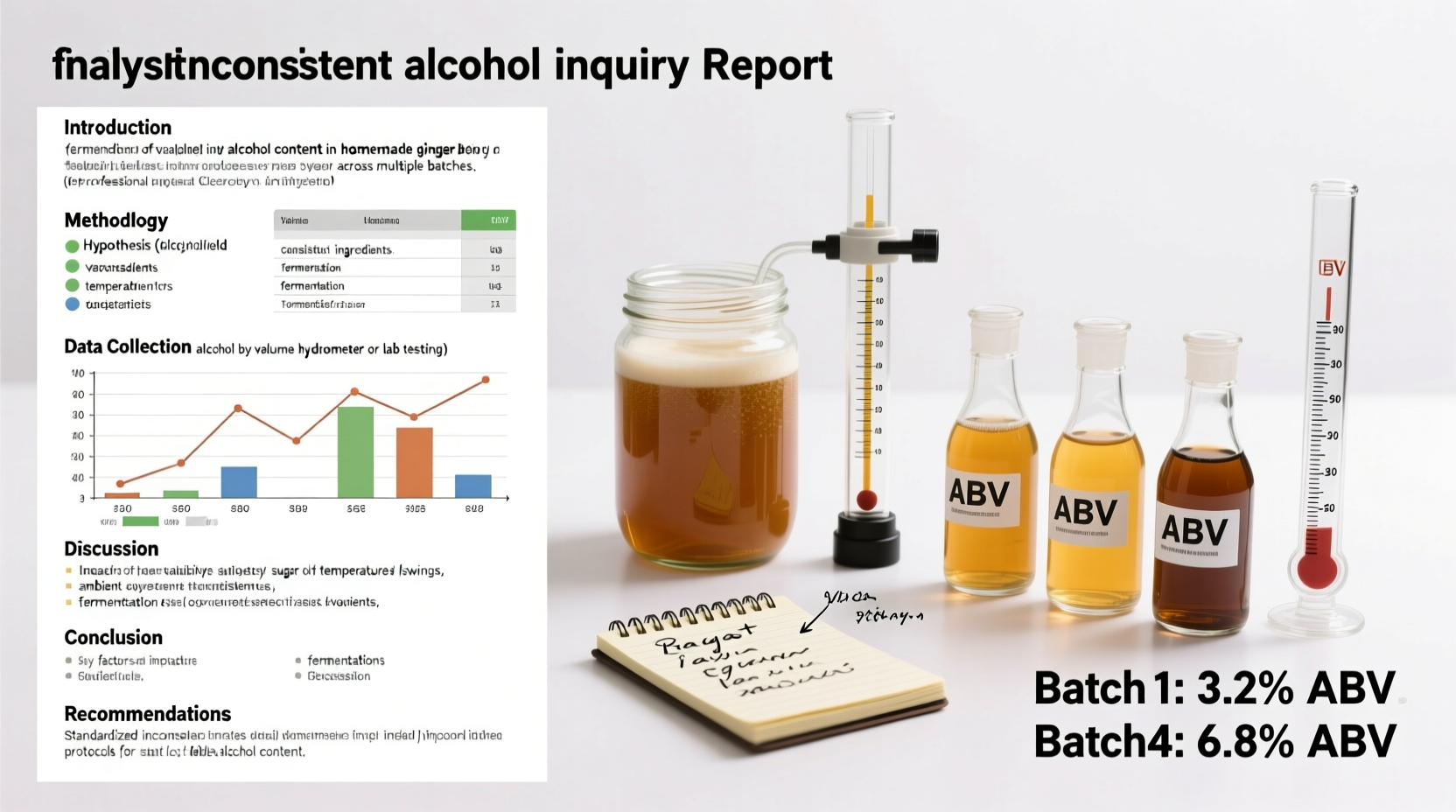
Ginger beer isn’t brewed like commercial soda (with forced carbonation and pasteurization) or distilled spirits (with precise alcohol separation). It’s a spontaneous or semi-controlled fermentation where Saccharomyces cerevisiae, wild Brettanomyces, Lactobacillus, and even native yeasts from ginger root convert sucrose, glucose, and fructose into ethanol and CO₂. Unlike lab-grade yeast cultures used in brewing, home setups rarely isolate or quantify microbial populations. That variability—combined with ambient conditions—creates inherent unpredictability. As Dr. Sarah Lin, food microbiologist and author of *Fermentation Dynamics for Home Crafters*, explains:
“Home ginger beer sits at the intersection of wild fermentation and intentional brewing. Without calibrated starters, pH monitoring, or temperature stabilization, you’re not making the same beverage twice—you’re conducting a different experiment each time.” — Dr. Sarah Lin, Food Microbiologist
This isn’t discouragement—it’s empowerment. Once you recognize which variables drive alcohol variance, you gain agency. Below are the seven primary factors proven to cause wild ABV swings—and exactly how to manage each.
1. Yeast Strain & Starter Consistency
Many home brewers rely on “ginger bug”—a fermented slurry of ginger, sugar, and water inoculated with ambient microbes. While traditional and flavorful, its microbial composition changes daily: humidity, season, kitchen airflow, and even recent baking activity alter which yeasts dominate. One week, a robust S. cerevisiae strain may prevail (moderate alcohol, clean finish); the next, a slower-fermenting, higher-alcohol-tolerant strain emerges—or worse, a mixed culture where lactic acid bacteria outcompete yeast, suppressing ethanol production entirely.
Commercial yeast (e.g., SafAle US-05 or Lalvin EC-1118) offers reproducibility—but only if used correctly. Under-pitching (using too little yeast) extends lag phase, allowing wild competitors to establish. Over-pitching can cause rapid, hot fermentation that stresses yeast, leading to off-flavors and incomplete attenuation (residual sugar = lower apparent ABV but higher risk of bottle bombs later).
Tip: For reliable ABV, ditch the ginger bug for your consistency batches. Use a rehydrated, measured dose of dry brewer’s yeast (1g per 4L), pitched into warm (35–38°C) wort for 20 minutes before adding to cooled ginger syrup.2. Sugar Type, Concentration, and Availability
Sugar isn’t just fuel—it’s the raw material for ethanol. But not all sugars ferment equally. Sucrose (table sugar) ferments fully. Raw honey contains inhibitory enzymes and antimicrobial compounds that slow yeast. Brown sugar adds molasses-derived minerals (good) but also phenolics (inhibitory at high concentrations). Most critically: residual sugar ≠ unfermented sugar. If your ginger syrup contains starches (from undercooked ginger), pectins (from over-blended root), or tannins (from prolonged skin contact), they can bind or coat yeast cells, limiting access to fermentables.
Alcohol yield follows predictable stoichiometry: ~17 g/L of fermentable sugar yields ~1% ABV. A batch with 120 g/L total sugar but only 85 g/L truly fermentable will cap at ~5% ABV potential—but if yeast stalls at 60 g/L consumed, final ABV drops to ~3.5%. That stall point varies wildly based on other factors below.
3. Temperature: The Silent ABV Amplifier
Fermentation temperature doesn’t just affect speed—it alters metabolic pathways. At 18–22°C, S. cerevisiae produces balanced esters and moderate ethanol. At 28–32°C, it metabolizes faster, generates more fusel alcohols (harsh, solvent-like), and reaches peak ABV sooner—but also exhausts nutrients rapidly, risking stuck fermentation. Below 15°C, yeast becomes sluggish; below 10°C, most strains go dormant, leaving sugar untouched.
A real-world example illustrates the impact: In Portland, Oregon, a brewer recorded ambient kitchen temps ranging from 19°C (winter) to 29°C (late summer). Using identical recipes and yeast, her ABV averaged 0.7% in December (fermentation lasted 5 days at 19°C, then stalled) versus 2.1% in August (fermented fully in 36 hours at 29°C). She didn’t change her process—her thermostat did.
4. Fermentation Duration & Bottling Timing
This is where most inconsistency originates—not in the brew, but in the decision to bottle. Fermentation isn’t linear. It has phases: lag (yeast acclimation), exponential growth (rapid CO₂ and ethanol), and stationary (yeast decline, flavor maturation). Bottling during exponential phase traps active yeast + residual sugar = continued fermentation in the bottle. That’s desirable for carbonation—but dangerous for ABV control. Letting it sit too long risks over-carbonation and potentially dangerous pressure buildup.
Conversely, bottling too early—before yeast has consumed target sugar—leaves high residual sugar and low ABV. Waiting too long—until yeast has flocculated and died—means no carbonation at all.
Step-by-Step: Calibrating Your Bottling Window
- Day 0: Prepare ginger syrup, cool to ≤30°C, pitch yeast.
- Day 1 AM: Check for visible bubbles/krausen. If none, stir gently and wait 6 more hours.
- Day 1 PM: Measure specific gravity (SG) with a sanitized hydrometer. Record (e.g., SG = 1.042).
- Day 2 PM: Measure again. If SG dropped ≥0.006, fermentation is active.
- Day 3 PM: Measure again. If SG is stable for 24 hours AND within 0.002 of predicted final gravity (e.g., 1.008–1.012 for 10–12% potential ABV), it���s safe to bottle.
- Bottle immediately after confirming stability. Do not wait “just one more day.”
5. pH, Nutrients, and Microbial Competition
Ginger beer wort typically starts at pH 3.8–4.2—ideal for yeast but borderline for bacterial inhibition. Lactic acid bacteria thrive in this range and consume simple sugars *before* yeast gets to them, producing lactic acid instead of ethanol. Their presence lowers pH further, eventually stressing yeast and halting ethanol production. Meanwhile, nutrient deficiency (especially nitrogen, zinc, and B vitamins) causes sluggish fermentation, prolonging exposure to contamination and increasing ABV variance.
Wild yeast strains from ginger skins often carry lower alcohol tolerance (≤5% ABV) than brewer’s yeast (≥14%). If your “bug” contains mostly low-tolerance strains, fermentation stops early—not because sugar is gone, but because alcohol itself becomes toxic to the microbes present.
6. Sanitation Failures & Cross-Contamination
Inconsistent sanitation doesn’t always cause spoilage—it causes *unintended inoculation*. A reused jar with invisible biofilm may harbor dormant lactobacilli from last month’s sauerkraut. A wooden spoon stored near sourdough starter picks up airborne wild yeast. These contaminants don’t announce themselves with mold or foul smells—they subtly shift metabolic output. One batch may see 80% ethanol yield; another, 40%, with double the acidity and half the fizz.
| Factor | Low-Variance Practice | High-Variance Risk |
|---|---|---|
| Yeast Source | Dry brewer’s yeast, rehydrated & measured per batch | Ginger bug maintained >14 days without refreshing |
| Sugar | Pure white cane sugar, dissolved fully in hot syrup | Raw honey + brown sugar blend, added cold |
| Temp Control | Fermentation vessel in insulated cooler with water bath + thermometer | Left on countertop near oven or sunny window |
| Bottling Time | Based on 24-hr stable hydrometer readings | “When it looks fizzy” or “after 3 days, always” |
| Sanitation | Star San soak (1 oz/gal) for all tools & bottles | Vinegar rinse or hot tap water only |
7. Bottle Conditioning Variables
Even after consistent primary fermentation, ABV can still diverge during bottle conditioning—the final 1–7 days when yeast consumes priming sugar to generate carbonation. This phase is highly sensitive to:
• Bottle seal integrity: Grolsch-style swing tops with worn rubber seals leak CO₂, forcing yeast to work longer to reach target pressure—potentially increasing ABV by 0.2–0.4%.
• Priming sugar accuracy: 4g/L sucrose adds ~0.25% ABV. A 2g variance per liter equals ±0.15% ABV swing. Measuring by volume (teaspoons) introduces far more error than weight (grams).
• Conditioning temp: A 5°C difference between batches (e.g., pantry vs. closet) changes yeast activity by 30–50%, altering final attenuation.
Realistic Case Study: The “Three-Batch Experiment”
Maya, a Seattle-based educator and home fermenter, tracked three consecutive 2-gallon batches over spring. All used identical organic ginger, filtered water, and US-05 yeast—but with one variable changed per batch:
- Batch A: Fermented at room temp (21°C), bottled after 48 hrs (no gravity check).
- Batch B: Fermented in water bath held at 24°C, bottled after 72 hrs (no gravity check).
- Batch C: Fermented at 24°C, bottled only after two consecutive hydrometer readings at 1.009 (24 hrs apart).
Lab-tested ABV results: Batch A = 0.4%, Batch B = 1.9%, Batch C = 1.1%. Why? Batch A was bottled mid-lag phase—little sugar consumed. Batch B fermented vigorously but was bottled during peak activity, trapping sugar that converted to extra ethanol *in-bottle*. Batch C hit true terminal gravity—maximizing predictability. Maya now uses Batch C’s protocol for all batches—and shares her hydrometer log publicly to help others replicate.
FAQ
Can I test ABV at home without sending samples to a lab?
Yes—but with caveats. A precision hydrometer (±0.001) lets you calculate *potential* ABV using original gravity (OG) and final gravity (FG): ABV = (OG − FG) × 131.2. However, this assumes all density change is due to ethanol—which isn’t true if acids or unfermented dextrins remain. For best accuracy, chill, degas, and filter samples before reading. Refractometers require correction calculators for fermented liquids and are less reliable than hydrometers for final readings.
Does refrigeration stop fermentation completely?
No. Cold slows yeast metabolism dramatically but doesn’t halt it. At 4°C, some strains continue fermenting at ~1% of room-temp rate. Over weeks, this can add 0.1–0.3% ABV—enough to turn a “0.5%” batch into a “0.8%” one. For true ABV stability, pasteurize (heat to 65°C for 10 min) or force-carbonate and keg—neither of which are typical for traditional ginger beer.
Why do some batches taste “hot” or “boozy” even at low ABV?
Fusel alcohols (isoamyl alcohol, propanol) form primarily at high fermentation temperatures (>27°C) or under nutrient stress. They have lower perception thresholds than ethanol and contribute harsh, burning notes at concentrations as low as 50 ppm—even when ABV reads only 1.2%. This creates the illusion of higher alcohol. Controlling temp and adding yeast nutrient (¼ tsp DAP per gallon) reduces fusels by 60–80%.
Conclusion: Consistency Is a Skill, Not a Secret
Wildly varying alcohol content in homemade ginger beer isn’t a flaw in your technique—it’s feedback from a complex biological system you’re learning to steward. Every batch teaches something: how your local air shapes microbial life, how your tap water’s mineral profile affects yeast health, how seasonal shifts recalibrate your kitchen’s thermal rhythm. The goal isn’t sterile uniformity, but informed intentionality. When you measure gravity, control temperature, standardize yeast, and time bottling deliberately, you transform fermentation from guesswork into craft. You reclaim predictability—not to eliminate character, but to deepen it. Because once you know *why* ABV shifts, you can choose when to let it wander, and when to guide it home.
💬 Your turn: Grab a hydrometer, log your next three batches, and share your biggest insight in the comments. What variable surprised you most? Let’s build a community database of real-world ABV patterns—because better ginger beer starts with shared knowledge.








